Posts Tagged → diamond
Lab grown vs Beautiful Naturals
Quite a debate has been raging for some years, decades really, about the impact of lab grown gems on the natural gem market. This debate is at peak right now, and appears to be headed in a surprising direction.
We are talking here primarily about colored gemstones, not diamonds. Lab grown diamonds for wearing as gems completely defeat the entire purpose of having a diamond in the first place. Gem-grade diamond grown by Mother Nature is quite rare, and therefore quite valuable. Lab grown diamonds are not rare, but are rather just cheap knock-offs of the real deal. What is the point of wearing a fake that looks just like the real? Are you trying to mislead people? That says a lot about you!
Forget those lab grown diamonds.
What started in the 1950s with junky, soft, easily identified, easily fractured high impact glass morphed into better quality lab-grown cubic zirconiums. Those “CZs” ruled the roost of cheap gem knock-offs for decades, both colored and clear, and were easily detectable by the eye and with simple two-prong “diamond testers” of many makes. Either a stone was diamond, or it wasn’t, and if it was not a diamond, it was most likely CZ.
The colored versions of CZ were almost ridiculous looking. They lacked the soft, deep, subtle nuance of the colored stones they were supposed to emulate, primarily red ruby and blue sapphire, and were often blindingly garish. Easy to spot these as fakes from a mile away, only the most unabashed or cheap wore them as deliberate gem representations.
Early attempts at lab growing blue sapphire corundum (and ruby, which is just the red version of corundum) gem-grade crystals bore rudimentary fruit, with clear growth rings that separated lab Frankenstein creations from Mother Nature’s real, beautiful, naturals. Same for lab emeralds, most of which still today have an unnatural nuclear-green Kryptonite color that is 99.999999% impossible to create naturally.
GIA really exploded in importance in this time period, because lots of decent lab-made fakes were being offered as natural colored stones, and GIA labs could analyze stones and certify them as natural, or not.
However, starting in the 1980s, the age of President Ronald Reagan’s “Star Wars” anti-Soviet space lasers and incredibly accurate laser sighting systems for terrestrial military tank cannons, and then for laser cameras on military satellites that can count the hairs on a fly’s ass from 100 miles up in space, etc, American and Russian laboratories began to grow various crystals from corundum and other chemical concoctions (like YAG) to suit the military’s optical needs, which also happened to result in true gem-quality product. Clear, clean, visually appealing, natural looking, hard.
In all of this re-purposing of mostly sapphire/ corundum and garnet crystals for high tech optical uses, a broader public niche slowly opened up: Gem-grade lab grown…gems. These lab-created crystals-cum-gems are mostly actual ruby and actual sapphire that look in all ways like something created over hundreds of millions of years in the Earth’s crust…. or, in the alternative, these gems are something else entirely, with non-garish, unnatural, but nonetheless truly beautiful gem properties, like the various colors of YAG.
Lab-grown Alexandrite is one of the cooler gems, because it occurs naturally (in extremely limited quantities, mainly in the Ural Mountains) and yet the lab creation looks exactly like the beautiful natural material. Making it in the lab is not that easy, so it is not ridiculously cheap.
Now, we are seeing people experiment with custom-grown lab crystals made to specific color (using various rare earth metals), refractive, and chatoyant characteristics, with hardnesses of 8-9 Mohs, which make them eminently wearable as personal gems. These purpose-crafted lab creations are not garish, but rather are beautiful gems to look at, and easy to appreciate. When encased in gold or platinum, they look every bit as beautiful as a genuine natural pigeon blood ruby or Ceylon cornflower sapphire, or more beautiful.
The advantages of these lab gems is that they cost far, far less than the naturals, and can be made to look as good as, or better, than the naturals. How is that for a ROI? Pretty damned good!
Why do humans wear gems and jewelry in the first place? First and foremost to make ourselves more attractive. Other reasons include showing off wealth, hoarding wealth, making wealth highly portable in times of war or dislocation. Royalty the world over wear crowns made of precious metals and absolutely loaded down with precious rare gems. These crowns are a form of banking, concentrating wealth – and thus power – in one very small place.
What the lab created colored gem stones have done is democratize beauty, making gems and personal beauty more affordable and thus more widely available. They have also grown appreciation for just how rare are the actual natural stones in those royal crowns and sceptres and sold by Harry Winston. By making beautiful gemstones both believable and also widely available, lab gems are here to stay. People can pick and choose personally tailored gems that work best for their own unique skin tones and eye colors.
And of course, there are already fakes of lab created gem stones, made of glass, so already the lab stones must have some greater value than just glass.
To put this crassly, everyone loves a beautiful natural, but boy, those lab enhanced “fakes” sure look good, don’t they? And the fact that they function just as well as the naturals, or even better, means they are here to stay.
If your emerald looks impossibly green, it is fake.
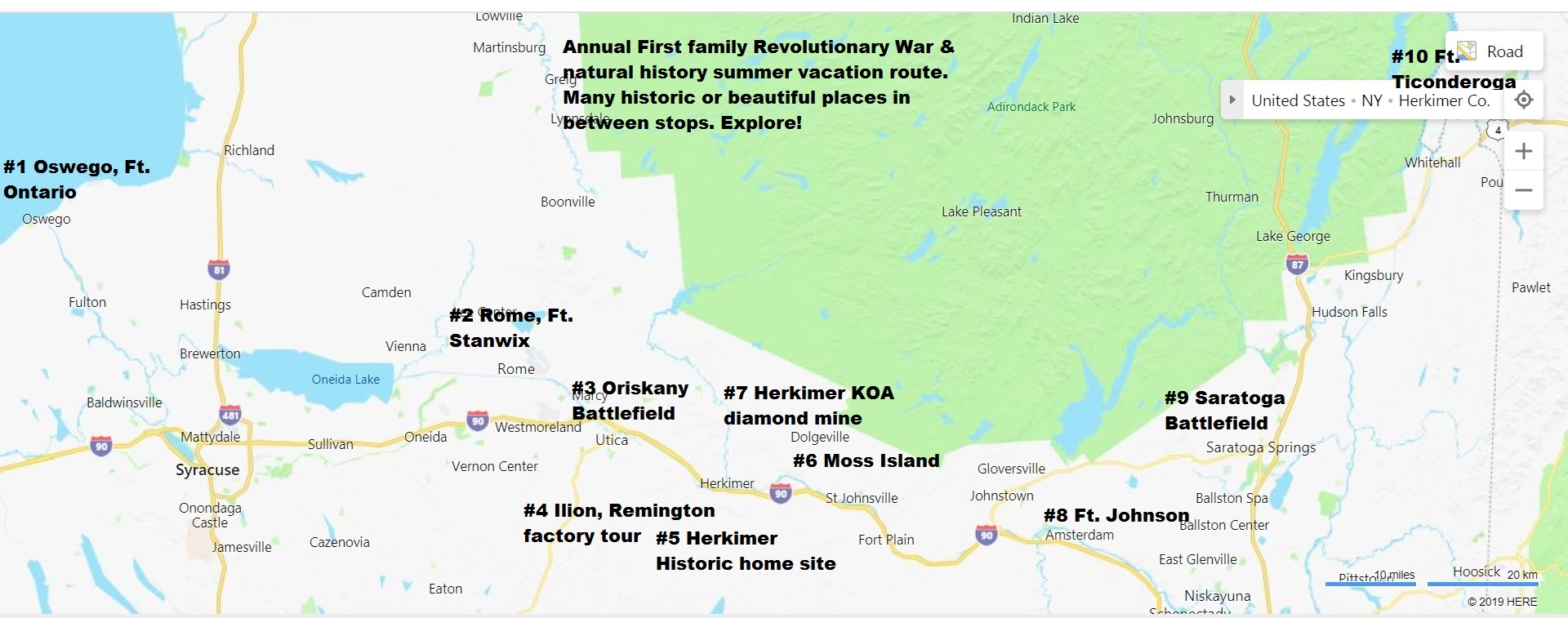
Our family’s best and favorite summer vacation route
When our kids were younger, say from ages seven and up, we would take them on an annual vacation through Upstate New York. The trip was devoted mostly to Revolutionary War history, but also to American frontier history, American Indian history, and natural history. All kinds of historic forts dot the Mohawk Valley, and in between these places are all kinds of incredible natural history places, like the Herkimer diamond mines in Middleville, Moss Island, and the Canajoharie River carved pool. Lots of places to fish at every stop and everywhere in between.
We always started at Fort Ontario in Oswego, NY, and working east we would end at Fort Ticonderoga on the New York/Vermont border. Since we started this trip the forts have all gotten better and better. Fort Ontario refurbished all of their cannons a few years ago. Fort Stanwix has been majorly upgraded and has regular re-enactments. And Fort Ticonderoga now has the biggest private cannon collection in America, so get your tickets to the night time cannon shoot.
The Mohawk River is now largely a canal, and from Oswego to Moss Island you can watch small pleasure boats that started in Florida being raised from lock to lock as they make their way to Lake Ontario, and then to the Ohio River and back down to New Orleans, where they will circle back through the Gulf of Mexico to Florida. Many of the boat owners will stand on the deck to make sure their boat does not bang into the walls of the locks, and they are happy to tell you all about their trip so far. A few years ago one guy told us how his wife had just left the boat and him, and had rented a car to drive home. By the time he expected to arrive back in Florida in the Fall, her things would be gone from their home and the divorce papers would be waiting for him on the dining room table. He actually seemed pretty cheerful about it and said he was still excited to complete the trip, even by himself. By the time he was done telling us this short story, his boat had gone from one end of the lock to the other and was about to start sailing up river.
Our kids had never heard such a thing in their lives, and it gave us plenty to talk about the rest of the trip.
So here is the Revolutionary War route that our family has taken many times over the years, often summer after summer. As our children gained age, they gained new abilities to comprehend and appreciate what they were seeing. Definitely start at Oswego, and do not miss Fort Stanwix. There are all kinds of places to stay each night as you make your way east. Most of them are inexpensive, and many are historic, the the old hotel in Rome, NY, which is actually pretty nice. We usually spend at least one night camping at the Herkimer KOA in Middleville, NY, where we will spend one day mining Herkimer diamonds and another day exploring Moss Island and the historic General Herkimer homestead, which has real cannons and lots of history.
The Oriskany Battlefield monument is one of those places you can’t believe no one talks about, and when you get there and learn and see what took place, you realize how the entire Revolutionary War’s outcome hinged on this one fierce battle between Mohawk Valley patriots and British Regulars, with Indians on both sides.
Moss Island is incredible; I won’t spill the beans and you have to go see for your self, but you absolutely have to go, wearing hiking boots or good trail sneakers. The little town there has a great ice cream store, and my kids always liked fishing under the bridge as well as at Moss Island.
The Canajoharie River has the carved rock pools you can wade in, which I do not identify on the map because I ran out of label room.
Saratoga Battlefield is where a certain famous and then infamous American general made his name. Fort Ticonderoga is AMAZING, and if you are able to get tickets to the night time cannon shoot from the ramparts, you will not be left unimpressed. Trip home to Central or eastern PA, or NYC/New Jersey, is via the NY Throughway south to any number of state routes and highways, depending on how much time you have. We usually do this trip in seven days, though it can be done in ten or even five. The Remington factory tour tickets should be secured beforehand. It is an incredible tour, or at least it was. I think we took it before OSHA stepped in and limited it. The museum there is excellent in and of itself.