Posts Tagged → agitator
Dear Labor Day: Make Appliances Great Again, please
How sad that our national holidays have become more about appliance and mattress sales than about the original purpose of, say, President’s Day, or Labor Day. But if I were to set out to write an essay about labor, and what working and worker’s rights mean to me, I would die of boredom trying to write it long before I finish it, and long before anyone might stumble onto it while cruising the internet at 3AM, and stay on it til the end. No one would read it, and even if someone might, I would never write it.
So appliances it is on this Labor Day’s essay, and we begin by asking Dear Labor Day, please make appliances great again.
If America is going to have this huge orgy of heavily advertised consumerism around this national holiday, can we at least have appliances worthy of their hallowed, legendary names and high advertising costs?
One must ask, because planned obsolescence is no longer a sideways joke among a handful of Americans who got burned once; today, everyone I know hates modern appliances. Because modern appliances are craaaaaap. All of ’em.
Got yourself a fancy, expensive WOLF stovetop, do ya? Guess what? It has the same exact cheap crap under the hood that the BOSCH has, that all the other ranges have. A little blue cartridge, some same wiring, some aluminum tubes to carry the natural gas, and four or five little piezo starters that are interchangeable among all of the gas stovetop ranges for sale today. And when the WOLF components go bad is about the same time as the BOSCH components will go bad, because they are all the same components. Just the names and a little bit of visible construction is different among the various makers.
How do I know this? Because I have been the ubiquitous frustrated husband who vows “Oh no ya don’t!” when the expensive appliance stops working, because some small electronic gadget way in the back in it goes bad, and I am faced with the bad choices of either bringing in the technician to fix it at nearly the price of a new appliance, tossing it and buying a new one, or trying to fix it myself, while our entire home just about shuts down until the problem is solved.
And I have now fixed enough of these various types of appliances to know the deal, the score, the trap that we are all presently in.
Recently, I bought a new clothes washer that has zero bells and whistles, does not connect to an application on a phone, has no lid lock, no digital display, no buttons. Quite the opposite: It has some old fashioned dials, an aggressive agitator that will rip your arm off, and is made in America. Smaller than most, by any measure, it cost much more than the fanciest washers for sale.
But it also has a waiting list, because Americans are sick and tired of crappy washing machines that put more emphasis on “efficiency” than they do on just washing clothes. Real market demand is bringing back ye olde fashioned washer.
I don’t care about efficiency when it comes to washing my clothes. I just want my clothes to be real clean, and not take all afternoon to appear clean. No low-energy impeller, a high-energy-suck powerful motor spins the agitator, and creates real water turbulence. The new Speed Queen starts and finishes in about twenty minutes total, and if the clothes survive the ride, they are real clean. You may also end up with very clean rags. This Speed Queen model is marketed to farmers and loggers. Think about that.
We Americans used to buy appliances by name brand, because name brand once meant something real, something substantive. Different brands offered different quality levels, different warranties, different life expectancies. Not anymore. Those days are long gone, far over, and I believe Americans all know it. Everything is now made by cheap whores for cheap whores, and tarted up with fancy shiny things and bold name plaques that are not worth the oxygen molecules you will breathe heavily around them as they are being initially installed in your home.
All are made somewhere far away from where legendary American brands started, out of the same crap internals. All of it, every name brand, all is cheap junk whose cheap junkiness will become revealed to you moments after the warranty runs out.
The places that once employed labor forces of American men and women to make the original name brand models, back in the 1940s, 1950s, 1960s, the 1970s, they are today deserted ghost towns. Elmira, New York, Utica, New York, half of Ohio, Philadelphia, PA, Pittsburgh, PA, these places are overloaded with empty, crumbling brick buildings that once housed the original manufacturers of the famous name brands we so treasure today.
But today, most appliances are made in Won Hung Low, Long Duk Dong, and Chee Ho, China, and they are all crap.
I know that a lot of American husbands think like I do, are probably battle scarred like I am, and they would also happily spend double the price on whatever the appliance is, if they know it was made in America, by American workers, out of sturdy, reliable, long-lived American-made components, and will not require us to make an impossible choice of fix, toss, or replace while our whole home life stalls out in mid-air, waiting.
Can we please make appliances great again?
(Side note: Author-poet-farmer-philosopher Wendell Berry died the other day; he changed a lot of lives for the better. Gil Freedman, whose father built my home address in 1939, and whose bedroom was long inhabited by one of my daughters, died earlier this summer, from Parkinson’s Disease. Gil was an engineer, and also a conservationist and clean streams volunteer; a gentle person. Nicest guy you will ever meet pharmacist and SCUBA SAR volunteer Steve Markowitz died real young last week, of a cancer he only found out about in July. Folks, do not waste your limited days on anything but moving the ball down the field. Because the older I get, that you get, the shorter and shorter the field appears to get, and we are all running out of field to run down, I don’t care how young you think you are. Spread love, be kind, be good, make our shared planet a little bit better. Editor over and out)
My dream clothes washing machine is from 1999
In the past twenty years- plus, an aggressively misleading effort has been shoved down our American freedom-loving throats that the only home appliances we should ever want to own are so energy efficient and water efficient that they don’t actually achieve the results they are made to achieve.
Mostly we are talking about clothes washers (washing machines), although dishwashing machines, ovens, and even microwaves and toaster ovens have been bastardized on the false altar of “efficiency.”
What I miss most about washing machines are two things: A powerful agitator, and a manual override so I can select exactly the combination and level of functions I myself believe best fit the clothes I have placed in the clothes washing machine. I miss these two aspects that were basic to washing machines up until about 1999-2000, because absent them, it is now almost impossible to find a washing machine that actually and fully cleans my clothes.
All electronic/electric clothes washing machines sold today are extremely water efficient, and also extremely energy efficient. For those who struggle with what we are talking about here, neither water efficiency nor electricity efficiency will clean your clothes. You need lots of water and energy to clean clothes in a modern washing machine. Water and electricity efficiency means less of both key ingredients, and energy-efficient machines will not clean your clothes. High efficiency will result in your clothes being far less clean than they could be, were we using a real basic washing machine from 1999.
Today’s washing machines use so little water that the clothes bathing in it are essentially just getting dirty over and over again. Insufficient water is used to actually clean the dirt out of your clothes and hold it in suspension. And the low-electricity thing is just as ridiculous, because the impellers that have replaced agitators do absolutely nothing to actually clean your clothing. What agitators are available on the market are pathetic, limp-wristed little creatures.
Watch an old-fashioned agitator at work. The water is flying everywhere, the clothes are being pushed violently in the water, and your eyes can see that the clothing is being bathed in a lot of water that is also moving very aggressively. That is how clothes get clean.
Now go watch an impeller do its thing. An impeller kind of limp-wrists a pizza throw. It is a half-hearted effort to move whatever is on it. It hardly moves the clothing or the water. I have put folded clothing and sheets and pillow cases in our “deluxe” washer with an impeller, and with the alternative mini agitator, and after the longest possible wash cycle, the objects are removed just as neatly folded as they were when they were placed in the “washer.” Yes, they are wet, but they were not moved around, and the dirt that was lodged in them before they went into the washer is just as lodged as it was in the beginning. In other words, impellers do not work, and claims that they are just a more efficient type of agitator are BS. Your own eyes will tell you this, and probably your nose, too.
And today’s agitators are so small, with such pathetically short turns (guessing about ten degrees of arc) that they, too, do very little to wash the clothes surrounding them.
Why are Americans being fooled into buying electronic appliances that do not work? Because people who think they are smarter and better than us have strong-armed appliance manufacturers to provide “efficient” items that use less water and less electricity than prior models. Yeah, it is true that these dish and clothes washers use less water and less electricity, and it is also true that their amount of clothes and dish cleaning also drops about 90% for the same effort.
The Maytag washer we mistakenly bought takes an hour and a half to do a “Normal” load of wash, and when it is done, we are lucky if the clothes don’t require a second wash. Maytag is not alone; it appears that all of the washing machines made today are just as weak and pathetic.
In other words, “efficient” washing machines are such bad cleaners that they require much more use (= more time, more water and more electricity) to achieve even a modicum of result. The now old fashioned washing machines kicked the crap out of our clothes in a large amount of water, and in about fifteen minutes our entire load of laundry was done. And in fact the formerly dirty clothes emerged very clean.
So my dream washing machine today is one from 1999. It has simple analog turn dials, very few gidgety-gadgety electronics or computer chips, and the entire thing is one big manual override. Every choice I make is because I want that choice and that outcome. The machine makes no choices for me. It is also a top-loading drum that holds enough water to actually wash the clothes that are placed in it, and it has a powerful enough agitator that sweeps far enough (at least a 30 degree arc, and 60 degrees of arc is even better) and aggressively enough to actually knock the dirt off of my clothes and push it into suspension in the abundant water.
That is how we clean clothes with a washer. Anything else is just getting the clothing wet.
When it comes to cleaning my clothes, I really don’t give a cr@p about water efficiency or electrical efficiency. I want performance. The job has to be done right, and whatever it takes to get the job done right is what should be put into the job. Lots of water? OK. Lots of electricity needed to push a powerful motor that churns a strong agitator? OK.
High efficiency? No thanks. I will take the very low efficiency and highly effective washing machine, please.
It is hilarious and also a little spooky that what used to comprise the most basic washing machine that cleaned the most clothing with the least amount of effort is now sold as a machine with “lots of bells and whistles.”
I can’t believe we consumers have to write things like this, because it all seems so self evident. Then again, literally everything surrounding us Americans has been hijacked for some “higher purpose” that ends up leaving us and our needs in the dust. Because the people who push this garbage are “better” than us and “smarter” than us, and they think we are dust, over whom they must exercise heavy manual control.
Funny how symbolically asymmetrical this all is. Like a washing machine that in the 1960s symbolized how advanced America was is now a symbol of how screwed up America has become, and all because of the Left’s extremist politics.
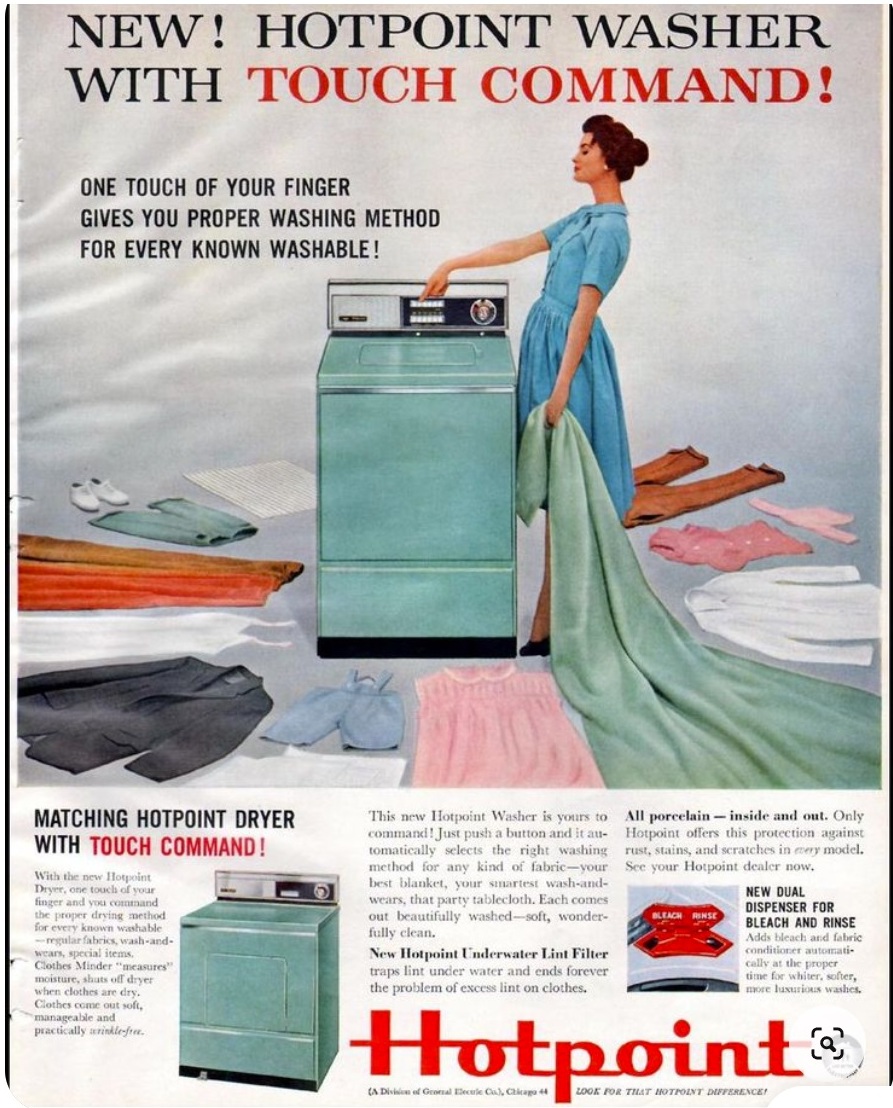
By the late 1950s and early 1960s, washing machines had reached their zenith of effectiveness
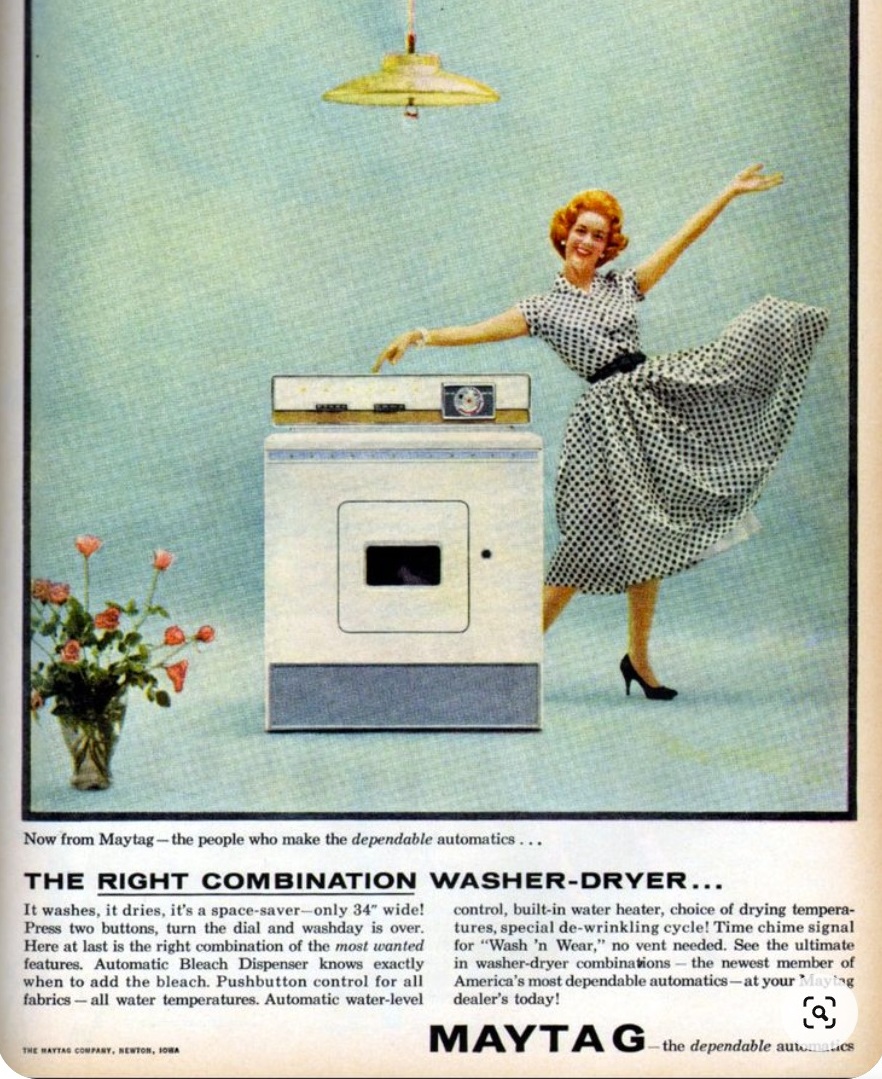
If I could get a “modern” and “high efficiency” washing machine to work half as well as this 1960 model, I would put on a dress and dance around, too
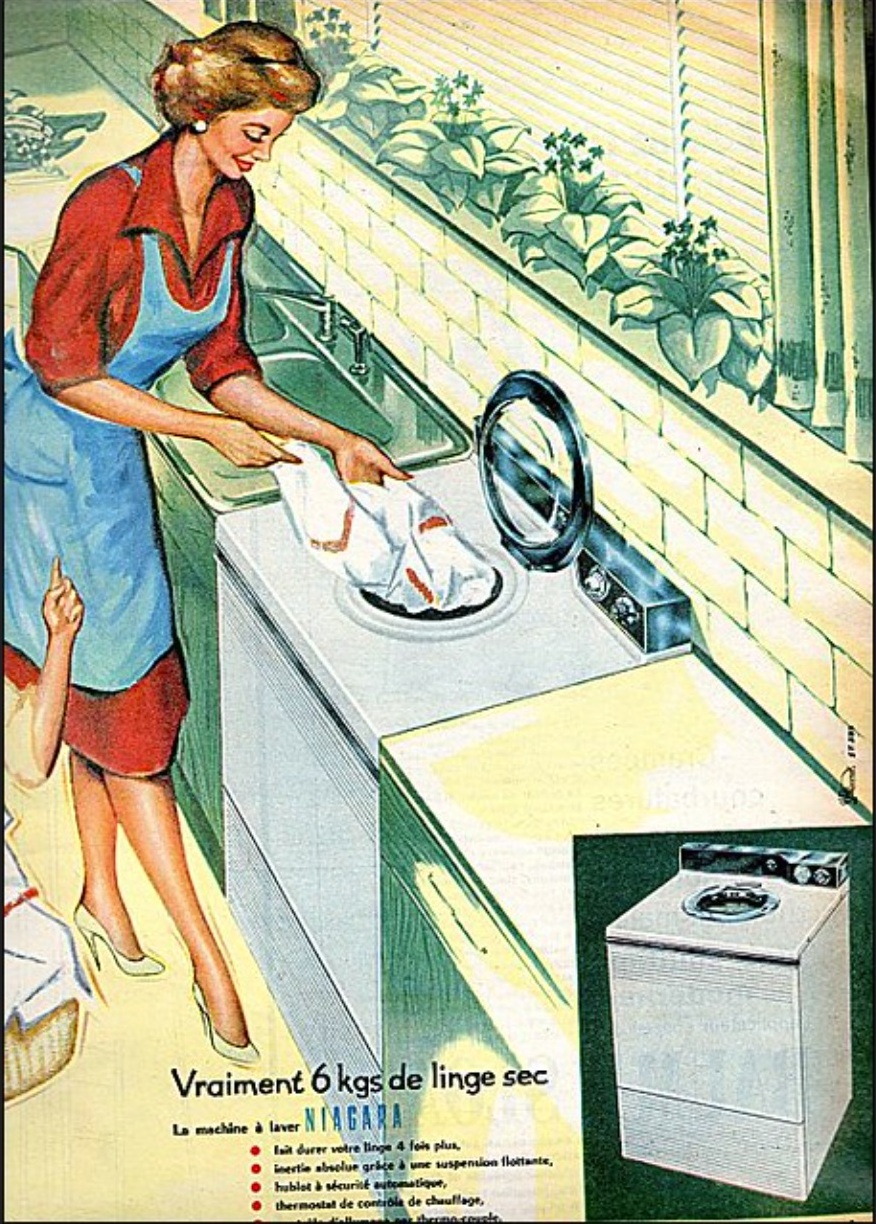
Imagine doing laundry dressed like you were ready to go out for dinner. Oh the painful irony that our grunge-dressing culture embraces crappy washing machines that in fact don’t get the grunge out of our clothing. Some things in Western Civilization were definitely much better in 1961 than now. Probably a lot of things.