Posts Tagged → Yankee
Two Hollywood legends I will actually miss
Normally I am not a fan of Hollywood in any sense. In recent times, including just days ago, America lost two Hollywood legends, two actors who personified Hollywood at its best and maybe its worst, but also at its most colorful. I will miss them both, for very different reasons.
First up is Rob Reiner, apparently murdered two days ago by his own son. Both Rob and his wife Michelle were found deceased in their home by their daughter. Their throats had been slashed. Their son Nick has been arrested and charged with their murders. Apparently Nick has had a long history of drug abuse and all of the resulting relationship challenges that come with it. We now see the gruesome result, and can easily imagine the victims disbelievingly pleading with their own son not to harm them…
…their murders are a tragedy on its face, as well as a statement about the unworkable culture that is “inside Hollywood.” A mix of libertine excess and constant parental indulgence and allowance followed by inexorable failure. What a symbol of the whole place.
Rob Reiner really began his Hollywood career as “Meathead,” the abrasively sanctimonious know-it-all liberal son-in-law of appropriately named American workingman archetype, Archie Bunker, in All In The Family TV sitcom.
Relying on a well-scripted, well-played political and cultural tension between old guard Archie Bunker and Hippie “Meathead,” Rob Reiner gave effective voice to his generation’s anti-war, anti-tradition, anti-religion, anti-America liberalism.
The show captured the “generation gap” of my 1960s-1970s childhood, where older Americans held the traditional values that built a fully functioning nation, and the younger Americans were utopian meatheads with unrealistic, unsustainable expectations guaranteed to derail the nation.
Confusingly, Rob Reiner never grew up or let go of his Meathead persona, nor his destructive goofball political views. I suppose to his credit, in a way, neither have nearly all of his contemporary eldering-in-place fellow ever-child meathead Hippies. I will miss his entertaining online rants against Trump, MAGA, conservatives, Republicans, regular working Americans, essentially against everything outside of the tiny bizarro world Hollywood bubble that Rob Reiner inhabited.
Rob Reiner created the living liberal strawman that conservatives easily use to prove their points. In essence, Meathead grew up proving that Archie Bunker was right, decade after decade. And so, as much as he was strange, he also contributed well to the American political discourse. Rest in peace, Mr. Reiner. I am genuinely sorry you left us in this horrible way.
The other Hollywood person who recently left us is actor, producer, film maker Robert Redford. Easily the best looking man in American history, and also the one Hollywood actor least addicted to plastic surgery as he aged, Redford inhabited a very different cultural place than Reiner.
Famous for playing a variety of all-American hero and anti-hero roles, from gritty to suave, from cowboy to playboy, Robert Redford was a fixture in Hollywood for a really long time. He also fueled the Sundance Film Festival, an alternative to Hollywood, where low-budget art films and documentaries could gain audience and funding outside of Hollywood’s metrics and politics.
One of my favorite Redford movies is Spy Game, with Brad Pitt. Redford plays the role of a CIA spook and patriot, who in a former job as Cold War spy went so far as to unilaterally murder/ execute a known American traitor in Europe. This role alone sends a loud message about Redford’s politics: He was no leftist, no Hollywood commie, but rather he was a true American patriot in every conservative sense of the phrase.
But Redford also promoted environmental quality, and public lands, two things that are close to my own heart and not always present in the conservative movement. Not that Redford followed the leftist doctrine of heavy regulation and anti capitalism, but rather, he simply said that these things are important. And of course, they are important. And there are other ways of achieving environmental quality and public lands conservation without following leftist doctrine. Such a moderate stance is unheard of among Hollywooders.
Redford played very well a famous, iconic role that still speaks to men of my generation, that of historic mountain man Jeremiah Johnson. Filmed right before the 1976 American Bicentennial, Jeremiah Johnson captured the spirit of the American frontier, Westward expansion, Manifest Destiny, rugged individualism, self reliance, urban vs rural, and the European-American conflicts with the western Indian tribes (Crow, Blackfoot, Cheyenne, Pawnee, Lakota and others) in the Rockies.
Many of these themes and character traits are still central to the American identity that us older Americans have. Including Archie Bunker.
Jeremiah Johnson promoted the now-underappreciated but still central role of undeveloped American open lands in forging the tough American frontier spirit and Yankee ingenuity that built our nation. That conservatives miss or ignore this link, or misunderstand it, is just as much a crime as leftist attempts to essentially shrinkwrap public lands and make them off-limits to humans.
Robert Redford represents an image and political philosophy almost at the other end of Rob Reiner’s place on the political bell curve. Both men played important parts in shaping American culture, and I appreciate them both. However, Robert Redford will forever be an aspirational icon, whereas Rob Reiner represents a dead end on the political evolutionary tree.
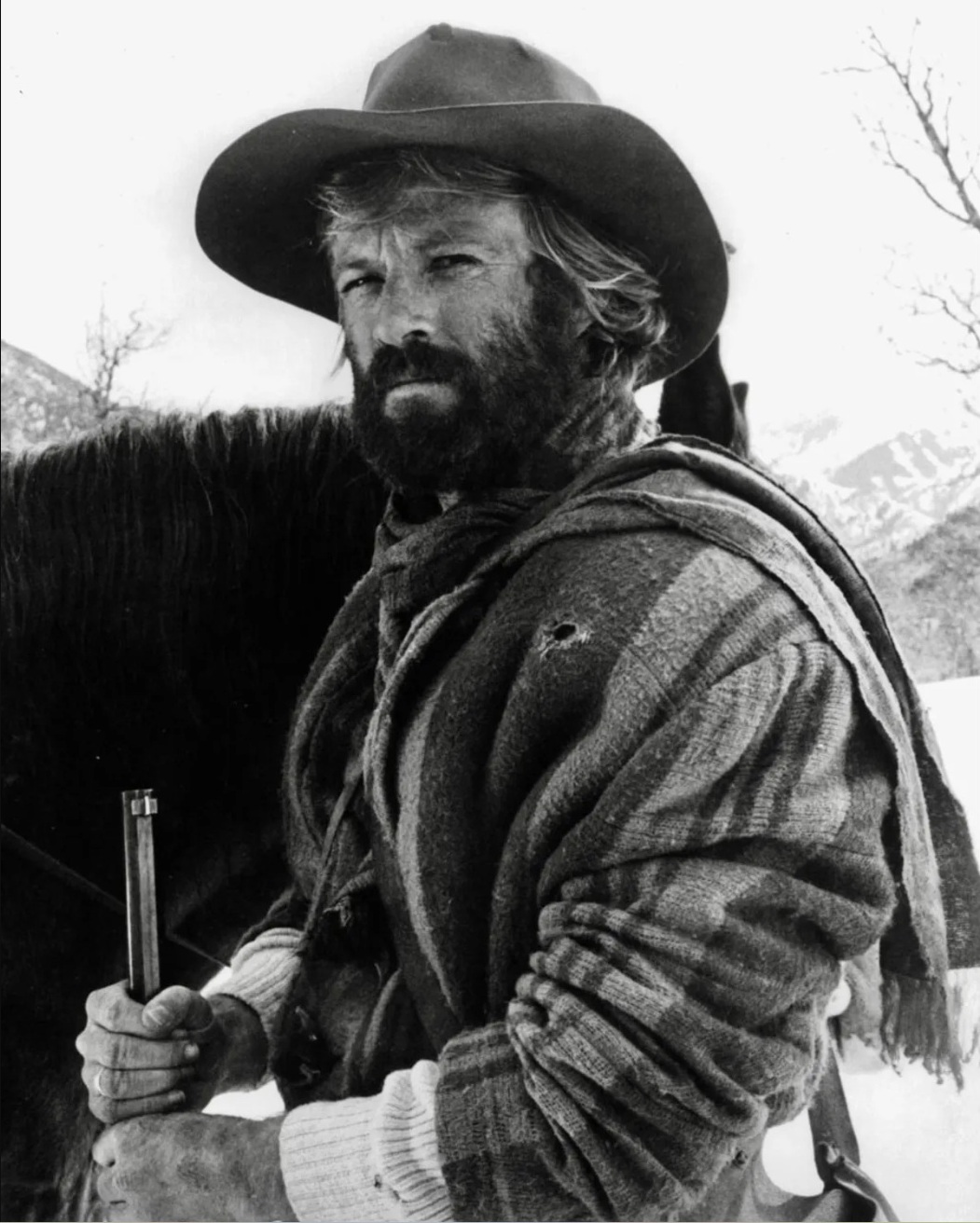
Robert Redford as Jeremiah Johnson, iconic American frontiersman
Remembering neat people, Part 1
A lot of neat, interesting people have died in the past year or two, or ten, if I think about it, but time flies faster than we can catch it or even snatch special moments from it. People I either knew or admired from afar who changed me in some way.
There are two men who influenced me in small but substantial ways who I have been thinking about in recent days. One of them died exactly ten years ago, and the other died just last year. Funny how I keep thinking about them.
It is time to honor them as best I can, in words.
First one was Charlie Haffner, a grizzled mountain man from central Tennessee. Charlie and I first crossed paths in 1989, when I joined the Owl Hollow Shooting Club about 45 minutes south of Nashville, where I was a graduate student at the time.
Charlie owned that shooting club.
Back before GPS, internet, or cell phones, the world was a different place than today. Dinosaurs were probably wandering around among us then, mmm hmmmmm. Heck, maybe I am a dinosaur. Anyhow, in order to find my way to the Owl Hollow club, first and foremost I had to get the club’s phone number, which I obtained from a fly fishing shop on West End Avenue. Then I had to call Charlie for directions, using a l-a-n-d l-i-n-e, and actually speaking to a person at the other end. You’d think it was Morse Code by today’s standards.
After getting Charlie on the phone, and assiduously writing down his directions from our phone conversation, I had to use the best map I could get and then drive way out in the Tennessee countryside on gravel and dirt roads. Trusting my directional instincts, which are good, and trusting the maps, which were pretty bad, and using Charlie’s directions, which were exactingly precise, I made my way through an alien landscape of small tobacco farms and Confederate flags waving from flagpoles. Yes, southcentral Tennessee back then, and maybe even today, was still living in 1865. Not an American flag to be seen out there by itself. If one appeared, it was either directly above, or, more commonly, directly below the Confederate flag. The Confederate flag shared equal or nearly equal footing with the American flag throughout that region.
Needless to say, when I had finally arrived at the big, quiet, lonesome gun range in the middle of the Tennessee back country, the fact that I played the banjo and was as redneck as redneck gets back home didn’t mean a thing right then. Buddy, I was feelin’…. Yankee, like…well, like black people once probably felt entering into a room full of Caucasians. I felt all alone out there and downright uncomfortable. And to boot, I was looking for a mountain man with a deeeeep Southern drawl, so it was bound to get better. Right?
Sure enough, I saw Charlie’s historic square-cut log cabin up the hill, and I walked up to it. Problem was, it had a door on every outside wall, so that when I knocked on one, and heard voices inside, and then heard “Over here!” coming from outside, I’d walk around to the next door, which was closed, and I would knock again, and go through the process again, and again. Yes, I knocked on three or four of those mystery doors before Charlie Haffner finally stepped out of yet one more doorway, into the sunshine, and greeted me in the most friendly and welcoming manner.
Bib overalls were meant to be worn by men like Charlie, and Charlie was meant to wear bib overalls, and I think that’s all he had on. His long, white Father Time beard flowed down and across his chest, and his long, flowing white hair was thick and distinguished like a Southern gentleman’s hair would have to be. And sure as shootin’, a flintlock pistol was tucked into the top of those bib overalls. I am not normally a shy person, and I normally enjoy trying to get the first words in on any conversation, with some humor if I can think of it fast enough. But the truth is, I was dumbfounded and just stood there in awe of the sight before me.
Being a Damned Yankee, I half expected to be shot dead on sight. But what followed is a legendary story re-told many times in my own family, as Charlie (and his kindly wife, who also had a twinkle in her eye) welcomed me into his home in the most gracious, witty, and insightful way possible.
Over the following two years, I shot as much as a full-time graduate student could shoot out there at Owl Hollow Gun Club, which is to say not as much as I wanted and probably more than I should have. Although my first interest in guns as a kid had been black powder muzzleloaders, and I had received a percussion cap .45 caliber Philadelphia derringer as a gift when I was ten, I had not really spent much time around flintlocks. Charlie rekindled that flame in me there, and it has burned ever since, as it has for tens of thousands of other people who were similarly shaped by Charlie’s re-introduction of flintlock shooting matches back in the early 1970s, there at Owl Hollow Gun Club.
Charlie died ten years ago, on July 10th, I think, and I have thought about him often ever since: His incredible warmth and humor, his amazing insights for a mountain man with little evident exposure to the outside world (now don’t go getting prejudiced about mountain folk; he and many others are plenty worldly, even if they don’t APPEAR to be so), his tolerance of differences and willingness to break with orthodoxy to make someone feel most welcome. Hollywood has done a bad number on the Southern Man image, and maybe some of that negative stereotype is deserved, but Charlie Haffner was a true Southern gentleman in every way, and I was proud to know him, to be shaped by him.
The other man who has been on my mind is Russell Means, a Pine Ridge Sioux, award-winning actor, and Indian rights activist who caught my attention in the early 1970s, and most especially as a spokesman for tribal members holed up out there after shooting it out with FBI gunslingers.
American Indians always have a respected place in the heart of true Americans, and anyone who grew up playing cowboys and Indians knows that sometimes there were bad cowboys who got their due from some righteous red men. Among little kids fifty years ago, the Indians were always tough, and sometimes they were tougher and better than the white guys. From my generation, a lot of guys carry around a little bit of wahoo Indian inside our hearts; we’d still like to think we are part Indian; it would make us better, more real Americans…
Russell Means was a good looking man, very manly and tough, and he was outspoken about the unfair depredations his people had experienced. While Means was called a radical forty years ago, I think any proud Irishman or Scottish Highlander could easily relate to his complaints, if they or their descendants stop to think about how Britain had (and still does) dispossessed and displaced them.
Russell Means played a key role in an important movie, The Last of the Mohicans. His stoic, rugged demeanor wasn’t faked, and he was so authentic in appearance and action that he easily lent palpable credibility to that artistic portrayal of 1750s frontier America by simply showing up and being there on the set. Means could have easily been the guy on the original buffalo nickel; that is how authentic he was.
Russell Means was representative of an older, better way of life that is disappearing on the Indian reservations, if that makes any sense to those who think of the Indian lifestyle that passed away as involving horses and headdresses. He was truly one of the last of the Mohicans, for all the native tribes. Although I never met you, I still miss you, and your voice, Mr. Means.
[Written 7/23/14]