Posts Tagged → supply
What makes a good podcast
Podcasts are such a hot thing right now, and have been since the 2020 covid plandemic, that even people employed in the mainstream media are trying their hand at it. Part of the draw is cache, like la la I have a podcast, as though it confers personal specialiness and high intelligence, and the other part of it has to do with simple reach and monetary remuneration.
Everyone who thinks they are someone, or who wants to be a someone, “has” a podcast.
Podcasts are a big net benefit to the world, to humans, to public policy debates, to the spread of ideas (good and bad), information (good and bad). Podcasts have democratized the spread and flow of opinions (artful and bluntly foolish), and have drawn a lot of disenfranchised people, people dejected by the low quality of ubiquitous legacy mainstream media, back into the public marketplace of ideas and news information.
American culture and politics are arguably now informed more by podcasts than by corporate establishment outlets.
Since 2020, when the world was largely locked down and stuck inside, podcasts became the latest and greatest information outlet. Doctors sitting in their living rooms, describing in detail how their hospital administration had politicized their treatment of covid patients, covid survivors, parents finally seeing for the first time the utter slop being served up as “public education” by the politicized teachers’ unions, you name it, podcasts became the end-run around the censorship-industrial machine weaponized against We, The People by the legacy media, Big Tech, and the installed Big Brother Biden Admin.
The dam had to break, the river had to find its level, and the podcast world was the most creative way for people with information that countered the brazen lies of Doctor Mengele Fauci to feel heard. And so it was with people sick and tired of the establishment lies and narrative about covid, which was more about controlling people than it was about public health.
And now that a bazillion people have jumped into podcasting since 2020, a Jurassic-level leveling is taking place. No, no metaphoric meteor is streaking towards Podcast World, ready to hit the Yucatan square on its nose and re-assemble all podcast life on our planet. But simple market forces are beginning to play out. Some people, who had made a big name for themselves during the covid plandemic and the Biden years, are now struggling to find their place in podcasting. Others took a few Tucker Carlson punches to the head and fell down, only to climb back up and give Tucker a few in the kisser himself, and now he is fallen.
Point being that actual marketplace dynamics are determining the success or failure of the podcast world. Supply and demand, risk and reward, appear to be the main arbiters of a podcaster’s success.
Unlike the legacy mainstream media, which has long been propped up by one political party and its constellation of funders and, really, political donors. Market forces only lately seem to have become a factor in the staying power and eyeball presence of partisan mainstream media outlets like CNN, CBS, NPR, the Washington Post, the New York Times. Slowly, the water falls into the cracks, freezes, expands, and widens the cracks over at the MSM. But the cracks are becoming more apparent.
So what makes a good podcast? Here are some of my filters, or requirements, that keep me returning to a podcast:
- Knowledgeable and experienced hosts. Twenty-something-year-old podcasters may be cute, they may be smart, but honestly, these people have no real life experience that I can look to in order to trust and value their opinions. Alternatively, highly experienced adults who have maybe failed here or there in their adult career, now these people intrigue me the most. They are grounded in reality, and nothing trains like pain. I will spend my precious time listening to someone who has learned some tough life lessons, and is sharing them. Alternatively, I cannot spend my precious time listening to or watching someone who merely represents my own methodology or values. This is where political/ religious/ cultural ideology is least important.
- Smart, incisive, witty commentary is a must. Simply reciting a litany of complaints or critiques should be insufficient for every prospective listener who values their own time. Humor goes a long way with this listener.
- Understandable, measured cadence in delivery. One famous podcaster is smart and knowledgable, sometimes witty, but he speaks so damned fast I cannot understand what he says half the time. It is almost physically impossible to listen to such a person.
- Creative and able to link the mundane to the big picture. A great deal of podcasting is simply evaluating and relating news events through the eye of the podcast host, and their simple blunt reactions / analysis are not (or should not) suffice to get your attention. Looking for the meta-link between small facts on the ground and bigger body politic ripple effect is the sign of a true analyst. Someone who adds real value to our understanding of current events.
So, yeah, I thought we were done with the podcast thing a few days ago, but it is such a big and timely subject that this part of the discussion had to be addressed. Because Google / YouTube so aggressively censored political and cultural ideas that its far left staff did not like, Rumble became the go-to place for intellectual refugees. Give it a shot.
99 Red Flags
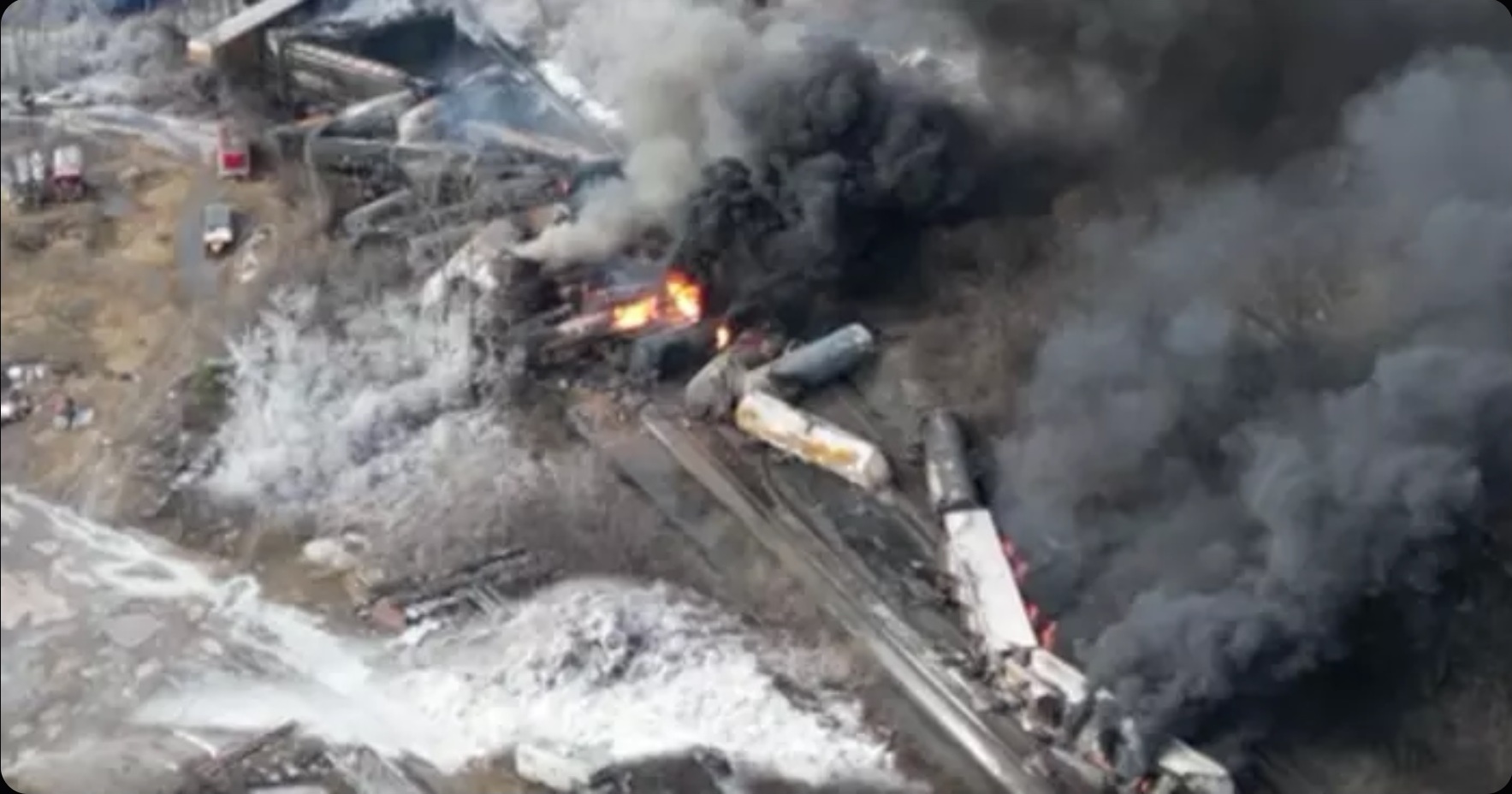
Catastrophic Norfolk Southern train wreck in East Palestine, Ohio. “President” Biden still has not visited, but he has flown to Ukraine

Waterways and drinking water in East Palestine, Ohio, are badly contaminated. But the federal government says no aid is available to help
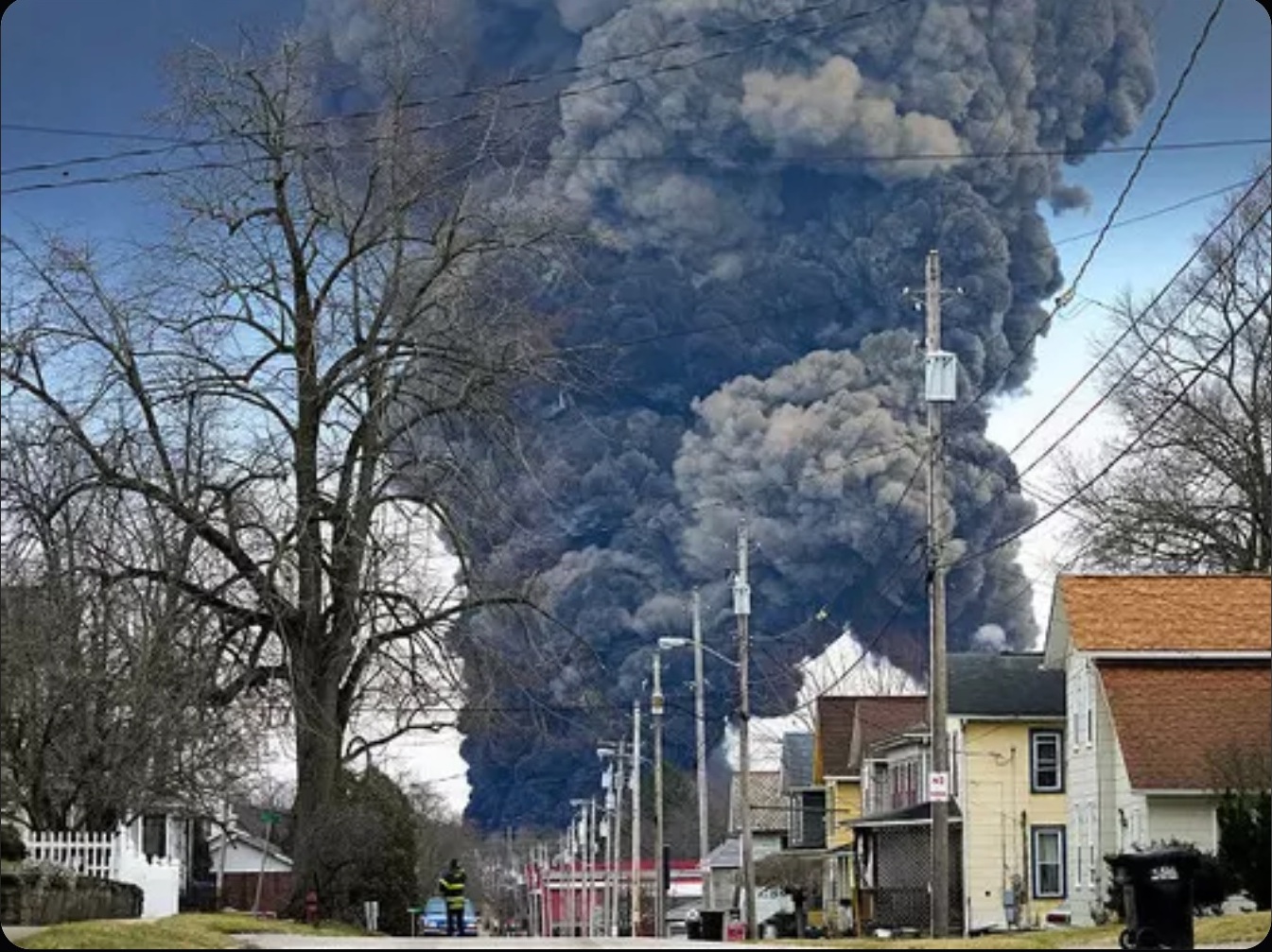
Train wreck mushroom cloud hangs over East Palestine, Ohio, whose toxic mess was greatly exacerbated by the way the federal government employees tried to mitigate the toxic chemicals in it
A red flag is used in car racing, team sports, and other activities to indicate a warning about something dangerous, or as a disqualification of some player or person, usually for breaking the rules of the game.
A new genre of “red flag” laws are being used to illegally disarm law abiding Americans, but that is a whole other subject. Even in this case, the term “red flag” serves the same connotation as elsewhere.
Recently America has experienced a whole slew of red flags as both warnings and as DQs. I don’t know how many red flags there have been, but there are easily a hundred of them. Let’s just say for argument’s sake that there are 99 red flags that we all should have seen in the past two years.
Examples of the warning kind include a handful of planes haphazardly and inexplicably flying into food processing plants out in the middle of nowhere, dozens of catastrophic mysterious fires breaking out at food processing plants and chicken farms, mysterious diseases striking large numbers of beef cattle and chickens at ranches and egg laying plants, adulterated chicken feed suppressing egg laying chickens from laying eggs across America for the past six months, and sophisticated attacks on electricity plants and on public water plants.
Now, when any one of these things happens, it is news. Or at least it should be news, and maybe it is news that such a freak event did not make the regular news. But when all of these things happen all of a sudden, across a relatively compact and short amount of time, with huge shockwaves sent through the American food supply chain that end up with empty super market shelves and very high food prices, it is all beyond news. This is happening on purpose. Each of these events is then a huge red flag that something is wrong. Something bad is happening to the infrastructure of our daily American lives, and if we do not understand what is happening, then we will not be able to address it. And if we do not address it, then we Americans will have little or no food to eat or clean water to drink.
When I talk to friends and strangers alike (I talk to strangers all the time) about these apparent overt attacks on our American food supply, I get a couple responses. One is “Wow, I had no idea. I guess that is why I see empty store shelves and high prices. Hmmmmm.” This response indicates the person is starting to think ahead about what this means for them, and what can they do about it. Self preservation in action.
The other response I get is “Really? I had no idea. Oh well.” And this indicates the person is so deeply asleep in the fat of the land that they cannot imagine either going without food, or how they can go about fixing their situation. Some joke about who will starve during a famine or domestic conflict, and it is no joke – these inattentive and incurious people will end up being the designated starvers. They foolishly take everything we have for granted.
The biggest red flag, both as a warning and as a DQ, was last week’s train crash in East Palestine, Ohio. Not sure why or how it crashed, but it happened in the middle of pristine farmland that grows a lot of important crops Americans rely on to eat every day. And then the Biden Administration’s impotent, uncaring non-response to the initial toxic chemical spill and then to the huge toxic mushroom cloud from the administration’s incompetent explosive “fix” that made the spill even worse said everything about what is happening to our country: HUGE RED FLAG alert. Joe Biden is either super incompetently or purposefully destroying American heartland farmland, and he must be disqualified from doing any further damage
Something bad is happening to America, on purpose. These serious domestic attacks are happening at a frequency too high for random accidents. As we see in other sectors, America’s domestic food production is being sabotaged. And this observation is not even taking into account the effect of giant industrial solar construction on pristine farmland all over the east coast. Farmland that is closest to America’s highest population centers is being destroyed, and will not be able to produce food or fiber (or quarry rock for public roads, or grow timber) for many decades to come, if ever again.
I see red flags all over the place. These red flags indicate that America is being failed from within on purpose, by people who are living inside our borders, who want to use their positions to destroy America. Hello, this is your country, and as it goes, so go you and your family.
As the 1970s bumper sticker read – “If you aren’t mad, then you aren’t paying attention.”
Invasives & Sustainability
Invasives present a challenge to sustainability because they quickly fill gaps where natives take longer to grow and thrive. Natives evolved in their environment over long periods of time and they perform certain key services and functions that are necessary for the overall system to function properly.
As non-native invasives proliferate, they choke out the natives and reduce their ecosystem services. Almost always, the non-native invasives perform limited or no services, despite showy appearances. Their presence is totally unsustainable and is ruinous if left unchecked.
A day or so ago while walking on my favorite rail-trail, it was impossible to ignore the sickly sweet smell of Japanese honeysuckle, a huge invasive nearly everywhere in Pennsylvania. For whatever reason, Japanese honeysuckle has spread like wildlfire in the past few years. My only neighbor’s property is like Ground Zero, so whatever fight I am carrying on at my place is limited in effect by the invasive sanctuary across the boundary line. Like a shrub explosion.
Sure, the ruby throated hummingbirds benefit from honeysuckle, and who doesn’t like watching the gentle, delicate little birds flit around?
But this much honeysuckle is quickly crowding out native trees that benefit our native wildlife. Occasionally deer will browse the tender tips of a honeysuckle shrub, but after the first inch it’s just tough woody debris that deer won’t eat. So it grows pretty much unchallenged. And boy does it ever grow!
Along with Japanese honeysuckle comes barberry, multiflora rose, and autumn or Russian olive, often all popping up unannounced in large clumps. Interesting, isn’t it, that they all appear together? Once in a while a nasty ailanthus (“Tree of Heaven”) will push its way in among the other invaders.
After years of battling these non-native invasives, I have come to rely on pulling up the barberry by hand, usually with the aid of a length of re-bar, and spraying the smaller olives, honeysuckle, and multiflora rose with glyphosate. Sawing substantially into the larger honeysuckle shrubs and spraying the cut with glyphosate usually does the trick; it works much better than trying to spray the whole big shrub.
Intriguing, don’t you think, that the biggest advocates of fighting non-native invasives are the ones most aggressively pushing non-native invasives in the form of lawbreaking illegal border crashers?
Recently I was on the West Coast, in an area in the grip of a Biblical-size drought. Water scarcity is becoming a serious problem. Public demand for water far outstrips supply. A drive through the Central Valley revealed apocryphal “Dustbowl” conditions, with signs everywhere warning about the consequences of poor water management.
It is not a sustainable situation. Yet this area also holds the greatest number of illegal invaders in America, who put an unsustainable demand on other public services besides water. Public transportation, public schools, roads, highways, sewage treatment, public spaces like parks, police, fire and hospital services are all stretched way beyond capacity by the presence of the non-native, non-tax-paying invasives.
And yet the voting citizens of Los Angeles and California continue to aggressively vote for unsustainability.
Boggles the mind.