Posts Tagged → new york
Where is the Manual Override lever?
A friend of mine has a beautiful home filled up with high technology gadgets. Everything in the house is automated, including opening and closing toilet seats, lights, music, the kitchen wine rack, you name it; if it can be programmed to happen or turn on or off when a person enters or exits the room or uses the potty, he has it set.
First time I encountered this was at a party. It was funny and entertaining. I would experience something newfangled and robotic, comment on it, compliment my friend for his ingenuity, and then retreat to the pool deck or his living room to talk with a human being.
Then a year later he generously hosted me as a guest for a weekend as I ran for state senate, while he and his family were away. Every time I stepped into the kitchen, lights would turn on, the fridge would light up, or automatically open if I approached it, same with the coffee maker, etc. When the shower was turned on, music started.
No matter what I wanted to do, or needed to do, or possibly indicated a desire to do, the automated electronics tried to anticipate me and do it for me. Even the toilet paper dispenser was set to go, maybe not enough, but it tried to provide. Everything but the final act was done by the toilet paper dispenser, but then the guest room toilet also had a bidet feature, which if you are into that, can work wonders if set on “fire hose high.”
After that weekend, I swore I would try to avoid automation as much as possible the rest of my life. It unnerved me, because almost as frequently as the robotics were correct, they were then incorrect, and then annoying. Put another way, the first hour of that is Golly! amusing. The second hour is provocative, as the human mind tries to find ways to work around the now-annoying robots. After that, one becomes tired of the novelty, and a bit alarmed by all of the automated activity that occurs no matter which room one enters into, and what one really wants.
And there is no manual override.
Several years ago I made the mistake of buying a newfangled clothes washing machine. Our old one died, and I had run out of fixes for it. I could not find its two-way electric motor, used, even on eBay, and so it went out into the world of recycling.
Looking for that old machine’s fierce old-fashioned tear-your-arm-off churn of the washing machines we all grew up with, I accepted the salesman’s representation that this new machine could do that, if I programmed it to do it. And Lordy but does it have buttons for programming! It even can link up with your smart phone and be run from that, if you download that manufacturer’s spyware app.
I figured that with all of these sophisticated buttons and options, the machine could probably be programmed to write Shakespeare sonnets, much less really, really clean our family’s clothing.
Nope.
Turns out that the machine has programming for a high efficiency absence of cleaning water set at cold, and shame-on-you low efficiency absence of cleaning water, set at tepid, with the same weak, flaccid, slow, low-energy half-turn of the cleaning rotor as happens with the high-efficiency choice. And the churny-rotor thingy is a superior action to the lift-and-flop motion the machine is set to do from the factory.
Any mistake in trying to run a wash and then stopping it requires the machine to drain out all of the wash water and then start all over again. Which is a waste of water, and whatever electricity it used, and is usually an unnecessary step.
With this new, expensive, high tech clothes washing machine, you are stuck with a set of poor or poorer choices in how to maybe clean your clothes. The machine was designed and programmed by people who care more about energy and water efficiency than actually cleaning clothes.
Note to clothes washer manufacturers: We consumers buy clothes washers because we want our clothes to get clean, however that is done, whatever it takes, at whatever amounts and temperatures of water are needed, and with whatever rotor churn power is needed to knock the caked dirt off of my work clothes. We don’t want high efficiency water and electrictity use for anything other than thoroughly cleaning our clothes. And if the high efficiency settings don’t clean clothes, as they usually do not, then we want a choice in setting the machine to really kick ass and do what clothes washers are supposed to do: Clean. Really, really, super clean. At whatever cost in water and electricity.
And no, there is no manual override for this fancy washing machine. You the consumer are given an incomplete set of choices, and by golly, that is what you will learn to like, whether it is likable or not.
Last but not least among the examples of modern thingies needing a manual override, we have the new car belonging to the Princess of Patience. It is a 2026 Toyota Rav4 hybrid, being number four in a progression of RAV4s the Princess of Patience has owned and relied upon, with great enjoyment.
Heh, well, this latest and greatest iteration of the tried and true and much favored RAV4 inspires our gentle, soft spoken, always well considered Princess of Patience to say things like “I hate this %*$#@! thing. I want to set it on fire and leave it on the side of the road!”
Now, what could inspire such a harsh reaction to something so wonderfully modern and reliable as her new car? In a word: Technological automation.
This damned RAV4 has more technology than a fighter jet, and more automation than the Toyota car factory that built it. The technology is overwhelming, unnecessary, superfluous, and impossible to control, unless one has a degree in computer programming. The little turny knobs we used for the past seventy years for selecting radio stations and interior temperatures worked, ya know. Simple solution, hard to break, easy to tune. Not the new car technology! It is all touch screen, which is hard to see, inelegant, and clumsy.
This RAV4 tries to grab and pull into its computer motherboard every electronic gadget and phone that passes within fifty feet of it, then downloading and storing everything digital on said gadget and phone (to then download to Toyota so the car company can then sell and monetize our most personal information). This car also has every kind of Nanny pseudo-safety feature automatically built in that a weenie sheltered mama’s boy could ever dream up.
The car beeps and chimes and dings if you swerve one inch into the road dividing line. It will also automatically swerve away from any car or dividing line it believes you have mistakenly turned towards, even if you are swerving to avoid a deer standing in the middle of the road, but end up hitting the deer instead, because of the car’s automated correction system.
Ditto for coming anywhere near another vehicle while driving or parking. Last week my left wrist was nearly broken because of the force it hit the steering wheel with, as the car automatically and harshly jammed on the brakes to “save” us from hitting the rear end of a car that was turning into an alley in a congested urban area. We were plenty far enough away from the other car’s bumper, but to the RAV4, we nearly died, and it saved us.
Whoever programmed this car’s automated sensors and driving instructions obviously never drove in Brooklyn, New York, where urban combat driving is the norm and clearances between moving and parked vehicles and with buildings and humans are all measured in tenths of inches. To everyone’s satisfaction. But not to this car!
If I were to try to drive this 2026 RAV4 in a place like Brooklyn, I would leave a trail of destruction and mayhem behind me, on account of the automated driving and “safe reaction” nanny settings programmed into the car. The car would swerve to avoid one perceived obstacle, and then take out two grandmas, a stroller, and a partridge in a pear tree in one full swoop, just to stop me from maybe hitting something. All while the damned thing scans my eyeballs and my brain for what music I might possibly want to listen to at that second.
Folks, there is just too damned much technology and automation and useless gee-whiz gizmos in everything we use. It is all working against us, against our interests, our choices, against our humanity. It is a reflection not of us and our choices, but of the weak and highly risk-averse fairies who program these things before we start using them. And there is no manual override for any of it.
Not everything analog is bad, and hardly everything digital is good. The deeper we go into digital everything, the more we want some of that old analog world back. It was easier, more user friendly, did more with less, easier to maintain, lasted longer and broke a lot lot less than the digital crap.
You want a tamper resistant and theft-proof vehicle, that does what you tell it to do, when you want it? Get a manual stick shift. That is what I want in my next pickup truck, if only to be able to regularly give Third Gear to The Man.
Back hair, chest hair, belly hair…baby, I got it all and more
Confession time: I have a hell of a collection of back hair, belly hair, chest hair, even butt hair and ear hair. Fo’ real.
I know, I know, a man of my age does not age well, as “things” begin to grow from every orifice and heretofore unknown location, but so why then do we have to write about it…sorry, my apologies. There is an honest purpose here.
You, the lone, long-suffering sole reader of this blog, are probably already thinking to yourself “Good Lord, this guy has finally gone off the deep end with this TMI shock jock shtick. ” And were we actually talking about real body hair from my own voluptuous, idyllic form, you would be correct. However, as racy or as disgusting as this may sound, the fact is that I do have a pretty cool record-setting collection of all the aforementioned clumps of hair, but they are not from my own body.
Again and now even more so, whoever is left reading here at this point is gagging, and wondering what happened to the erudite intellectual who used to occupy this lonely outpost of fascination. Well, the bad news is I yet remain under the mal-influence of one Bill Heavey, the also-lonely humor writer of the once-wonderful magazine known as Field & Stream, now digitally un-dead and unknown to Americans under the age of sixty.
The good news is that I am not talking about human hair here, but rather the hair, or fur, of the many deer I have shot arrows at over the past five decades. This is true. I am not lying.
See, I fancied myself an archer at a young age, and so I got somewhere (probably at the kind of now-gone country auction that elderly collectors dream about and salivate over) a cheap recurve bow and a motley assortment of mis-matched arrows and dull broadheads, and set out to bag a deer.
Yes, I practiced, for years, as only the uninitiated and un-groomed and un-mentored can practice. Which meant that on Tuesdays and Fridays my archery “form” aligned well enough that I could hit the broad side of a barn, which were plenty, large, bright red, and quite broad where I grew up. And on all other days of the week my arrows sailed off into the wild blue yonder, to sit hidden in the fallow weeds and maybe puncture a neighbor’s tractor tire the following spring. Or maybe eventually catch my eye and be re-purposed as an arrow, more defunct stick than game-getter at that late point, but available and at-hand, and so useful nonetheless.
As a young man, I shot at deer from the ground and from neighbor’s hillbilly blinds, AKA rickety wooden death traps in today’s more refined hunting circles. My woodcraft was then and remains now unbeatable, and I am not lying or exaggerating when I tell you that I could stalk within feet of a dumbfounded deer, and let fly. Only to watch my arrow clip hair from the aforementioned areas and parts of the deer’s external anatomy, time and time again.
Bill Heavey would tell you, had he been as cool as me as a kid himself, that the deer died of laughter from the ridiculousness of the experience. But no, my deer did not die of anything. Not from shock, not from surprise, not from overwhelming mockery of the incompetent human mere feet away, and not an arrow in the heart. No, my deer stood stock still, with grass or acorns or corn hanging out of their slack jaw, staring at me in disbelief. Some even provided me with two shots.
I could have died from the shame of it all.
This routine of Bad-Indian-Sucky-Bow went on for decades, even as I graduated to used but working Fred Bear Kodiak recurves and then to custom “stick” bows. My prize and pride is a beautiful reflex-deflex longbow made by none other than Mike Fedora, the dean of modern traditional archery in America. Back in 2000, Jack Keith and I traveled from Harrisburg to the Eastern Traditional Archery Rendezvous, then at Denton Hill in Potter County (home of many more bears than people), where we connected with Jack’s dear friend John Harding, and where I was introduced to Mike Fedora.
At ETAR, Fedora traced my bow-holding hand, did some phrenology-like measurements of my various body parts, and pronounced that the bow of my dreams would be ready within a few months. And no sh*t, Mike Fedora did produce a beautiful bow that was like an extension of my soul. I could then and still can shoot that thing into bullseyes all day long. At archery targets, me and that custom bow are deadly.
At deer, I still drop the ball. No can hit. Must be nerves, which are steely when I am hunting with a rifle. And so my arrows continue to clip bits of hair from all over deer bodies all over Upstate New York and Upstate Pennsylvania.
I am telling you, my collection of these bits and clumps of hair is large and legendary. If nothing else, no human being alive has missed so many deer at so short a distance for so long as I have. A living, walking, malfunctioning Guiness Book of World Records I may be in this regard, around these parts it is nothing to brag about. Rather, I inspire pity from even little kids dressed in camo who have already arrowed several Pope & Young bucks by the age of seven.
In the not too distant past, someone with my pathetic archery hunting skill would have perished from starvation long before amassing even the beginning of such a fine and rare collection.
And yet, I have discovered hope, salvation for my pathetic-ness and hopeless skill-less-ness. As much as I hate to admit it, I, a traditional archery snob who mocked bows with “training wheels” (compound bows) and belittled “bow-guns” (crossbows) as un-sporting arms that no worthy deer would allow itself to be taken by, I have finally fallen to the siren song of the modern crossbow. Or, to be honest, the cross-gun that shoots a short arrow like some kind of James Bond super-weapon.
Despairing of my ineffectiveness at archery hunting, and desiring to finally carve some notches in something to prove my prowess as a traditional hunter before I expire, I went and bought a Ravin R10X crossbow. It came highly recommended by contractor Ken Pick of Renovo, PA, whose son aced a very nice mountain ten point with one two weeks ago at the distance of 87 yards.
I can barely hit a deer with a modern centerfire rifle at 87 yards, so when I saw the photos of the young chap and his buck and his James Bond cross-bow-gun, I decided if I could not beat them, I had to join them. And join them I did, by buying said Ravin R10X at Baker’s Archery in Halifax, PA. Vindication and verification and all related cations came at me real fast as soon as I took that scary-ass contraption afield.
This is no lie and no exaggeration: Ten minutes after I took a little mosey to a spot where I had not hunted before, but where I thought deer had to be (this is the woodcrafty Josh), I had whacked an anterlessless deer. I had only put the scope reticle on the spot where I thought the arrow would hit the deer, and before I even pulled the trigger a loud THWACK resounded in the woods.
The deer ran twenty yards and died of fright, with a gigantic hole coursing through its body where I must have aimed but do not remember doing so, due to my own shock at having actually killed something with a stick and a string.
Life is full of surprises. Don’t deprive yourself of these dangerous-as-hell you’ll-shoot-yer-eye-out-kid bow-gun contraptions. Dude, they are cool and totally worth it.
Take my experienced word for it.

The trophy of my dreams: A yearling button buck taken with a James Bond super weapon on a ground stalk
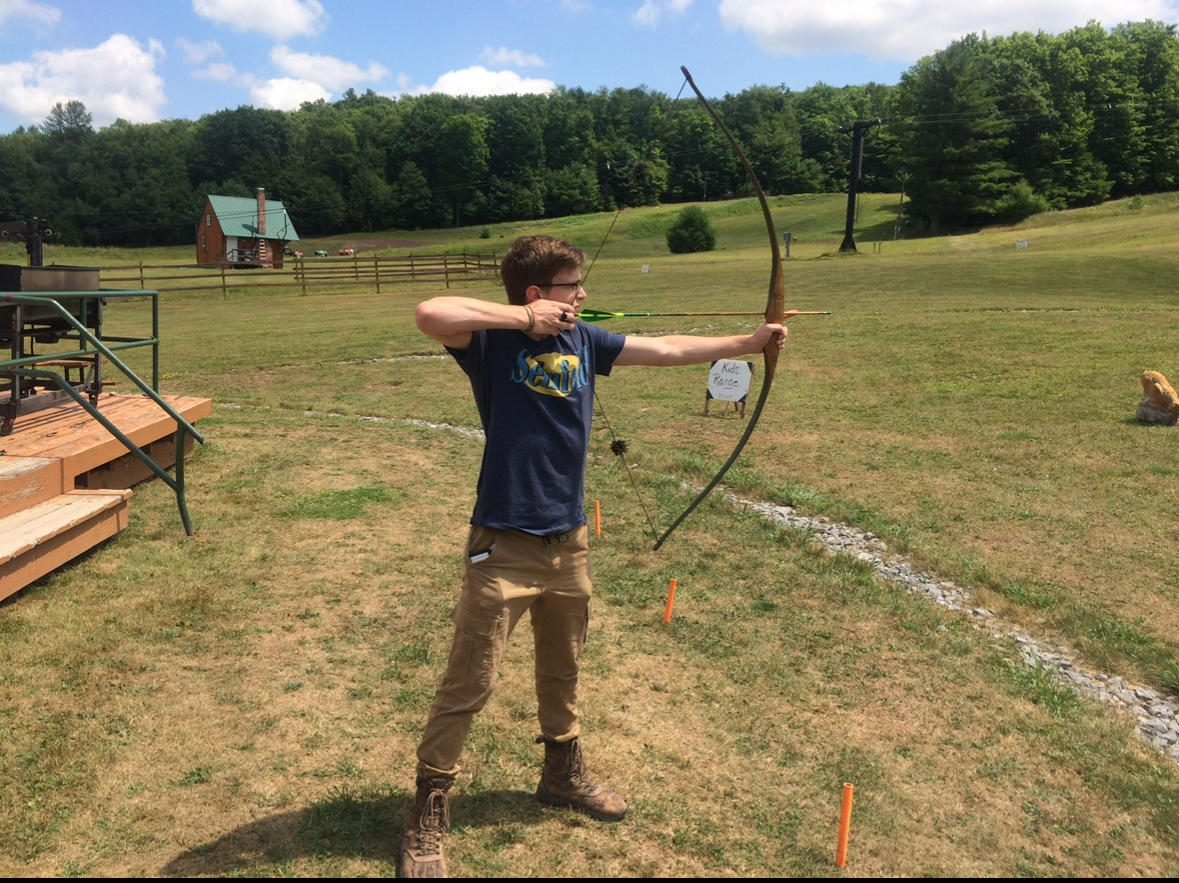
A young man who was mentored in traditional archery, with good form, at ETAR 2020 at Ski Sawmill

People’s trail cameras are literally everywhere. This was sent to me as I was preparing to ask this kind young man to help me drag the deer fifty feet to the gravel road

No joke about it, my friend and archery and life mentor, Jack Keith, was the real deal in everything, and I miss him every day.

People who subsist on archery can’t afford to write silly essays about sucking at archery
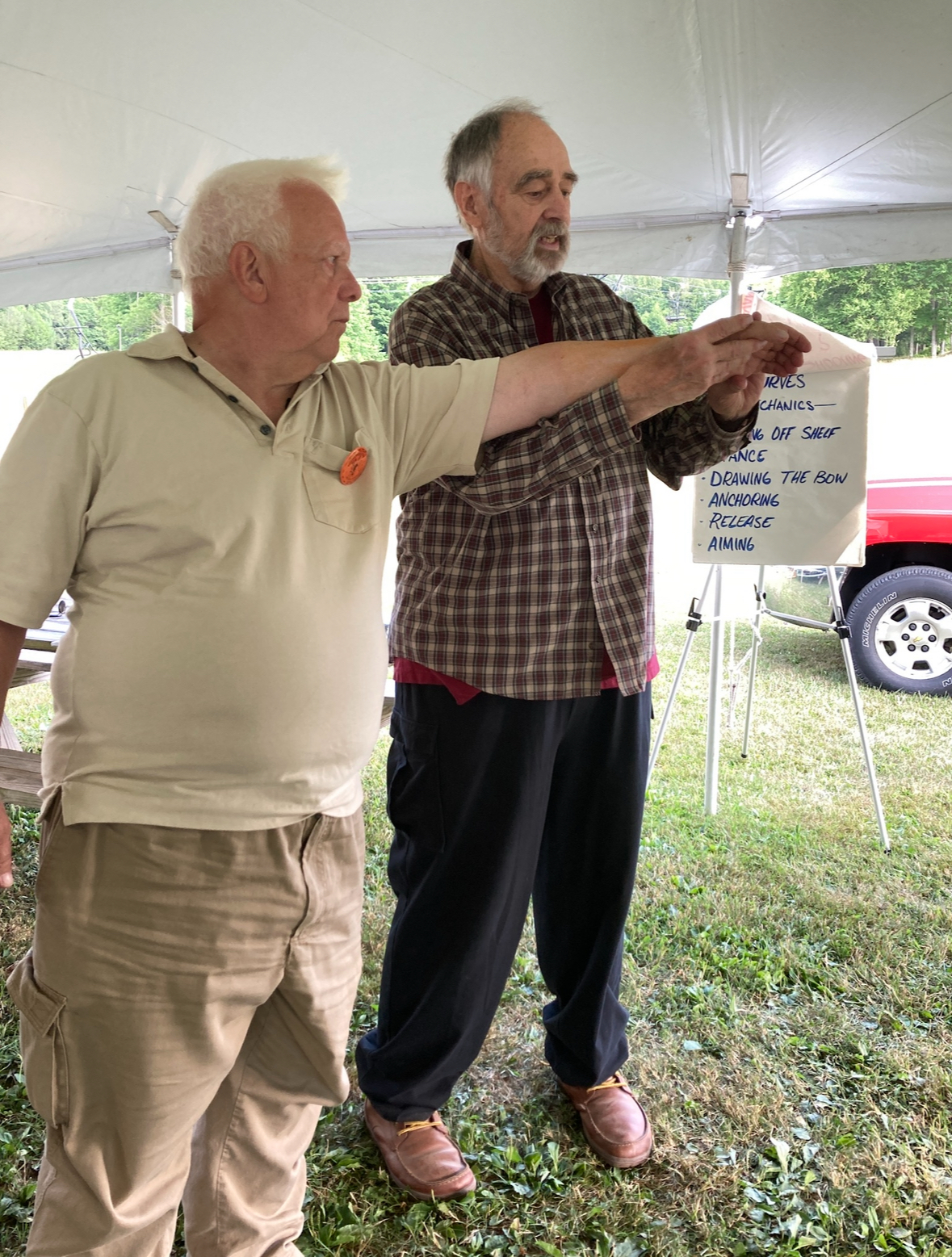
Traditional archery legend Fred Asbell showing how to correctly hold the bow while hunting. Fred took all kinds of animals all around the world with traditional archery tackle
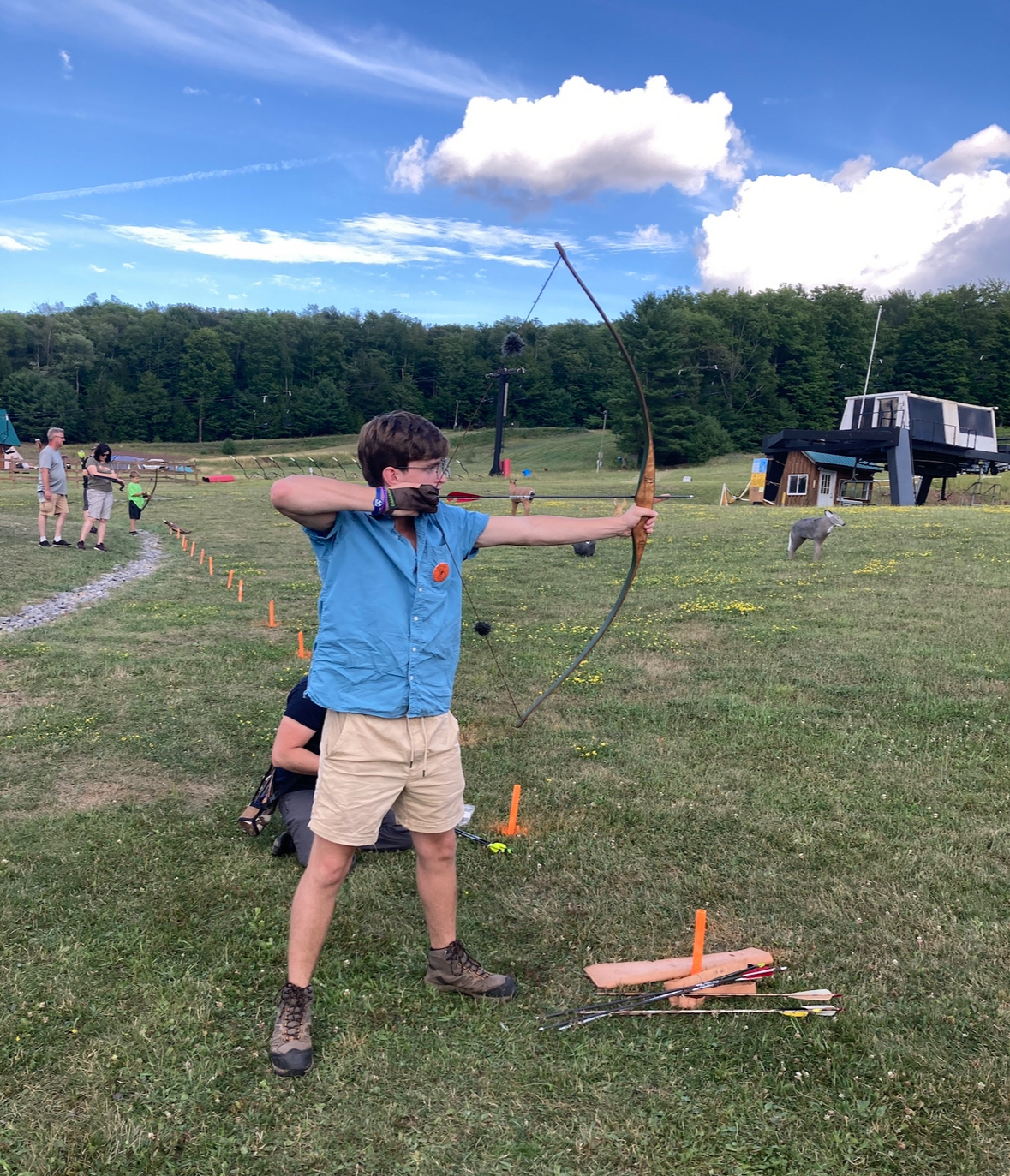
A young man with even better archery form at ETAR 2022

Fallen apples
Recently drove to Upstate New York and back, and the country roads everywhere were loaded with apple trees. Especially in New York, and less so in Pennsylvania.
The apple trees were growing alongside the roads because most of the roads were built along the original dirt tracks that connected farms. And farms always had apple trees growing as an important source of food. The farms are largely gone, and the dirt farm lanes have become paved public roads, but the trees remain, and for whatever reason this is a banner season. Lots of production, lots of beautiful delicious apples of every variety and sort.
What intrigued me was not just how many trees held apples that had not been picked by people, but how many trees had apples gathering at their base. Piles of fallen apples at tree after tree, many of which were in front of or right next to homes. The apples were just lying there rotting in the hot summer sun, and no one cared. No one was picking them up to use them.
My family members chuckled at my constant outbursts about these beautiful apple trees and their abandoned apples both on the ground and on the branches. But what do my kids know about having to forage for food? I grew up in a time and a place where no food was ever wasted, discarded, or thrown away. Or worse, ignored. Apple trees were always picked clean by somebody, if not by many people, for home made applesauce and canned sliced apples, or for fresh apple pies.
I have never seen apples go to waste in my life, until now.
The idea that literally tons of free delicious, organic fruit is just sitting there and rotting within arm’s reach of the public way is anathema to me. For miles and miles and miles. It is a literal shame, and it casts a shadow over the American culture that has emerged from ubiquitous junk food and over-abundance.
It is almost as if these miles and miles of fallen, rotting, abandoned apples are symbolic of our rotting, fallen, bloated, pudgy and lazy culture. Everyone has more than they need, and so they just ignore the free healthy and abundant food that Mother Nature and past farmers have bequeathed to us now, if only we get out of our speeding vehicles for five minutes to gather some.
America and its apples, falling. I think the whole world sees it, and our people don’t.


Why are museums closed on Mondays?
Can someone reasonably explain why museums are still closed on Mondays? It is a longstanding tradition that defies common sense. You won’t find many people advocating for tradition more than I, but what tradition I argue for makes sense. Museums closed on Monday makes no sense. It seems to be an outdated, strange sense of special privilege that almost all museums are closed on Monday.
In a nation full of highly mobile travelers and vacationers taking long weekends, and where so many small towns and rural counties have worked hard and significantly invested to attract tourists, we still come up against the strange tradition of museums being closed on Mondays. No one I have spoken to can give a good reason for this educational shut-down. They are even shut on Monday during the summer season, when tons of tourists are traveling through town.
Going to visit your old uncle via an oddly zig-zagging road trip you will never do again in your life? Don’t count on seeing the local museums or historical society that Monday; they will be inexplicably closed. “It’s Museum Monday, dontcha know…..”
Taking a long weekend summer vacation on a whim to some remote place you will never visit again? Don’t make Monday your local museum day, because regardless of where you are, the museums are likely to all be closed. “It’s Museum Monday, dontcha know…..”
Every other business sector works hard to meet its customers’ needs, except the museums, when they are closed on Monday. The list of Open On Monday Despite The Terrible Hardship businesses includes funeral homes, libraries, car mechanic shops, pet care shops, and ice cream stands. Among most other businesses.
Every other business sector has to survive, and can’t afford to artificially turn away customers, except for museums with their “poor me” donation boxes that are inexplicably closed on Monday.
Every other business sector rotates staff in order to give workers a day off, a weekend off, except most museums, apparently. Only museums have staff that must get Monday off. Only Monday. Not Sunday. Or Wednesday. But Monday….
Yes, I recognize that a hundred years ago when museums were becoming a thing, they developed a common culture of being available over weekends (except those museums that are closed on Sunday…and also Monday, of course), which necessitated having a day off for facility cleaning, repair, exhibit updates, and rest for the staff. I suppose. But now? Every other business is open on Monday, and yes, museums can do it, too! They should do it.
Find some new staff or volunteers for the Monday shifts. Pay the museum staff more on Monday. Whatever it takes to meet customer demand, museums should do; this ain’t rocket science. The Smithsonian is open seven days a week, and if that gigantic place can be open on Monday, then so can small museums in Podunk USA across the USA.
I would like to thank the Ward O’Hara agricultural museum in Auburn, New York, and the Museum of the Fur Trade in Chadron, Nebraska, for being open on Mondays. We just happened to be passing through their respective rural necks of the woods on two given Mondays, a year apart, and lo! – a museum with an Open for Business sign! We happily paid their fees, left generous donations in the donation box, and had a really enjoyable time learning what they had to teach us. And no one involved turned into a pumpkin because it was Monday.
Dear museums, please join the 21st century, and make yourselves available for the highly mobile 21st century traveler. Arrange your open hours to meet the demand of your would-be customers; especially during the summer vacation season. And to those foundations who write big operating grants to museums, you should stipulate that the museums must be open when people are expecting to use it. That would definitely include all the week days, like every other business.
Four years ago, Jeffrey Epstein did not kill himself
Four years ago, Jeffrey Epstein did not kill himself. He died mysteriously in not just any prison, but in New York’s Metropolitan Correctional Center, in the heart of and under the complete control of the Democrat Party political apparatus that he was a threat to. He was under 24 hour scrutiny by two guards and he was under 24 hour surveillance by multiple cameras.
Epstein had tons of horrible dirt on a ton of Democrat Party bigwigs and donors. Had he been allowed to stay alive, he would have talked, spilled the beans, disclosed the horrible secrets about these horrible people that would have disrupted the evil shadow world occupied by so many Hollywood and Democrat Party bigwigs.
Mysteriously, the guards watching his cell got up and disappeared from their guard duty at the same time Epstein died. No one was around to see how exactly he died.
Mysteriously, the cameras trained on Epstein’s cell also failed, did not record his cell, and had no backups. No one ever explained this coincidence.
A mystery visitor to the prison at that same time was never found. No one knows who the burly guy was.
Ultra-Democrat federal prosecutors then dropped the charges against the two guards for leaving their positions and for falsifying their log books that night. Everything was then hushed up. Someone with the information to destroy a political party conveniently died, and no one was held responsible. Not even the paid uniformed guards who were supposed to be watching him. The entire Epstein murder is one giant coverup in plain view of the American public.
Is anyone paying attention to this?
The deep mark on Epstein’s neck is the thin line of a strong wire or cable, nothing Epstein had access to. A ligature, the kind used by hitmen. But his cause of death was laughably and disbelievably recorded as death by hanging from his bed sheet, by a New York City Democrat bigwig, medical examiner Barbara Sampson.
Longtime Democrat Party donor and insider, Epstein was also a convicted pedophile and child molester leading a bizarre life of high finance and child rape on his “orgy island” in the Bahamas. Hundreds of children were illegally sexually trafficked on Epstein’s island, and at least hundreds of Democrat Party bigwigs and insiders joined him there, including Bill and Hillary Clinton. Apparently a few Republican Party bigwigs participated, too. This might account for why “Republican” US AG Bill Barr immediately and outright dismissed all the mystery surrounding Epstein’s death as nothing to see here, everyone just move along. Barr obviously covered for not just the Democrat child molesters, but the Republican ones, too.
Here is one good article about what a sham this murder was, and what a sham the coverup was.
No wonder so many Americans see this disgusting arrangement as a “uniparty” or a “deep state” or an “administrative state” that illegally operates separately from the We, The People, who are supposed to have complete control over our government. Both political parties are in on the sham. They cover for each other, they take care of each other. Meanwhile, the rule of law that is supposed to keep America operating is thrown out the window.
It is almost as if Epstein’s blatant murder was a run-up to the stolen 2020 election, that also happened right in front of our faces, and which the uniparty also told us to move along, forget about, nothing to see here.
Folks, America is in huge trouble from this crap. The only reason all this evil skulduggery has not destroyed us yet is that America is in effect a huge bank account. There is just so much of everything in America that it will take a long time before the rot inside begins to really show up on the outside. Our cultural, political, and financial wealth is all being quietly siphoned off, one political murder at a time, one dropped charge at a time, one official coverup at a time, one stolen election at a time. At a certain point, this corrupt rot will become so prevalent and so blatant that no one will believe in the system any more. And then all hell will break loose.
I do believe that is their plan.

We all fold bed sheets. Have you ever seen a bed sheet that could leave this very sharp, deep cut in human flesh? Neither has anyone else but the New York City Democrat political hack Barbara Sampson. Jeffrey Epstein did not kill himself. He was murdered to shut him up.
PGC’s strange hunter survey
Today a Pennsylvania Game Commission email arrived, asking if I would participate in a brief hunter survey. Being 100% opinionated about everything, naturally I acquiesced. “Shy” was maybe used to describe me when I was young, but not as an adult. Because I consider myself a careful thinker, committed only to First Principles from America’s founding and to The Bible, and being relatively uncommitted to mass movements or parties, I enjoy sharing my perspectives with people who are open minded and interested in understanding different points of view than the prevailing narratives hawked by the Mainstream Media Corporate Industrial Complex.
The PGC survey consisted of really just three questions, all of which were about hunting waterfowl such as ducks and geese.
First question was did I hunt ducks last season, to which I responded No, I Did Not Hunt Ducks Last Season. The reason being that although I live just two blocks from that once famous migration route on the mighty Susquehanna River, the current duck migration down the Susquehanna River is not even a shadow of its former self. Rather, the duck migration here does not exist and has not existed for twenty years. I see more ducks lounging about and crapping on people’s yards in Italian Lake City Park across the street from my front yard than I see out on the Susquehanna River sitting on a bucket with a shotgun in my hand.
So, unless I travel to the Chesapeake Bay to hunt ducks, it is rare for me to get out after them any longer. Without Sunday hunting like all the surrounding states have, my opportunities for waterfowl hunting in Pennsylvania are pretty limited to what I can access quickly and easily. Like the dead Susquehanna River within sight of my dining room window.
Second question asked which Goose Zone I hunted in. Easy enough to answer.
Third question, which was broken down into three different alternatives, pertained to which of three unbearable and useless goose hunting seasons I liked or did not like, and how much I liked them or disliked them. All three alternative seasons PGC presented were unnecessarily fragmented from late October into February, and included very little early season but lots of late and really super late season. The problem being that the southward goose migration is heaviest in the part of October when the PGC shuts down our goose hunting, and the goose migration is entirely over by the time the PGC season opens back up. Fat lot of help these potential seasons offer!
This is a curious situation, which I have never had satisfactorily answered. Some hunters I know say that the Susquehanna River Waterfowlers, to which the PGC looks for hunter guidance, is made up of anti-Sunday hunting fuddy duddys who would rather give up hunting entirely than see Pennsylvania hunters get our share of the goose migration and also have Sunday waterfowling. True or not, this is what I am told.
Other hunters I know say that the PGC is hopelessly tangled up with the US Fish & Wildlife Service on all kinds of policies, not the least of which is that PA has a boatload of passionate hunters who, given the least opportunity, will, it is said by wildlife management officialdom, destroy, decimate, eliminate, and exterminate every duck, goose, gander, coot, loon, pimpernel, plover, and shoveler that flies, walks, waddles, crawls, or ducks through the migration route between New York and Maryland. And so, according to this view, Pennsylvania waterfowl hunters must be artificially hamstrung and kept from going afield when the birds are flying the most. Again, I do not know how much truth there is to this, though I will testify to the fact that Pennsylvania does in fact field a lot of hunters. A lot.
And so we get to my response to the three ridiculous seasons proposed in the PGC survey: Not one of them makes any sense; all three are equally nonsensical alternatives.
What is the point of giving me various dates to hunt if the animal we are hunting is no longer in the venue in those dates, but has long since flown the coop and is doing leisurely backstrokes in Florida and Louisiana?
It appears that the PGC knows its three silly seasons are indeed silly, and yet the agency is overtly committed to them.
“You can have a crap sandwich, a sh*t sandwich, or an imaginary sandwich,” is what PA waterfowl hunters are presented here.
This means Pennsylvania waterfowl hunters outside the Philly area southeast corner and outside a couple of interesting little “habitat and flyway bubbles” around Lake Erie and Shenango Lake in Western PA are officially SOL and just wasting their time sitting with a shotgun on a bucket and freezing solid past late December.
This current no-win situation begs for a bigger than life solution, but it also reminds me of the old Sunday hunting situation, where the PA Farm Bureau stole our private property rights for decades by artificially preventing any Sunday hunting. Only by marginally nibbling around the political edges did PA hunters finally get three weenie Sundays to hunt big game, and one suspects that such a small and unsatisfying “solution” is what is in store for PA waterfowlers, if a solution is to be had at all.
Maybe PGC will add more waterfowling days afield in March, when every single last duck and goose north of the Mason Dixon Line has landed in Costa Rica for the winter. Thanks but no thanks, PGC.
I for one, though I undoubtedly represent many others, would like to hunt ducks and geese in Pennsylvania at or closely around the same times/dates/days that hunters in New York are hunting them. But that would make sense, and if there is one thing I have learned as a PA waterfowl hunter, our seasons here are not intended to make sense.
How’d that go? PA begins online hunting license & tag sales
Today at 8:00 AM marked the first day of the Pennsylvania Game Commission’s true entry into the modern world of home computers and the Internet. This probably sounds like an unnecessarily harsh or even a commonly outlandish criticism of the venerable PGC, but it is a technological fact that today marks the very first step by the 1895-founded-and-minded wildlife agency into directly integrating with its customer base.
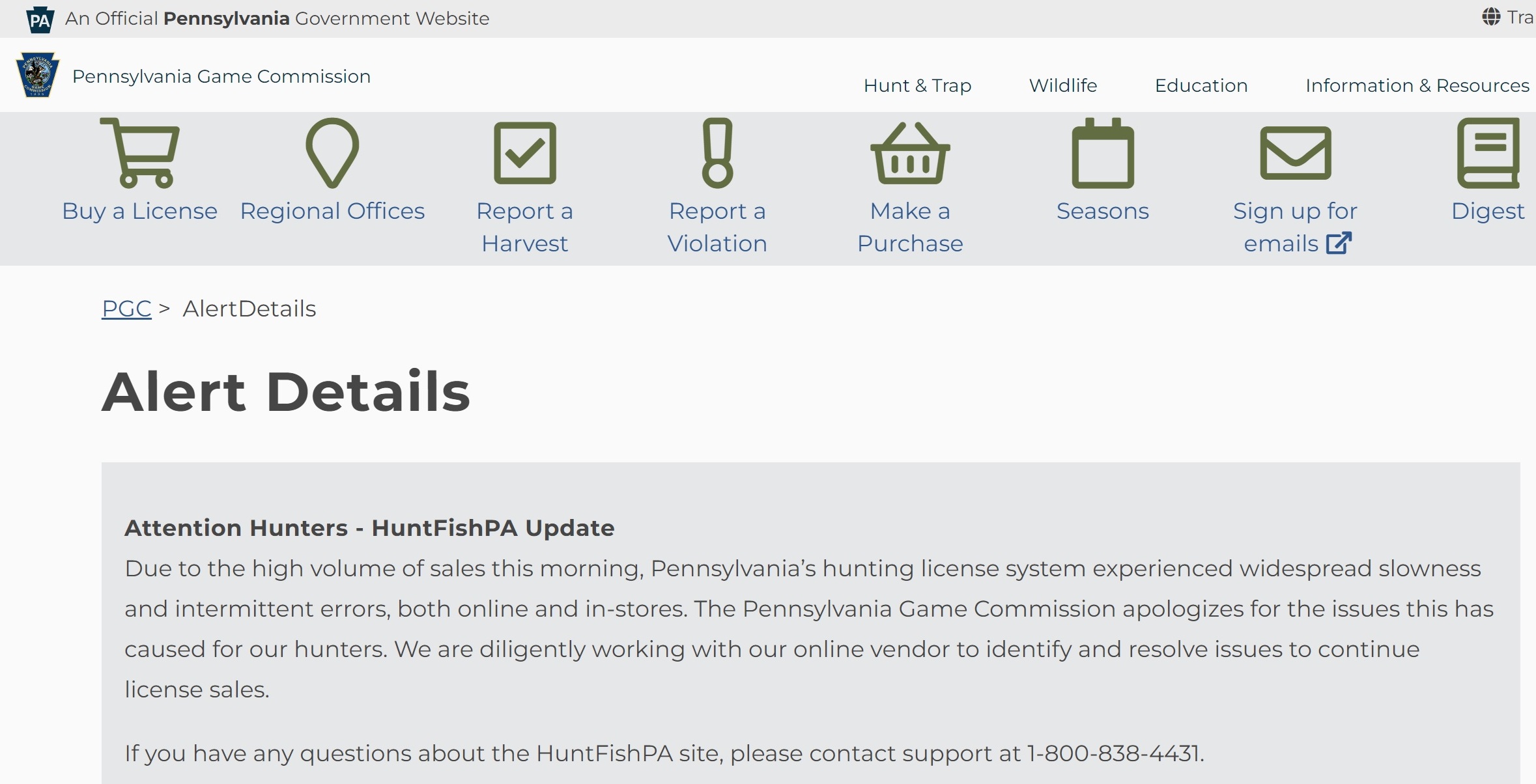
And it has not gone well, although it could have gone a lot worse. Monday end-of-business hours analysis shows the PGC website processing about 7,090 license purchases per hour. That is about 118 per minute, which is a lot faster than the roughly 1,900 licenses per hour purchased in the early time frame I operated in. Given all of the little moving parts involved, especially that carefully measured doe tag purchase, I guess I can see why this is taking longer than the two to three minutes total that each person expected to spend on it. It still frustrated me and others who are not at war with PGC.
The process has been marred by exceptionally long waits, both in-person at brick and mortar retailers and online, with lots of “system crashes” and people standing in line for hours, spawning humorous memes like the old and now former pink doe tag envelope saying “Miss Me Yet?” I like the meme of the skeleton passed out over the desktop computer “Waiting for my 21st century Internet purchase from the PA Game Commission.”
The truth is that this day had to come, sooner or later. The old double-stamped pink envelope US Mail process was increasingly marred by the US Postal Service’s incredibly ever worse performance, to the point where people were photographing piles of time-sensitive pink envelopes sitting in heaps in some post office rooms, waiting for who knows what or who knows who. No one likes to be treated differently than everyone else, and the pink envelope lottery was an idea from 1945 that worked when postal employees did their jobs. These days, the Postal Service is notoriously unreliable. We can’t have a doe tag distribution process that relies on unreliable people and institutions. Even when the applying hunter does everything correctly, his or her pink doe tag envelope might take a wrong turn at Albuquerque and arrive days or weeks after the last doe tag was distributed. Which greatly impacts the hunter’s plans and prospects for that upcoming hunting season.
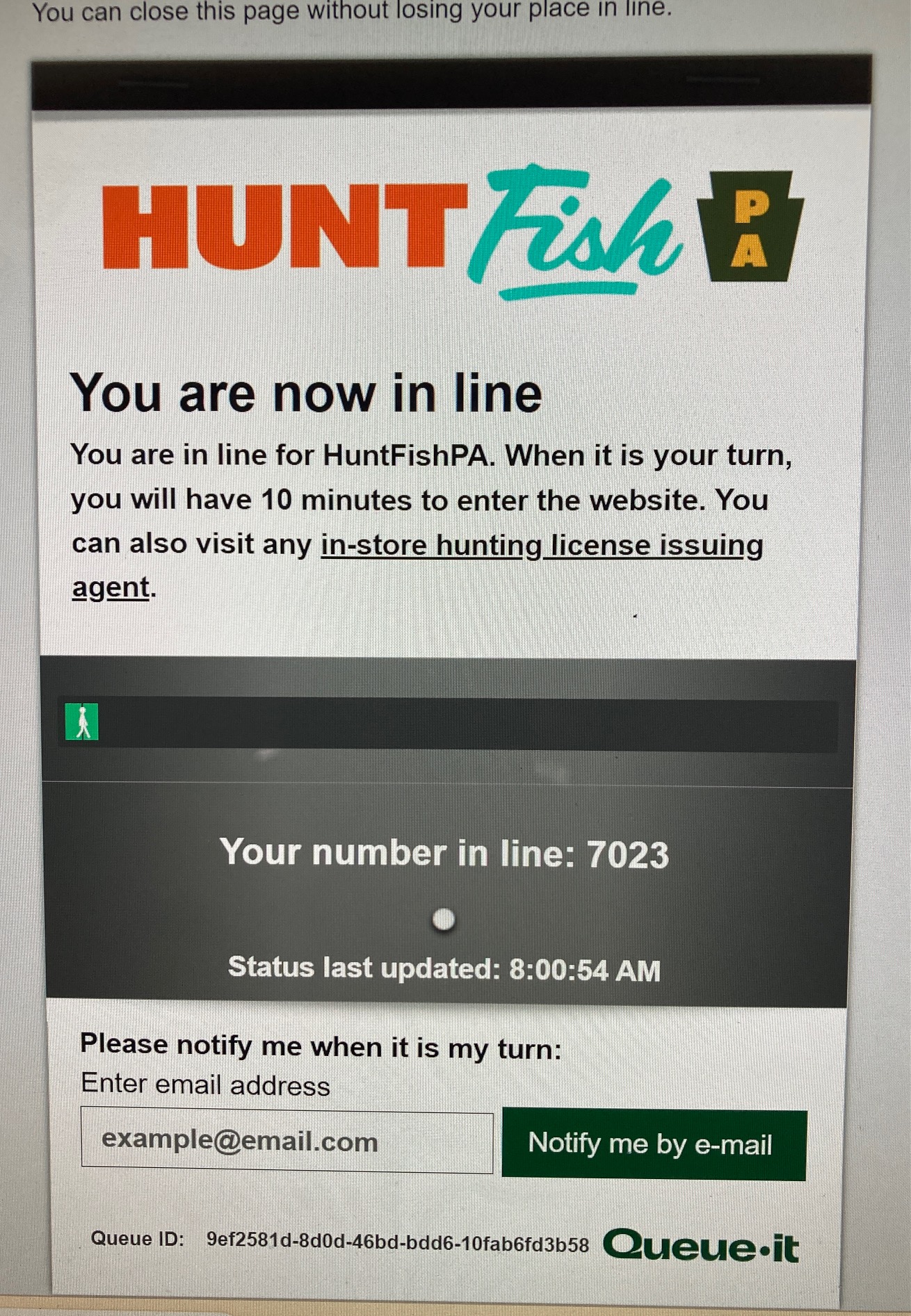
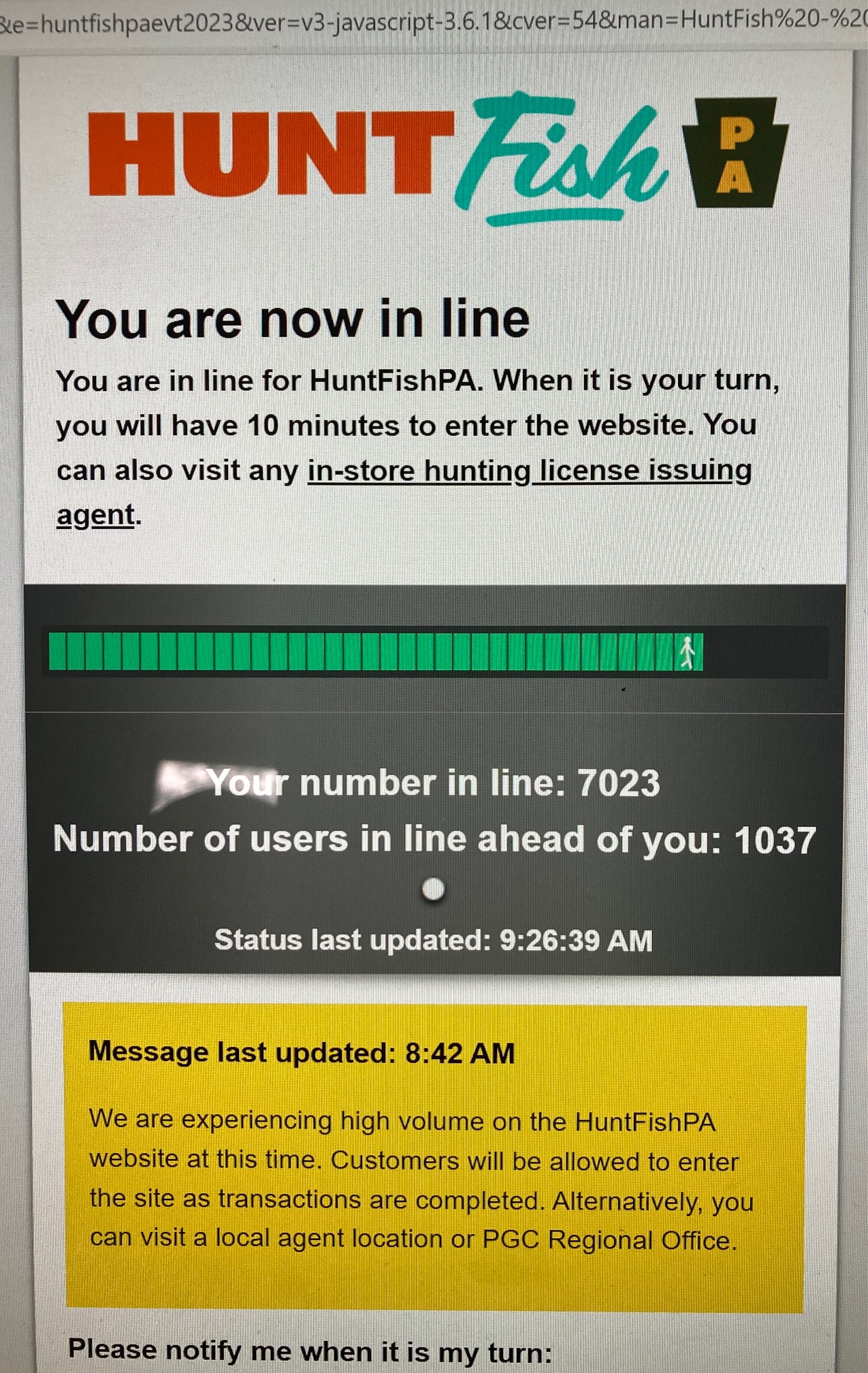
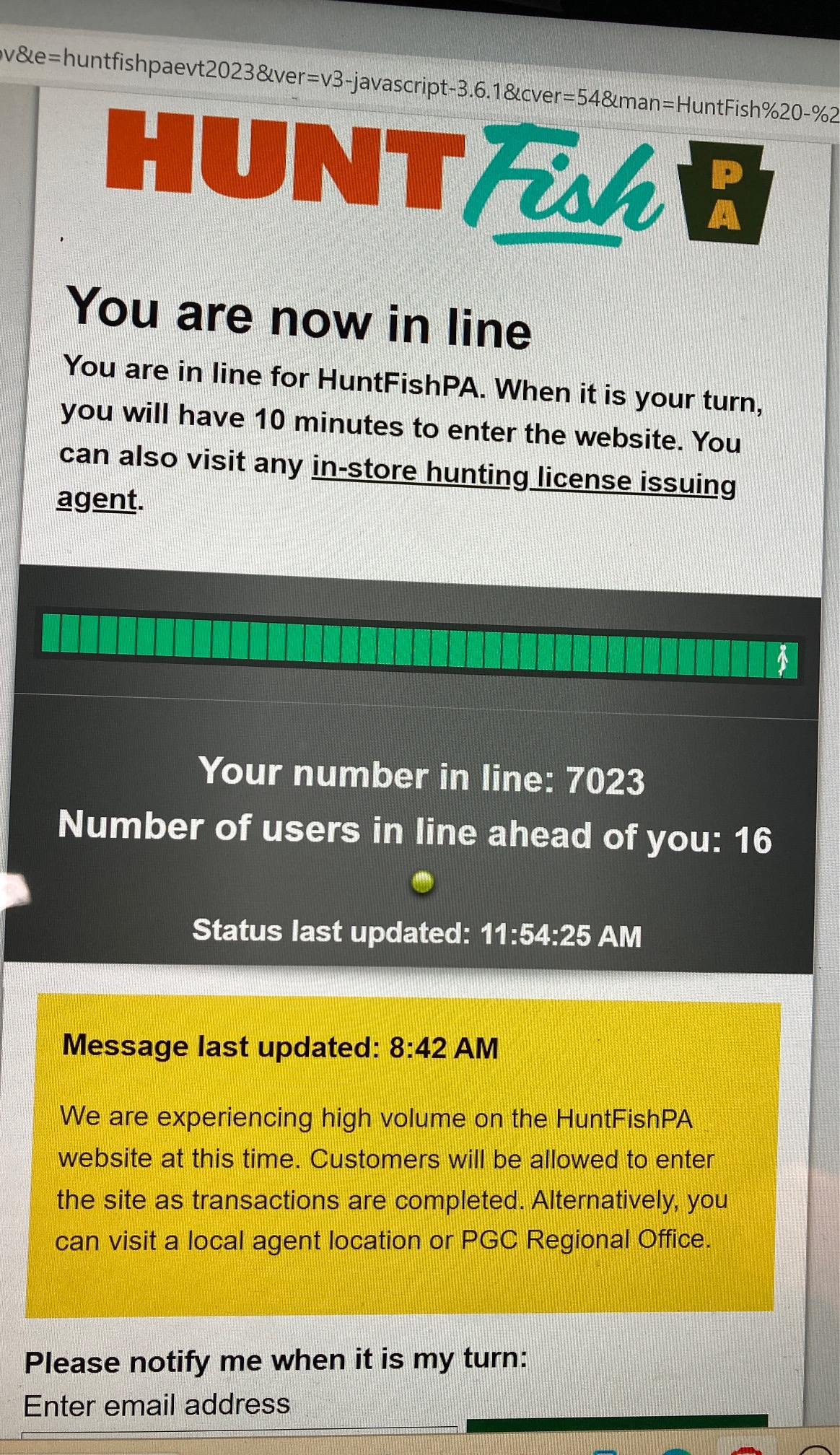
My own experience today had me first sleeping fitfully all night like it was hunting season, and finally dragging myself out of bed and hunkering down by the laptop well before the 8:00 AM beginning of the online purchase process at www.huntfishpa.gov. Almost like opening day of deer season and sitting down at an ambush site. Except this process revealed itself as having actually started well before the appointed 8:00 AM hour, as I was number 7,023 in line when I signed into my PGC huntfishpa account. With barely any coffee in my veins to buffer this unhappy revelation, an ice cold shock ran through me as I realized I was both early and yet already very late to the process. Thousands of hunters were ahead of me in an online process that was unknown, untested, and sure to have its ups and downs and delays.
The big ticket item for most of us early applicants is getting the doe tag of our first choice Wildlife Management Unit. It is why we stayed in the game til the very end. And the numbers tell the tale: My own first choice, WMU 2G, sold 17,000 doe tags by 5:00 PM today, about twice as many doe tags as any other WMU. There is a strong fear in a lot of guys that if you don’t get in line early either online or at a store, you won’t get your coveted doe tag in your primary hunt region. Fact is, with the ever popular northern “Big Woods” WMU 2G, that fear is well founded. There are many more hunters wanting WMU 2G doe tags than there are WMU 2G doe tags to hand out. The early bird gets this worm, every year.
[UPDATE: At 9:42PM I looked at the doe tag numbers and 23,502 WMU 2G doe tags out of the 35,000 total allocation for that WMU have been sold so far. A sale rate far beyond any other WMU. This means that 2G will be sold out by Tuesday early morning hours. The hunter demand for Big Woods 2G tags has always been high, we knew it, and now we get to see how that demand plays out when the hunters themselves are put in direct control of their tag orders]
Four hours and ten minutes later, having obsessively hovered over my laptop screen the entire time while emailing and bitchfest-texting with friends in both better and worse positions than I, I finally had ordered my general hunting license plus all of the additional license and permits I get, like furtaker (trapping), the annual elk application (I will take anything ya got anywhere ya got it), muzzleloader, archery, spear, atl-atl, sling, blowgun, black bear, fisher, bobcat, armadillo, hog, dog, rat, bat, and zinjanthropus tags. And yes, I got my WMU 2G doe tag, which enables me to hunt the way I enjoy most – solo pack and rifle and maybe an overnight and campfire somewhere way off the beaten path and far from roads and people, and the promise of a long and heavy pack-out of boned-out meat with a single doe’s ear and a completed tag attached. This kind of hunt is the most rewarding among big game hunters everywhere. Guys sitting in warmed box blinds overlooking fields and ravines have no idea.
So yeah, I waited and waited to ensure I got that 2G doe tag. A lot of my Big Woods hunting depends on it.
Anyone old enough to pick up on the Bugs Bunny theme above will understand where I am coming from; it was a loooong and kind of zany morning. In this day and age of Amazon and eBay and Gunbroker one-stop-shop badda bing badda bang badda boom go online and it’s yours two minutes later, Pennsylvania’s entry into the online hunting license world was practically Stone Age. New York has about as many hunters as Pennsylvania, and I have never encountered anything like this when I order my hunting license and tags from NY. It is usually immediate. Even Kentucky’s online hunting license and elk tag application process is faster than ours was today.
I am not picking on Kentucky….but come on, we all know it, Kentucky is not known for being especially technologically advanced. And yet….!
On the one hand, we must must give PGC credit for taking the long step out of 1895 and into the computer and internet age. This step the agency took this morning was one small step for PGC and one giant leap for hunterkind, or maybe the reverse, or whatever….. something like this. It is a big deal and I send you guys three cheers. Three grouchy cheers. Let’s not do this again, OK?
Yes, today’s license purchase has been marred by delays that seem unacceptable, but we all know that the PGC’s public employees have way too much pride to let this situation continue. It is a fact that a lot of employees and contractors will be working all night on this new system, and that by the time 8:00 AM breaks tomorrow, a lot of the glitches and delays we experienced today will be a bad memory for some, and a non-experience for a million others.


Turkeys and the critters who eat them
Wild turkeys are one of Pennsylvania’s great conservation success stories. When I was a kid, wild turkeys were like a fable, a mythical animal inhabiting far distant wild lands, that could be seen and maybe heard if you were one of the lucky few. They had been decimated by market hunting in the 1800s and early 1900s. When I took my hunter safety education course at the age of ten at the old Army Reserve building out in the farmland on the east side of State College, the Pennsylvania Game Commission staff proudly showed us films of their successful trap-and-transfer program, where wild turkeys were lured with bait into the range of nets, caught, and then driven to the far reaches of Pennsylvania’s rural areas. Usually State Game Lands with fields.
From the 1970s until the early 2000s, Pennsylvania’s wild turkey population grew and grew, until they seemed to be everywhere, including well south of I-81, the old imaginary dividing line between concrete civilization and wild man country. Apparently turkeys are adaptable to concrete wilderness, because they took up urban residence all over the east coast. Not content with being colorful freeloaders along with the ubiquitous and nasty pigeons and rats in these urban areas from Massachusetts to New Jersey, wild turkeys also provide much hilarity as they attack everything that moves in a display of misguided dominance, including mailmen, soccer moms and their kids, and dogs being walked. Look up the “incident reports” of wild turkey muggings of disbelieving urbanites; lots of funny videos to go along with them, too.
So when turkey populations began to decline in Pennsylvania and parts of New York starting ten years ago, people knew it was not due to the birds’ lack of tenacity. Something new and powerful in the old bird + habitat equation was having an effect.
And in fact in many places here in PA, formerly huge turkey populations are now really low or non-existent. I myself used to look out my windows and watch three separate flocks cycle through our clover-planted yards. When I hunted spring turkeys there (northcentral PA), I would start the day surrounded by gobbling toms, and usually had a couple different opportunities to harvest one within the first few days of the hunting season. It was exciting and fun and a great way to begin the work day, although I will say that by the end of May, I was a hollow shell of a human, having run myself ragged either chasing toms myself, or calling for friends who had not yet filled a tag.
Bottom line is, those old flocks of twenty to thirty birds no longer exist. We are fortunate to see one or two wild turkeys at all on our place. And we have excellent habitat with grouse.
What caused the loss of wild turkeys in PA has generated a discussion similar to the one surrounding the demise of the once amazing world famous smallmouth bass fishery in the lower Susquehanna River. It seems that almost everyone involved has a reasonable opinion about it, and the official experts are being second-guessed by people who have witnessed circumstances different than those described by said experts. The ubiquitous use of trail cameras since 2000 has accompanied this growth in sportsman observational opinion, and very often individual hunters will use their cameras’ footage to make very compelling arguments that contradict official wildlife managers’ narratives.
Something similar happens in the aquatic environment, when thousands of fishermen experience and see something different than what they are being told through official government channels.
So now PGC is toying with the idea of releasing martens into the wilds of Pennsylvania. Similar to the fisher that was released back in the 1990s, martens are a furry little weasel-type animal that, like all weasel type animals everywhere, has an insatiable appetite for everything they can catch and kill. Not necessarily kill and eat. All members of the weasel family (wolverines, fishers, martens, mink, otters, weasels) have periods where they become “surplus killers.” That is, they will kill many more animals than they can eat, just because they seem to enjoy the hunt and the kill. Question being now, What will the new marten do to our turkeys?
Will martens do more of what fishers have so clearly done to PA turkey populations, which is to climb up into trees and eat them while they are roosted and asleep? Will martens only eat turkey eggs? Who knows? And so it follows, why release martens into our forests and farms if we don’t know what impacts they will have?
The question I have, and which I know so many other sportsmen have, is: What kind of studies have been done to date that provide confidence that reintroducing marten will have a net-benefit result, and not a net-negative/cost result?
Most of us agree with government biologists that biodiversity in general is important, and we agree that increasing biodiversity is a worthy goal. But, what are the costs and benefits of doing so? What costs and benefits do marten bring to our forests? I can imagine quite a few costs, mostly impacts on ground nesting birds (like wild turkeys, grouse, pheasant, woodcock, and a zillion species of cute little migratory dickie birds) that are already under tremendous pressure from overpopulating (thanks to urban sprawl) raccoons, skunks, possums, feral cats etc., and I wonder if the benefit of a few hundred citizens annually catching a view of one of these cute and elusive furry weasel-like animals is worth the inevitable costs.
One of the things we must struggle with today is that, as much as we would like to return to the pristine conditions of three hundred or four hundred years ago, where humans had a measurable but relatively minor impact on the environment, the reality on the ground today is totally different. The social carrying capacity among different human groups is one consideration. The carrying capacity of other wildlife is another consideration. I imagine that before people go petitioning or pushing to have these newest predators released back into our forests, we should know what their likely impacts are going to be first. I am willing to sign a petition to have PGC thoroughly study this subject, but I would feel irresponsible to ask the agency to jump before knowing what lies ahead and below.
I will say that I like knowing fishers are in our forests, but I do not like the tremendous impacts they have had on squirrels, rabbits, and turkeys. Everywhere a fisher takes up residence, the small game and turkey populations drop dramatically. Personally, I would prefer to know that there were a few hundred fishers living across Pennsylvania, instead of the thousands we now have that are over-impacting a lot of other equally valuable wildlife (and I enjoy recreationally trapping for fisher every year).
I am not saying that adding martens to Pennsylvania will necessarily be pouring fuel on the fire burning up wild turkey populations, but we really should know. That is the responsible thing to do.
I stand with President Donald Trump to whatever end
Since 2016, we have all watched an unbroken stream of political, personal, and legal lawfare attacks on Donald J. Trump by the entire political and cultural establishment. Despite every single attack proving to be false and therefore a failure, the attacks were nonetheless maintained, like a pack of rabid dogs circling a stoic man  who refuses to give up.
So today, the District Attorney for New York City Alvin Bragg brought an indictment against President Trump for reasons that remain hidden, but by all accounts it is about a private payment of money to a private citizen. Many years ago. With a non-disclosure agreement. Something that is done every day in America. If this is a crime, then half the country is due for an indictment. But we all know this is not a crime, this is the old Beria approach: “Show me the man and I will give you the crime.”
In other words, this indictment is nonsense. It is also way way way outside the norm of how America has been run for 250 years. First time a presidential political candidate has been indicted. By the opposition party, no less. This fake indictment is how dictators in Latin America and eastern Europe and China operate, in order to stay in control and artificially suppress their challengers. It is an attack on democracy like all the others that have been tried.
This is all being done by one particular political party that cannot stand being without power. If the Republican Party culture is all about money, the Democrat Party culture is all about power. Tons and tons of centralized, unstoppable, non-democratic, tyrannical power. Stopping President Trump is how they think they will hold onto power, especially in the corrupted federal agencies.
I will stand with President Donald Trump to whatever end comes of this. If evil people have to resort to this kind of lawlessness in order to try to hold onto ill-gotten power, then it is obvious Trump is the man to save America. And I hope that DAs around America take note here of how power is truly wielded, and I hope they use their own offices similarly to indict brazen criminals like Bill Clinton, Hillary Clinton, Barack Obama, Eric Holder, etc et al. Do it. Don’t hold back. Don’t think that some Good Fairy will sprinkle pixie dust on you and make you all shiny if you are a good little boy and make nicey-nice with these bad people. You cannot make nice with Alvin Bragg or any other elected Democrat Party official. Those days are over. They are coming for you next, GOPe weaklings. Better fight back while you still can.
If American DAs across America do not fight back and use the same method and legal theory as DA Alvin Bragg is using against President Trump, against Democrat Party criminals, crooks, liars, and cheats, then they are essentially giving up the battlefield and walking off.
Which raises the other question, which has been much discussed the past month. That is the “national divorce” between conservative patriots who believe in the Constitution and the rule of law on one hand, and the lawless, rabid, violent communist revolutionary left on the other hand. One group can live in one place, and the other group can live in another place, but it is clear that both groups cannot live in the same place, together.
In the 1850s “Bleeding Kansas” became a symbol of the growing national disagreement between Republican abolitionists and Democrat slave owners. America is there again, right now. We are at each other’s throats, although the problems are all coming from just one party and one cultural direction. It is time to figure out how we Americans can all go live with people we like, and stay away from people we don’t like, before we end up resolving this disagreement the primitive way.



Recent gun “buy backs” hugest waste of money and time
Leave it to people who are so consumed with hate that they can’t think straight to make a solid public policy, and so they expend public time and funds on really stupid things.
We are talking here about the hate that so many elected officials (99.5% of whom are registered Democrat Party) have for firearms. Firearms that otherwise secure our police forces, secure our armed forces, secure food for the table, and secure our private homes and personal bodies from violence. Firearms by themselves never did anything to anybody, but if you are an ineffective elected fool, and you are looking to make some kind of statement about how effective you are to people who are easily impressed, you do a “gun buy back.”
Such foolishness recently happened here in Northampton County, Pennsylvania and in Utica, New York.
Never mind that there is no “back” in the gun buy-back, because the guns being purchased never belonged to the official buyer. But hey, fools are gonna fool, especially with foolish sounding policy names, and so we get these mis-named public gun purchases in mostly Democrat-run towns and counties. *I grew up in a rural area where the Democrat Party was heavily represented. Today, not one person out there is a registered Democrat, because this political party has gone off the rails.
Public funds are expended to buy guns, with great fanfare and yet very little or no gain in public safety. Usually the public message goes something like this: “If our purchase of guns here today stops just one mistaken shooting, just one crime, just one accident, why then this is all worth it.”
Which is of course more foolish nonsense. The same communities are often wracked with violence and epidemic official failure, causing hundreds of local citizens to die unnecessarily and prematurely every year. But the “just one life” thing always sounds so serious.
Never does anyone ask What if these guns were used instead to defend our borders by state militia in Arizona, or New Mexico, or California, or Texas? Think about how many lives THAT would save, given how many drug and drug violence deaths are being walked across America’s open southern border right now. These guns in the hands of private citizens defending the American border could probably save hundreds of thousands of lives!
Or, what if the local police put on a gun safety program and taught these same private gun owners with little firearms experience how to safely shoot and store their guns? They would probably make their homes so much more safe and crime-resistant!
When all of the potentially saved lives are compared to the one or two potentially, theoretically, possibly saved by the “gun buy-back,” then we see these gun buy-backs a) don’t save lives and b) are a waste of public money.
What really strikes the eye in these publicized public firearm purchases are the purchased firearms’ low quality, the large number of antique black powder guns that have not hurt anyone since the 1860s, the valuable historic and collectible guns that should be sold to raise money for public agencies, and the simple hunting-grade weapons that leftists tell us they never ever want to take away from us. And all of the hunting ammunition! Destroying this stuff is the crime!
Why don’t the police use the ammunition for police officer training? Why destroy something so valuable as ammunition?!
And since when does the government rip off private citizens, paying them literally pennies on the dollar for high value guns, and then instead of monetizing that public money investment, the government employees then destroy the high value property?
Why doesn’t the government have an appraiser on site who can advise private citizens about the actual high value of the old gun the local government is offering them $75.00 for? Why is ripping off local people a good policy?
In Utica, New York, roughly $30,000.00 of public money was spent on purchasing… “ghost guns,” which is a political term, a loaded term, and a fake term to describe guns that are manufactured off the grid. And you know what? Those “ghost guns” that sound so dangerous and scary to the New York Attorney General… they were printed on a 3-D printer! In other words, they probably cost a few bucks each to make, and then the public mis-paid the owners hundreds of dollars each.
How does any of this make sense?
And yet all of these guns and the ammo are destined to be destroyed. So say the unquestioning mainstream media fools, who stand up in front of the cameras and parrot the talking points they are handed. Hint to the paid media people: You got a degree in “journalism,” I think because you were supposed to be…journalists? What kind of a journalist doesn’t ask questions, especially of those in positions of political and official power? (Answer is: Mainstream media people are not journalists and they do not ask questions. Instead they parrot narratives given to them by leftist government employees).
So we here are doing the job of the “journalists” who appeared in writing and on TV with the articles and reports about the gun purchases in Northampton County, PA, and Utica, NY. We are asking the simple questions, and making the simple points that these are not intelligent uses of official time or money. But then again, we do not begin at the assumption that destroying any and all firearms is the right and intelligent thing for government to do, because we are not filled up with mindless hate for inanimate objects.
[Question to the pro 2A activists in Northampton County: Why not sue this nincompoop of a DA, Terry Houck, and demand that he at least assess the market value of these guns before having them destroyed? In no other area of government do people get rewarded for destroying valuable public property]

Terry Houck is Northampton County’s idiot DA, who takes great pride in knowing zero about the collectible, valuable guns he is destroying
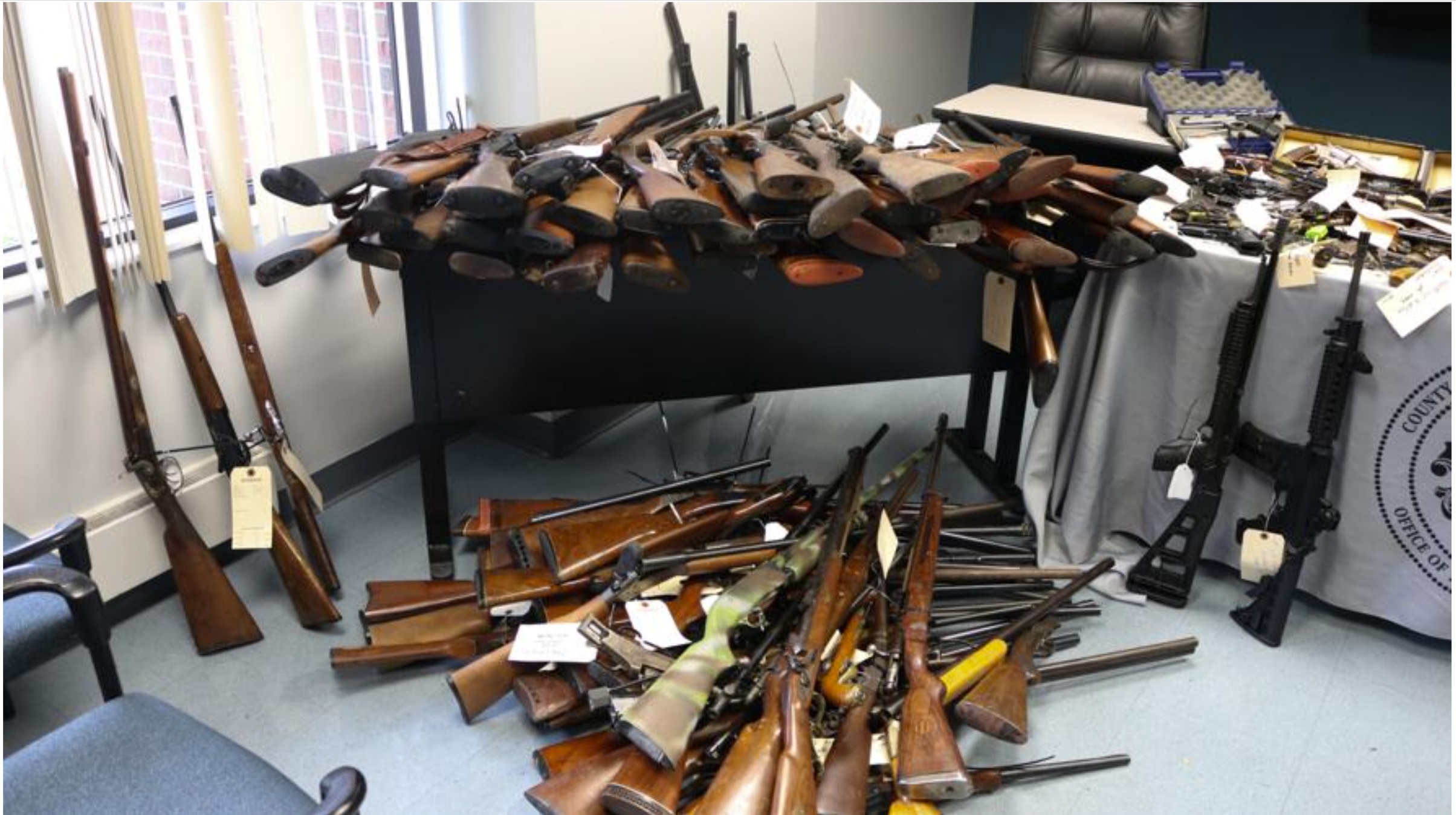
Flintlocks, black powder percussion guns, hunting shotguns, single shots, highly collectible and valuable Veteran bring-back guns from Europe, all said by DA Terry Houck to be dangerous. And yet…none of these are associated with crime. And therefore they are not dangerous.
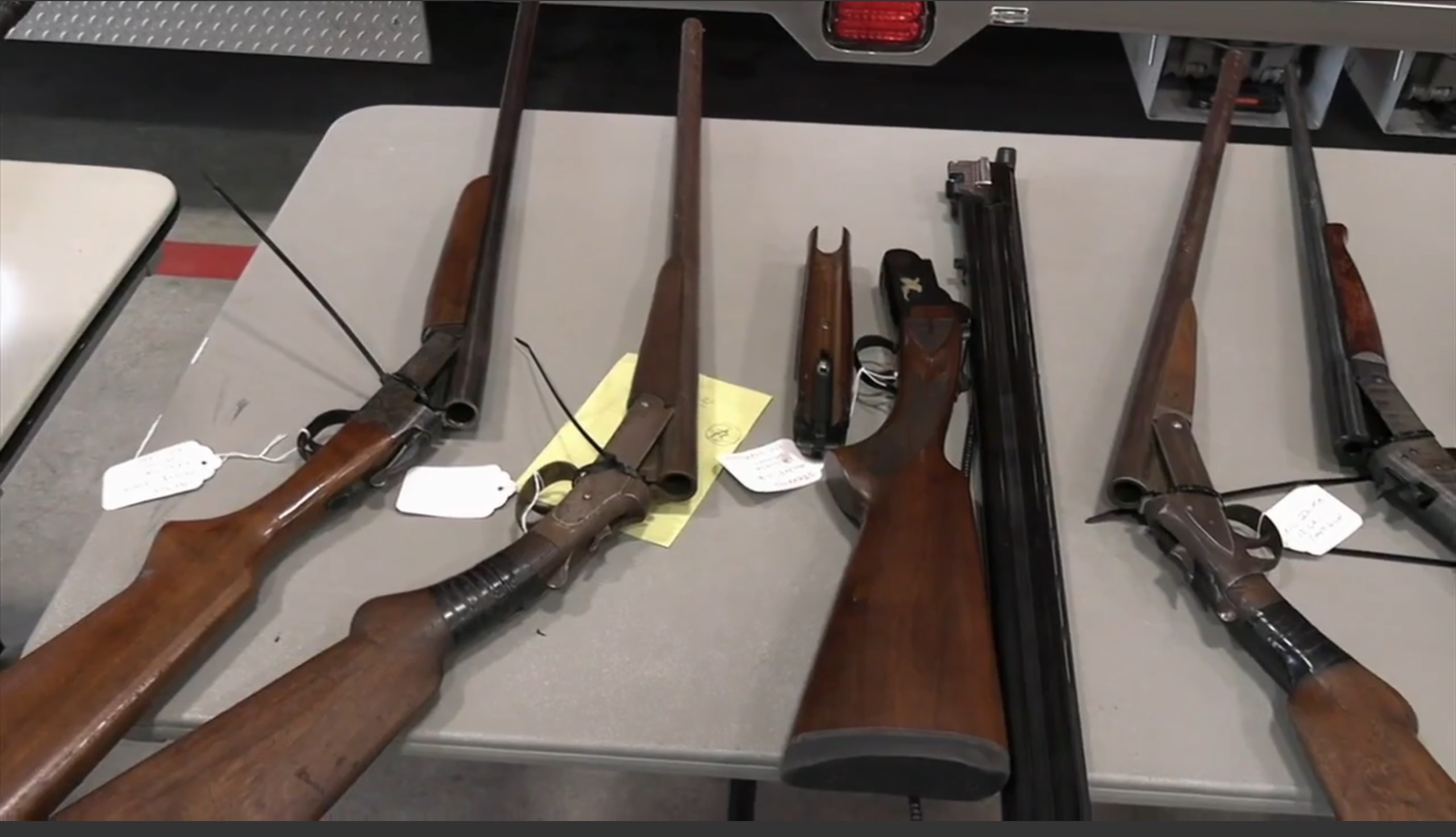
These are not the kinds of guns used in crime. Simple single shot shotguns and one really valuable over-under hunting shotgun, all destined to be destroyed. For no public benefit at all. Just to make fools feel good about themselves

If you stand in front of a camera and talk like a parrot, are you a journalist? Priscilla Liguori asked no questions, committed no acts of journalism in the making of her report about Northampton County’s gun purchases. One more big mainstream media failure

The green-colored gun is a Remington 20-gauge pump shotgun used for hunting birds and rabbits. The rifle at the far right bottom with the rounded pistol grip is a high value Veteran bring-back gun from Europe that never hurt anyone. The gun at the very top of the heap is a single shot black powder FLINTLOCK muzzleloader used to hunt deer; with 1790s technology, it has zero potential use in crime. Only hatred-filled firearm prohibitionists cheer on the destruction of these useful and safe recreational and collectible guns.