Posts Tagged → efficiency
Where is the Manual Override lever?
A friend of mine has a beautiful home filled up with high technology gadgets. Everything in the house is automated, including opening and closing toilet seats, lights, music, the kitchen wine rack, you name it; if it can be programmed to happen or turn on or off when a person enters or exits the room or uses the potty, he has it set.
First time I encountered this was at a party. It was funny and entertaining. I would experience something newfangled and robotic, comment on it, compliment my friend for his ingenuity, and then retreat to the pool deck or his living room to talk with a human being.
Then a year later he generously hosted me as a guest for a weekend as I ran for state senate, while he and his family were away. Every time I stepped into the kitchen, lights would turn on, the fridge would light up, or automatically open if I approached it, same with the coffee maker, etc. When the shower was turned on, music started.
No matter what I wanted to do, or needed to do, or possibly indicated a desire to do, the automated electronics tried to anticipate me and do it for me. Even the toilet paper dispenser was set to go, maybe not enough, but it tried to provide. Everything but the final act was done by the toilet paper dispenser, but then the guest room toilet also had a bidet feature, which if you are into that, can work wonders if set on “fire hose high.”
After that weekend, I swore I would try to avoid automation as much as possible the rest of my life. It unnerved me, because almost as frequently as the robotics were correct, they were then incorrect, and then annoying. Put another way, the first hour of that is Golly! amusing. The second hour is provocative, as the human mind tries to find ways to work around the now-annoying robots. After that, one becomes tired of the novelty, and a bit alarmed by all of the automated activity that occurs no matter which room one enters into, and what one really wants.
And there is no manual override.
Several years ago I made the mistake of buying a newfangled clothes washing machine. Our old one died, and I had run out of fixes for it. I could not find its two-way electric motor, used, even on eBay, and so it went out into the world of recycling.
Looking for that old machine’s fierce old-fashioned tear-your-arm-off churn of the washing machines we all grew up with, I accepted the salesman’s representation that this new machine could do that, if I programmed it to do it. And Lordy but does it have buttons for programming! It even can link up with your smart phone and be run from that, if you download that manufacturer’s spyware app.
I figured that with all of these sophisticated buttons and options, the machine could probably be programmed to write Shakespeare sonnets, much less really, really clean our family’s clothing.
Nope.
Turns out that the machine has programming for a high efficiency absence of cleaning water set at cold, and shame-on-you low efficiency absence of cleaning water, set at tepid, with the same weak, flaccid, slow, low-energy half-turn of the cleaning rotor as happens with the high-efficiency choice. And the churny-rotor thingy is a superior action to the lift-and-flop motion the machine is set to do from the factory.
Any mistake in trying to run a wash and then stopping it requires the machine to drain out all of the wash water and then start all over again. Which is a waste of water, and whatever electricity it used, and is usually an unnecessary step.
With this new, expensive, high tech clothes washing machine, you are stuck with a set of poor or poorer choices in how to maybe clean your clothes. The machine was designed and programmed by people who care more about energy and water efficiency than actually cleaning clothes.
Note to clothes washer manufacturers: We consumers buy clothes washers because we want our clothes to get clean, however that is done, whatever it takes, at whatever amounts and temperatures of water are needed, and with whatever rotor churn power is needed to knock the caked dirt off of my work clothes. We don’t want high efficiency water and electrictity use for anything other than thoroughly cleaning our clothes. And if the high efficiency settings don’t clean clothes, as they usually do not, then we want a choice in setting the machine to really kick ass and do what clothes washers are supposed to do: Clean. Really, really, super clean. At whatever cost in water and electricity.
And no, there is no manual override for this fancy washing machine. You the consumer are given an incomplete set of choices, and by golly, that is what you will learn to like, whether it is likable or not.
Last but not least among the examples of modern thingies needing a manual override, we have the new car belonging to the Princess of Patience. It is a 2026 Toyota Rav4 hybrid, being number four in a progression of RAV4s the Princess of Patience has owned and relied upon, with great enjoyment.
Heh, well, this latest and greatest iteration of the tried and true and much favored RAV4 inspires our gentle, soft spoken, always well considered Princess of Patience to say things like “I hate this %*$#@! thing. I want to set it on fire and leave it on the side of the road!”
Now, what could inspire such a harsh reaction to something so wonderfully modern and reliable as her new car? In a word: Technological automation.
This damned RAV4 has more technology than a fighter jet, and more automation than the Toyota car factory that built it. The technology is overwhelming, unnecessary, superfluous, and impossible to control, unless one has a degree in computer programming. The little turny knobs we used for the past seventy years for selecting radio stations and interior temperatures worked, ya know. Simple solution, hard to break, easy to tune. Not the new car technology! It is all touch screen, which is hard to see, inelegant, and clumsy.
This RAV4 tries to grab and pull into its computer motherboard every electronic gadget and phone that passes within fifty feet of it, then downloading and storing everything digital on said gadget and phone (to then download to Toyota so the car company can then sell and monetize our most personal information). This car also has every kind of Nanny pseudo-safety feature automatically built in that a weenie sheltered mama’s boy could ever dream up.
The car beeps and chimes and dings if you swerve one inch into the road dividing line. It will also automatically swerve away from any car or dividing line it believes you have mistakenly turned towards, even if you are swerving to avoid a deer standing in the middle of the road, but end up hitting the deer instead, because of the car’s automated correction system.
Ditto for coming anywhere near another vehicle while driving or parking. Last week my left wrist was nearly broken because of the force it hit the steering wheel with, as the car automatically and harshly jammed on the brakes to “save” us from hitting the rear end of a car that was turning into an alley in a congested urban area. We were plenty far enough away from the other car’s bumper, but to the RAV4, we nearly died, and it saved us.
Whoever programmed this car’s automated sensors and driving instructions obviously never drove in Brooklyn, New York, where urban combat driving is the norm and clearances between moving and parked vehicles and with buildings and humans are all measured in tenths of inches. To everyone’s satisfaction. But not to this car!
If I were to try to drive this 2026 RAV4 in a place like Brooklyn, I would leave a trail of destruction and mayhem behind me, on account of the automated driving and “safe reaction” nanny settings programmed into the car. The car would swerve to avoid one perceived obstacle, and then take out two grandmas, a stroller, and a partridge in a pear tree in one full swoop, just to stop me from maybe hitting something. All while the damned thing scans my eyeballs and my brain for what music I might possibly want to listen to at that second.
Folks, there is just too damned much technology and automation and useless gee-whiz gizmos in everything we use. It is all working against us, against our interests, our choices, against our humanity. It is a reflection not of us and our choices, but of the weak and highly risk-averse fairies who program these things before we start using them. And there is no manual override for any of it.
Not everything analog is bad, and hardly everything digital is good. The deeper we go into digital everything, the more we want some of that old analog world back. It was easier, more user friendly, did more with less, easier to maintain, lasted longer and broke a lot lot less than the digital crap.
You want a tamper resistant and theft-proof vehicle, that does what you tell it to do, when you want it? Get a manual stick shift. That is what I want in my next pickup truck, if only to be able to regularly give Third Gear to The Man.
My dream clothes washing machine is from 1999
In the past twenty years- plus, an aggressively misleading effort has been shoved down our American freedom-loving throats that the only home appliances we should ever want to own are so energy efficient and water efficient that they don’t actually achieve the results they are made to achieve.
Mostly we are talking about clothes washers (washing machines), although dishwashing machines, ovens, and even microwaves and toaster ovens have been bastardized on the false altar of “efficiency.”
What I miss most about washing machines are two things: A powerful agitator, and a manual override so I can select exactly the combination and level of functions I myself believe best fit the clothes I have placed in the clothes washing machine. I miss these two aspects that were basic to washing machines up until about 1999-2000, because absent them, it is now almost impossible to find a washing machine that actually and fully cleans my clothes.
All electronic/electric clothes washing machines sold today are extremely water efficient, and also extremely energy efficient. For those who struggle with what we are talking about here, neither water efficiency nor electricity efficiency will clean your clothes. You need lots of water and energy to clean clothes in a modern washing machine. Water and electricity efficiency means less of both key ingredients, and energy-efficient machines will not clean your clothes. High efficiency will result in your clothes being far less clean than they could be, were we using a real basic washing machine from 1999.
Today’s washing machines use so little water that the clothes bathing in it are essentially just getting dirty over and over again. Insufficient water is used to actually clean the dirt out of your clothes and hold it in suspension. And the low-electricity thing is just as ridiculous, because the impellers that have replaced agitators do absolutely nothing to actually clean your clothing. What agitators are available on the market are pathetic, limp-wristed little creatures.
Watch an old-fashioned agitator at work. The water is flying everywhere, the clothes are being pushed violently in the water, and your eyes can see that the clothing is being bathed in a lot of water that is also moving very aggressively. That is how clothes get clean.
Now go watch an impeller do its thing. An impeller kind of limp-wrists a pizza throw. It is a half-hearted effort to move whatever is on it. It hardly moves the clothing or the water. I have put folded clothing and sheets and pillow cases in our “deluxe” washer with an impeller, and with the alternative mini agitator, and after the longest possible wash cycle, the objects are removed just as neatly folded as they were when they were placed in the “washer.” Yes, they are wet, but they were not moved around, and the dirt that was lodged in them before they went into the washer is just as lodged as it was in the beginning. In other words, impellers do not work, and claims that they are just a more efficient type of agitator are BS. Your own eyes will tell you this, and probably your nose, too.
And today’s agitators are so small, with such pathetically short turns (guessing about ten degrees of arc) that they, too, do very little to wash the clothes surrounding them.
Why are Americans being fooled into buying electronic appliances that do not work? Because people who think they are smarter and better than us have strong-armed appliance manufacturers to provide “efficient” items that use less water and less electricity than prior models. Yeah, it is true that these dish and clothes washers use less water and less electricity, and it is also true that their amount of clothes and dish cleaning also drops about 90% for the same effort.
The Maytag washer we mistakenly bought takes an hour and a half to do a “Normal” load of wash, and when it is done, we are lucky if the clothes don’t require a second wash. Maytag is not alone; it appears that all of the washing machines made today are just as weak and pathetic.
In other words, “efficient” washing machines are such bad cleaners that they require much more use (= more time, more water and more electricity) to achieve even a modicum of result. The now old fashioned washing machines kicked the crap out of our clothes in a large amount of water, and in about fifteen minutes our entire load of laundry was done. And in fact the formerly dirty clothes emerged very clean.
So my dream washing machine today is one from 1999. It has simple analog turn dials, very few gidgety-gadgety electronics or computer chips, and the entire thing is one big manual override. Every choice I make is because I want that choice and that outcome. The machine makes no choices for me. It is also a top-loading drum that holds enough water to actually wash the clothes that are placed in it, and it has a powerful enough agitator that sweeps far enough (at least a 30 degree arc, and 60 degrees of arc is even better) and aggressively enough to actually knock the dirt off of my clothes and push it into suspension in the abundant water.
That is how we clean clothes with a washer. Anything else is just getting the clothing wet.
When it comes to cleaning my clothes, I really don’t give a cr@p about water efficiency or electrical efficiency. I want performance. The job has to be done right, and whatever it takes to get the job done right is what should be put into the job. Lots of water? OK. Lots of electricity needed to push a powerful motor that churns a strong agitator? OK.
High efficiency? No thanks. I will take the very low efficiency and highly effective washing machine, please.
It is hilarious and also a little spooky that what used to comprise the most basic washing machine that cleaned the most clothing with the least amount of effort is now sold as a machine with “lots of bells and whistles.”
I can’t believe we consumers have to write things like this, because it all seems so self evident. Then again, literally everything surrounding us Americans has been hijacked for some “higher purpose” that ends up leaving us and our needs in the dust. Because the people who push this garbage are “better” than us and “smarter” than us, and they think we are dust, over whom they must exercise heavy manual control.
Funny how symbolically asymmetrical this all is. Like a washing machine that in the 1960s symbolized how advanced America was is now a symbol of how screwed up America has become, and all because of the Left’s extremist politics.
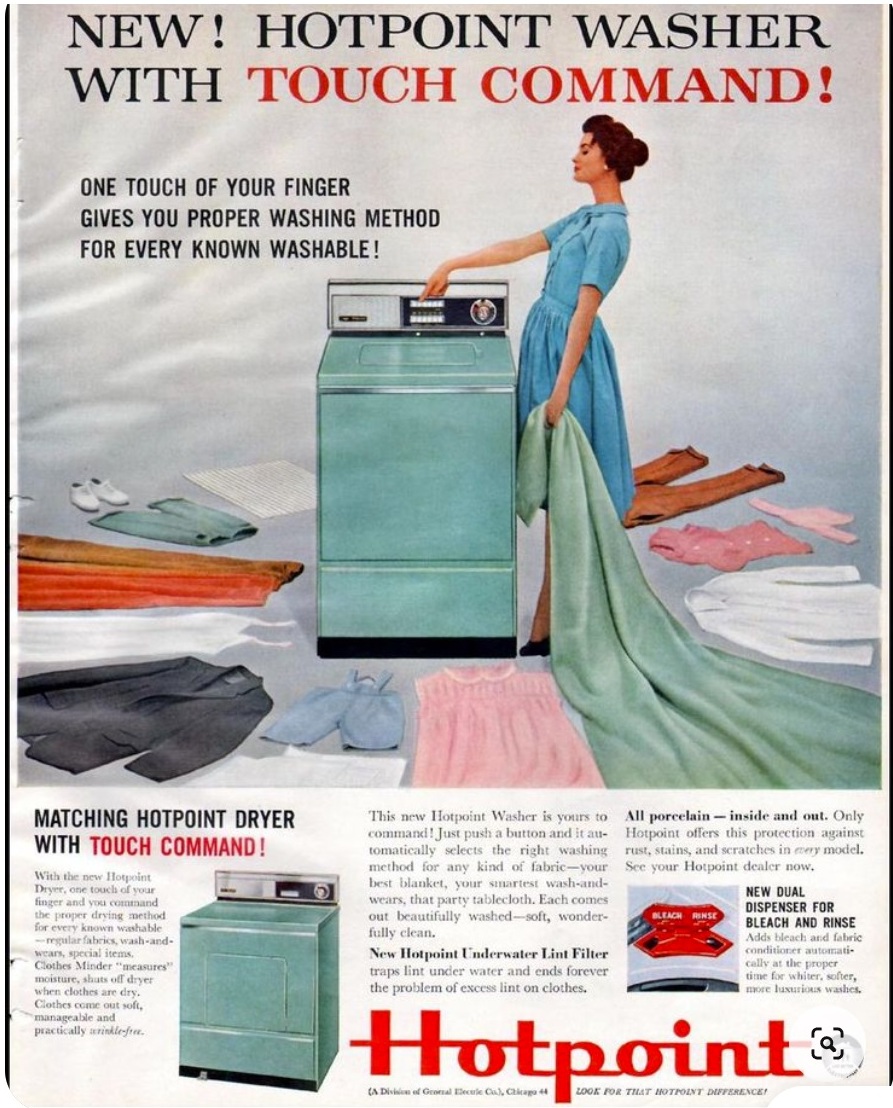
By the late 1950s and early 1960s, washing machines had reached their zenith of effectiveness
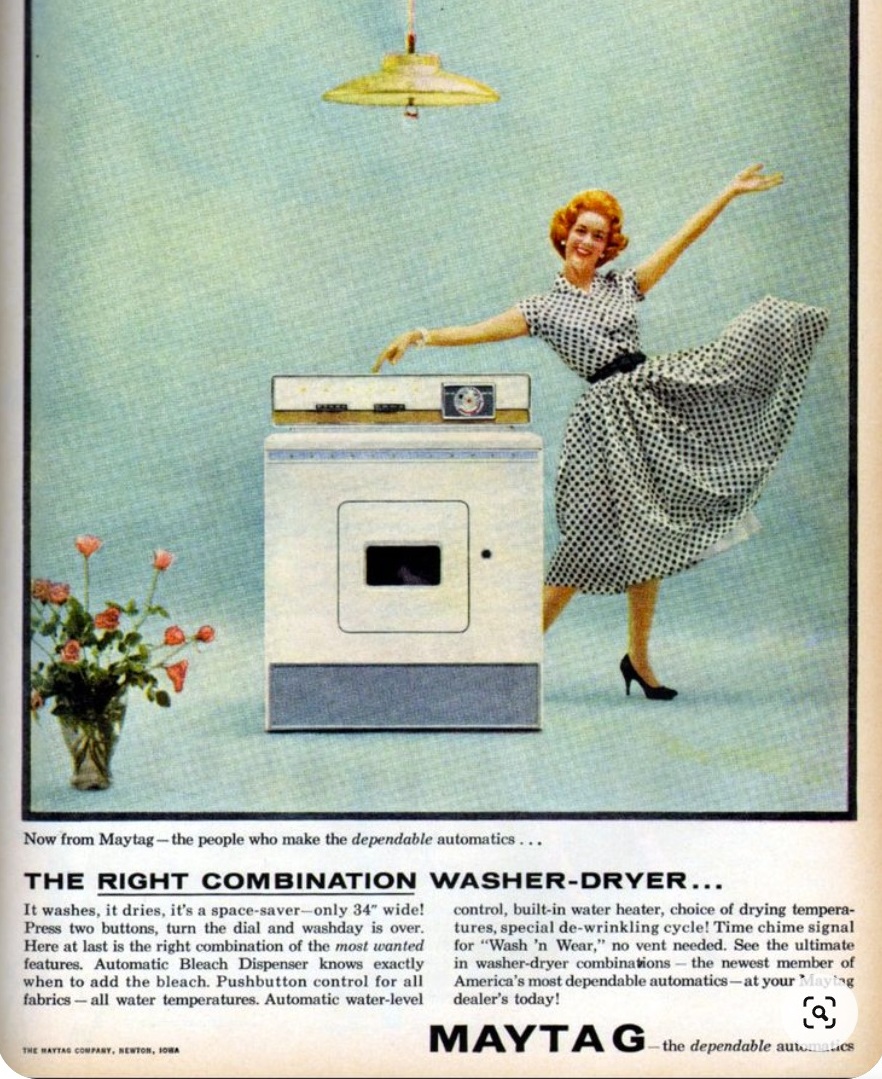
If I could get a “modern” and “high efficiency” washing machine to work half as well as this 1960 model, I would put on a dress and dance around, too
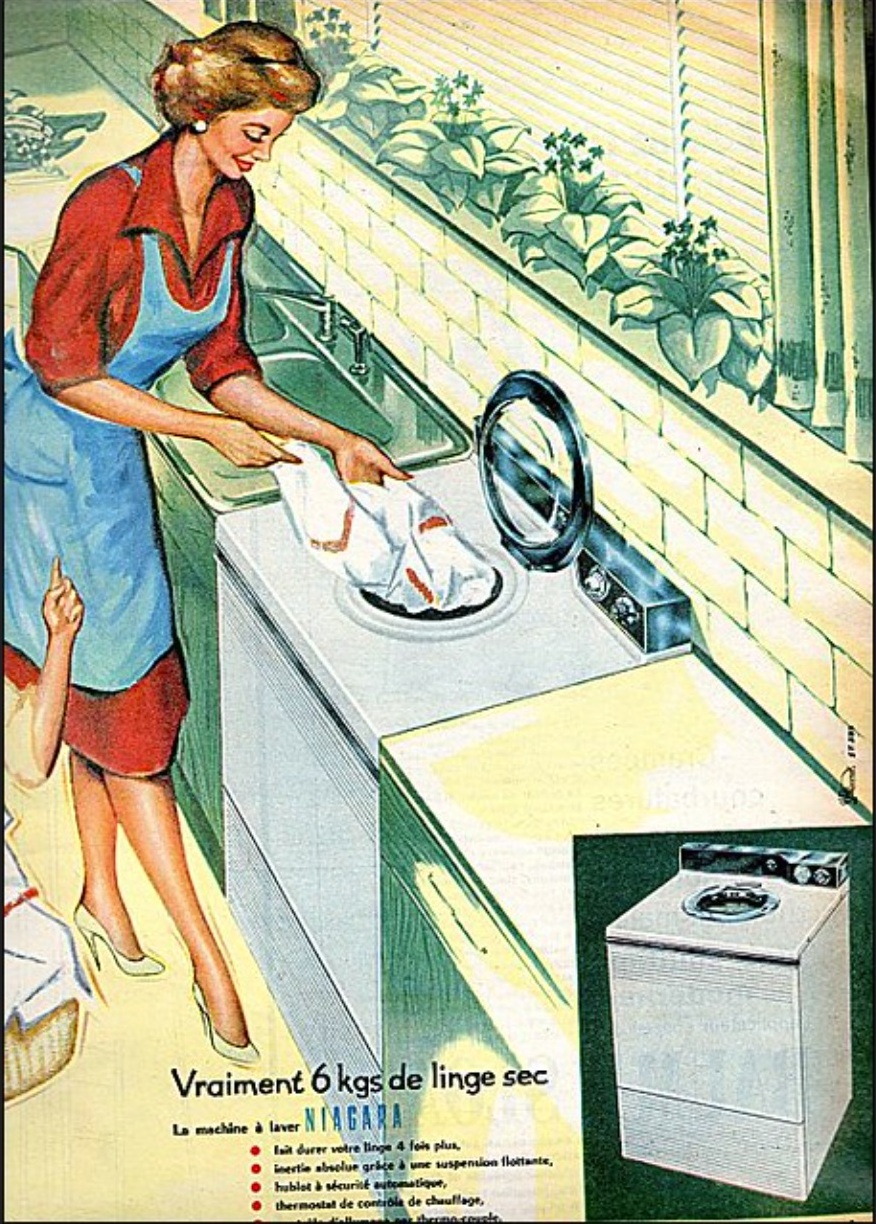
Imagine doing laundry dressed like you were ready to go out for dinner. Oh the painful irony that our grunge-dressing culture embraces crappy washing machines that in fact don’t get the grunge out of our clothing. Some things in Western Civilization were definitely much better in 1961 than now. Probably a lot of things.