Posts Tagged → department store
Portrait of an American Man
Across America, tourists visit all kinds of special places, built and natural. Across America, university campuses are home to special academic buildings, donated by successful business people who graduated from those same colleges. Probably everyone who visits and studies at these places take them for granted, except the conservancies, land trusts, and other caretakers charged with the operations and maintenance jobs.
Here today, we look at one of these historic donors, who built and donated one of America’s most famous architectural statements. He was a successful businessman from humble beginnings in Pittsburgh, Pennsylvania.
Back in the 1920s and 1930s, the heyday of department stores, which were the internet/ Amazon/ eBay of their time, his family went from owning small clothing, fabric, and hat stores to one big department store in downtown Pittsburgh. The enormous store was famous for carrying everything that every household required, in grades, qualities, and prices that every household could afford. Foods, clothing, fabrics for making clothing, pots, pans, utensils, firearms and ammunition, fishing gear, shoes, work boots…the list is endless.
Incidentally, in the 1970s State College, PA, where I grew up, the O.W. Houts department store, out at the Western very end of College Avenue, carried everything a family would need, including old coins, stone arrowheads dug up in the local farm fields, records, a wide selection of utility-grade firearms (where I got my first .22 single shot rifle and a 16 gauge single shot shotgun), clothing, shoes, food, etc. Next door was the Houts Hardware store and Lumber Yard. They sold nails by the pennyweight, tools, keys, and of course all kinds of locally sourced lumber.
Despite its relatively small size, the O.W. Houts department store and hardware store were absolutely core parts of the State College area lifestyle. And so we can imagine what the gigantic Kaufmann Department Store was like in Pittsburgh, many many times the size of Houts. The wives and daughters of coal miners shopping for calico two aisles over from the wives and daughters of coal mine owners shopping for lace and fur trimmings. 1920s Pittsburgh was a gigantic melting pot of iron, steel, and fifty different nationalities from around the world, and everyone got most of their necessities from the Kaufmann Department Store.
Edgar Kaufmann built the family business from the ground up, taking big risks and making big sacrifices along the way, and became exceptionally wealthy. His family upbringing emphasized giving charity, which he did in large amounts throughout his life. The one charitable donation he is best known for is Fallingwater and its surrounding Bear Run Preserve.
Below is Edgar Kaufmann’s portrait, done in 1929, and occasionally on display at Fallingwater, which is where I photographed it. It is filled with meaningful symbolism and clues to his personality and outlook on life. Below is my understanding of this statement.
Edgar is standing between two potent symbols, the (Christian?) alms bowl (charity) to his right, and the carefully shielded Middle Eastern crescent moon, on his left. This moon would be his own background, of the desert, partially obstructed by cloth, that is slightly pulled back to both cover it, and also reveal it by drawing the eye to it. Cloth being the most representative symbol of his department store’s biggest staple as well as its famous fashion statements.
He is holding a rustic walking stick in his dominant right hand, which puts emphasis on the importance of this simple cut branch. Yes, it is a humble symbol of hiking and the outdoor lifestyle, and it also has the V top for holding venomous snakes’ heads. The other venemous snakes in 1929 were the Nazis, and maybe this is his way of saying he would be seeking to catch them and pin them down. Or that he was at least aware of them in his life.
Edgar’s left arm leans heavily on the chair, perhaps a symbol of his never-ending work ethic stuck at a desk.
The chair’s right side, Edgar’s outdoorsy, charitable, artistic, manly, masculine, and muscular side, is well carved, carefully defined. Its left side is deliberately stunted and malformed, as if to say that his outdoors life and his charity work defined him best, and his boring work life was his least interesting aspect. Don’t we all have have different sides to us and to our personalities?
His sporty tennis sweater says all-America, while his shirt sleeves are pulled up to reveal his manly biceps. The tennis sweater is Harvard red, instead of the blue from his alma mater Yale. Something must have happened at Yale to make him upset with the school.
Edgar Kaufmann conveys an image of American masculinity straddling two worlds, one of which he must subtly hide. And the reason I picked this portrait to write about is because nearly 100 years after this was painted, America is back to that 1929 period, where American Jews have to hide their identity, lest they be hurt, abused, robbed, for merely being Jews. This is not a good reflection on Americans, that we have come back to this kind of un-American behavior.
Edgar was a political conservative, but a cultural libertine..another personality split some readers might relate to. He helped design, build, lived in, showcased, and then donated Fallingwater through his son, Edgar jr, for public benefit. Across America, so many historic tourist attractions and artistic buildings were created or donated by Jews, as were an awful lot of the donated buildings at universities. We should be celebrating this ethic, not picking on these people as a whole.
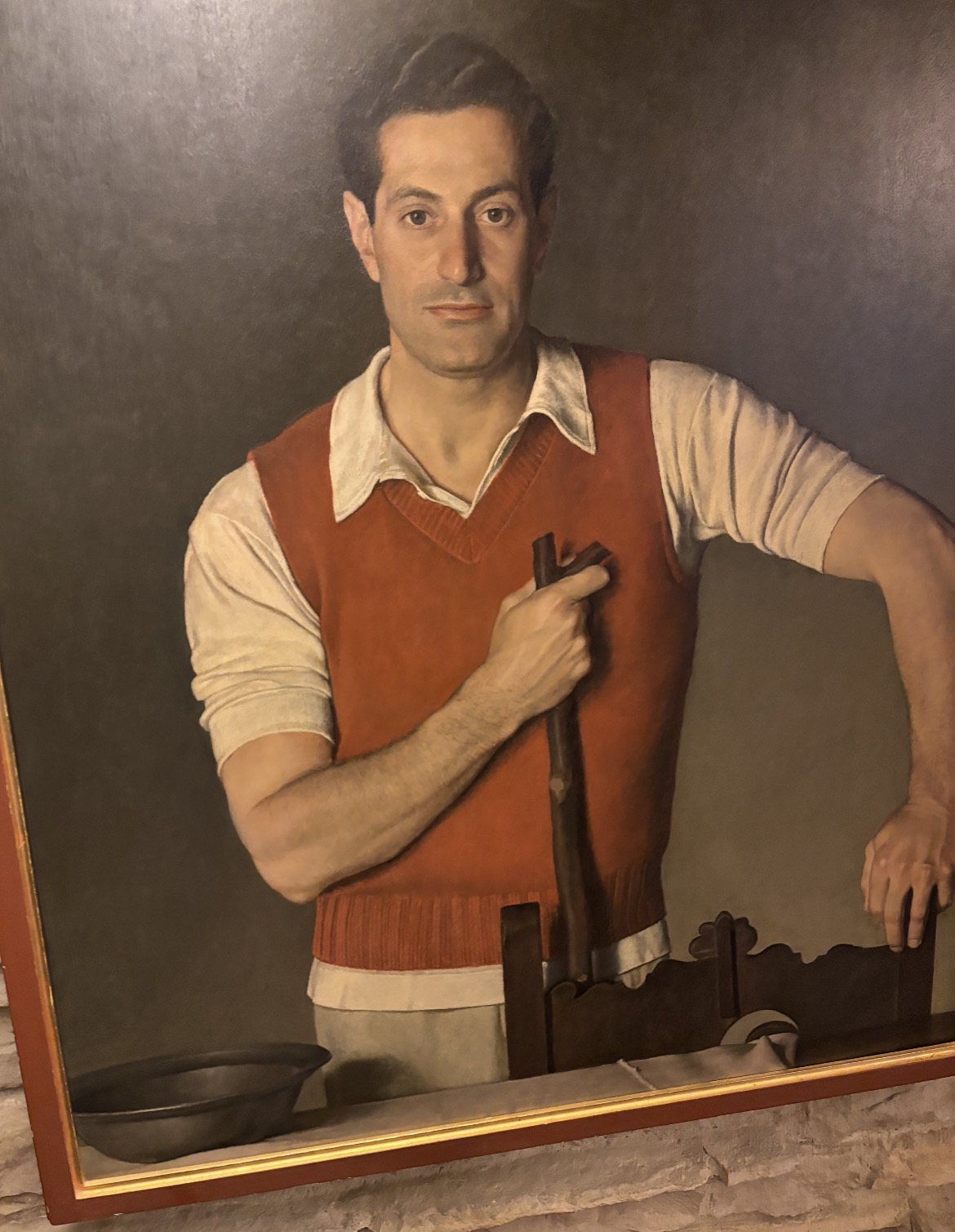
Edgar Kaufmann