Posts Tagged → deer
Review of Kirschner’s deer lures
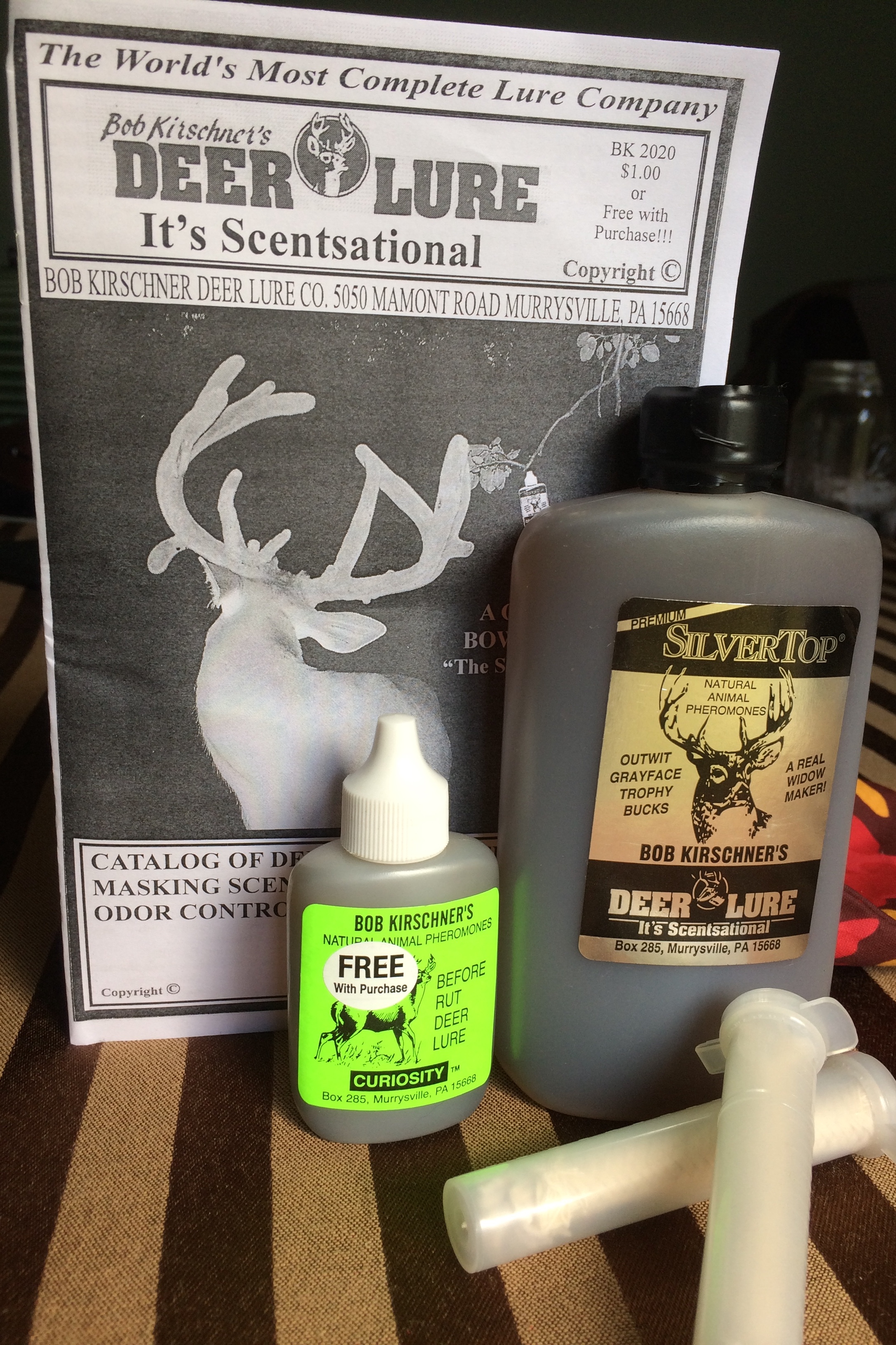
The whitetail deer rut is now under way across the Americas, and although writing about politics (especially a handful of days before such a momentous Election Day) is the bread and butter of this blog, man does not live on bread alone. Occasionally there must be a beverage. And Kirschner’s deer pee lure is it.
Twenty years ago I first met Bob Kirschner at the Pennsylvania Outdoor Show at the Pennsylvania Farm Show complex, in the traditional archery section. Among a slew of often cantankerous iconoclasts (think about the kind of people who hold onto traditional archery against the tide of ultra high-tech training wheel bows), he was a funny guy. As in kind of odd, as in not a huckster or a salesman, but almost shy.
Even though he was surrounded by a big display of his wares, which included his own videos on how to bowhunt wary deer using his unique deer pee lures, Bob was not a hard selling, fast talking circus barker. Instead, he seemed almost embarrassed that he had to take your money at all. Such is the way of the pure hearted, because of all the deer pee lures out there, Kirschner’s is among the very few that are worth anything. And that is because his pee is pure. No jest.
Somewhere at camp I have one of his videos that shows him making his deer lures. In one scene he is wearing a work smock, a big toothy grin, and carrying a large tub of deer legs sticking out in all directions. Each of those legs has a tarsal gland on it, which deer use to communicate with each other through their highly refined sense of smell. Bob painstakingly cuts out each gland and grinds it up into a paste, which forms the base of his very smelly deer lures. This takes a lot of work and a lot of time.
Contrast Bob’s laborious hands-on process to the over-the-counter stuff sold by the gallon at the big box stores. Not to knock anyone in particular, but my experience with many different brands is they are at best watered down versions of Kirschner’s lures, and at worst they are synthetics that don’t last very long and that lose their smell within a few months of purchase. Like Code Red and Code Blue….golly, guys, what do you put in your bottles? I do not think it is 100% estrus deer pee.
Somewhere a few years ago I saw an article about how much doe pee lure was sold nationwide, which is a LOT, like hundreds of thousands or millions of gallons, compared to how many penned farm doe deer there are, which is very few, and how a basic back-of-the-envelope calculation showed that the vast majority of “doe pee” lure sold in the USA is not actual doe pee. At least not 100%. Because the standards are so lax or even non-existent, what is sold as doe pee lure might only have 1% estrus doe pee in it.
There just are not enough penned farm deer to produce the vast amount of “deer pee” sold to hunters. Not even close. Which means that a lot of what is being sold as deer pee lure is not.
And this sorry situation is NOT what Kirschner sells. He sells stuff that will curl your hair if you sniff it, because it is that nasty tarsal gland paste he made mixed with actual pee from his own pet deer. No, you don’t want to ask how he gets the deer urine….same story with foxes, coyotes, and bobcats, all of which are kept in farms where their excrement is collected and made into lures for trappers and hunters. It is all expensive stuff, and it all works very well.
From the time I bought a small squeeze bottle of Kirschner’s SilverTop at that year 2000 outdoor show (what is now the Great American Outdoor Show, which will not be held in 2021), until four years ago, when it ran out, I killed a PILE of deer coming in to his lure. When I say a pile, I mean a literal pile, like piles of deer stacked like cord wood in the back of my pickup trucks. How, you ask? Answer: I get as many DMAP and doe tags as possible, which might number ten each season, and then usually fill 75-100% of them from archery season through the late muzzleloader season and late shotgun-only season in southeast PA.
Then I ran out of the Silver Top, which only required a few drops on a tampon hung on a tree branch each time hunting, and so it had lasted so very very long. And I thought, “Why not try some other brands, see what they can do, how they work.”
And what I found was that not one other deer lure has worked anything like Kirschner’s in the southcentral and northcentral regions in which I mostly hunt. Not even close.
Bob Kirschner tells me that very few people make deer lure like he does any longer, and at age 74 he is about to hang up his spurs from his incredibly physical work. He says that some Amish farms are beginning to make deer lure the way he does, and that they will have to take up the slack when he shuts down his operation (hint hint young people out there, here is a chance to run your own business and have fun).
So I bought an 8-ounce bottle of Kirschner’s SilverTop the other day, and I am hoping this will last me a good twenty years. How can this one bottle last so long? Because only a few drops are needed each time out.
Here is another hint to hunters: Don’t overuse deer pee lure. It does not need to be sloshed about by the bucketful, and it should only be used during the actual rut, which is end of October into mid-November.
When hunters mis-use deer pee lure, either by using too much or by using it in early October, they are desensitizing deer to their world of smell, and instead of luring in deer, they confuse them and make them cagey and wary.
Using too much deer pee or using it at the wrong time eventually trains deer to stay away from it, or to be skeptical of it.
Two years ago I watched a Maryland hunting guide set off an enormous bottle of “Buck Bomb” for a youth hunter, which filled our woods with a chokingly sick scent that vaguely smelled like doe estrus. One buck was eventually brought in, a nice eight point, but he was so suspicious that he literally ran up to within 75 yards, looked around, and seeing no doe, turned and ran like hell back to where he had come from. Using too much of a good thing is not always a good thing to do, and hunters will do better in the short term and the long term if they are much more judicious in their application of deer pee lure.
So, there, that is my endorsement of Kirschner’s deer pee. I get no royalties, kickbacks, baksheesh, or remuneration from this essay. In fact, I hope Bob does not read it because he will probably object to being called shy. I write this out of simple admiration for a well done product that has made me a very happy hunter for a very long time, and I hope you get some, too. Just use it correctly.
Good luck this season. Have fun and be safe!
Eugene DePasquale vs. PA Sportsmen
Until a few years ago, Eugene DePasquale was to me just another career politician who was making the rounds of political seats in Pennsylvania, with his eye on the eventual governorship. There are people in both the Republican Party and Democrat Party (I used to be a Democrat) who do this, so I am not going to hang this boring and nettlesome practice around the neck of one particular political party.
Political careerism in a republic like America is inevitable, and while it bothers most voters, those same voters also overwhelmingly re-send their own elected representatives back to office repeatedly. So the idea of term limits is only as good as the voters are willing to make them, themselves.
Don’t like career politicians, most of whom make a hundred promises and say one thing and then do another thing altogether? Then stop voting for the same damned people over and over and over again. This power to inflict term limits is held in the hands of the voters in every election. But like old married couples who argue with one another and poke at each other with their canes, voters eventually become comfortable with the career politicians in their own lives, and repeatedly send them back to office, even while finding their voting record or behavior disagreeable. For whatever reason, this is especially true with registered Democrat Party voters. Senator Bob Casey , Jr. is probably Exhibit A in this phenomenon, because you cannot find anywhere a more do-nothing guy career politician than Bob Casey, Jr., who nevertheless keeps getting re-elected, despite having zero to show for his time on the taxpayer dime.
Eugene DePasquale is another example of this phenomenon, an Exhibit B of revolving door careerism, hunting down one political seat and then moving on to the next. I am unaware of DePasquale actually having a real world job. Ballotpedia lists his biography as:
“DePasquale received a B.A. in political science from the College of Wooster, an M.P.A. from the University of Pittsburgh, and a J.D. from Widener University School of Law. He worked as an attorney and for the City of York as director of economic development. DePasquale then worked as deputy secretary for the Department of Environmental Protection. He also served as chair of the York County Democratic Party from 1998 to 2002.”
In other words, DePasquale’s actual real-world, hands-on life and work experience is about zero, or it may be zero. Candidates from either political party like DePasquale sicken me, because they are power-hungry and their policy lens is shaped entirely by what others (donors, political bosses) tell them to think, or worse, by what they believe will sell to the most voters. This is how we get such polarized political contests; candidates whose entire adult lives and professional careers have been in an insulated, unaccountable womb, where they are being groomed for the next step.
Yuck yuck yuck.
I met DePasquale once, a couple years ago, at a sportsmen’s round table he held in Lewisburg, PA. He was there at the urging of a lobbyist close to him, and to his credit he sat down with about ten of us from around the state, to discuss two things. First subject was his audit of the Pennsylvania Game Commission, focusing on the deer program, including chronic wasting disease, and the collection and use of royalties from oil, gas, minerals, and timber removed from State Game Lands. Second was his openly anti-gun public policy position, which he had found creative ways to implement or promote through his role as Auditor General.
In our discussion with him that day, DePasquale struck a severely cagey disposition. You could just so easily tell that our comments on his various positions and doings were passing right in one ear and out the other. He did not care. This was a perfunctory meeting set up to give the appearance of a career politician listening to constituents, when in fact the politician was probably thinking about dinner out with his wife or mistress or drinking buddies.
DePasquale evinced little concern that his obviously political investigation, designed to burnish his own credentials at the cost of whatever happened to get damaged in the process, could really hurt the PGC. And especially damage both its science-based deer management and its erstwhile political independence. Erstwhile, because as DePasquale’s Grand Inquisition into the PGC books showed, no public agency is bulletproof against meddling politicians. Had PGC officials or staff mis-spent public money, then by gosh fry ’em.
But of course, DePasquale found nothing that the PGC’s own regular annual audits had not found. And thus, the PGC did not have to change course on a damned thing it was doing. But DePasquale benefited politically from making it seem that he had possibly found something. And that is where I come out on this election he is in.
Here we have a candidate who has almost zero private work experience, who is 99.5% a political party construct and product, who has been sucking at the taxpayer teat for his entire career in one role or another, who tried to damage Pennsylvania sportsmen’s interests for his own political gain, running against incumbent congressman Scott Perry. To me, there is little to nothing compelling or exciting about Eugene DePasquale. He is another career politician drone who could be from either political party, except that he hates guns, used his elected position to beat on gun owners, and tried to hurt Pennsylvania sportsmen by hurting the PGC.
In great contrast to DePasquale, his opponent, Scott Perry, has been a complete champion for gun rights, AKA our Constitutional rights. He does not blame law-abiding citizens or manufacturers for other people’s criminal acts. And he has had a whole career in the private sector, including as a small business owner, prior to becoming a politician. I admire these two things about Scott Perry. Yes, yes, yes, I know, I know, I know, he also served in the military, as a chopper pilot, at a high rank.
I am one of those voters who only gets excited about a candidate’s military duty when it shows real gumption and leadership, and I guess Scott Perry has that. But it is his real-life business experience, his willingness to work hard, take risks, and make sacrifices that impresses me the most.
In contrast to Eugene DePasquale, whose biggest risks were wondering which pressed suit to wear to whatever fundraiser, and whether it was worth it to burn the Sportsmen enough to impress his gun-grabbing supporters to a degree that they would really, really write him bigger campaign checks.
In this election for Congress, it is not even close. It is Scott Perry who is the best candidate. That is who I am voting for. The other guy DQ’d himself a long time ago.
Father’s Day
Today is Father’s Day, the day we celebrate our dads, the people who helped us grow into young men and women. For thousands of years, fathers have been the protectors and providers for their families, and they have traditionally been the source of life-saving wisdom and decision making. The lessons and skills they teach their children, especially their sons, are essential for living life properly.
Thank you to my dad, for teaching me to use a chainsaw and an axe from a young age. For giving me the childhood chore of splitting and stacking firewood all summer long, so that our family would have heat and comfort all winter long. Other chores included weeding the garden and shooting pests like chipmunks, squirrels, and groundhogs, all of whom could easily do tremendous damage to the garden in just minutes. And while these chores trained me in self-reliance, hard work, and planning ahead, it was the one thing that dad would not let me do that probably shaped me the most.
Although my dad comes from a hunting family, he himself did not and still to this day does not hunt. Oh, he appreciates wild game and will eat it over everything else, given a choice. But when I started taking my BB gun on deer hunts with neighbors at age eight, my dad always told me I had to get close to the animal to shoot it. As I grew into a young Indian or frontiersman out there in the wilds of southern Centre County, I was prohibited by dad from topping my rifles with scopes. Only open sights were allowed. He said using only open sights taught me woodcraft, requiring me to get close to the wild animals I wanted to harvest, before taking their lives.
“It is only fair,” he said. “You can’t just assassinate unsuspecting wild animals from hundreds of yards away. If you hunt, you must be a real hunter. You must get close and take the animal with skill, on its own terms, where it can see, hear and smell you. That is fair.”
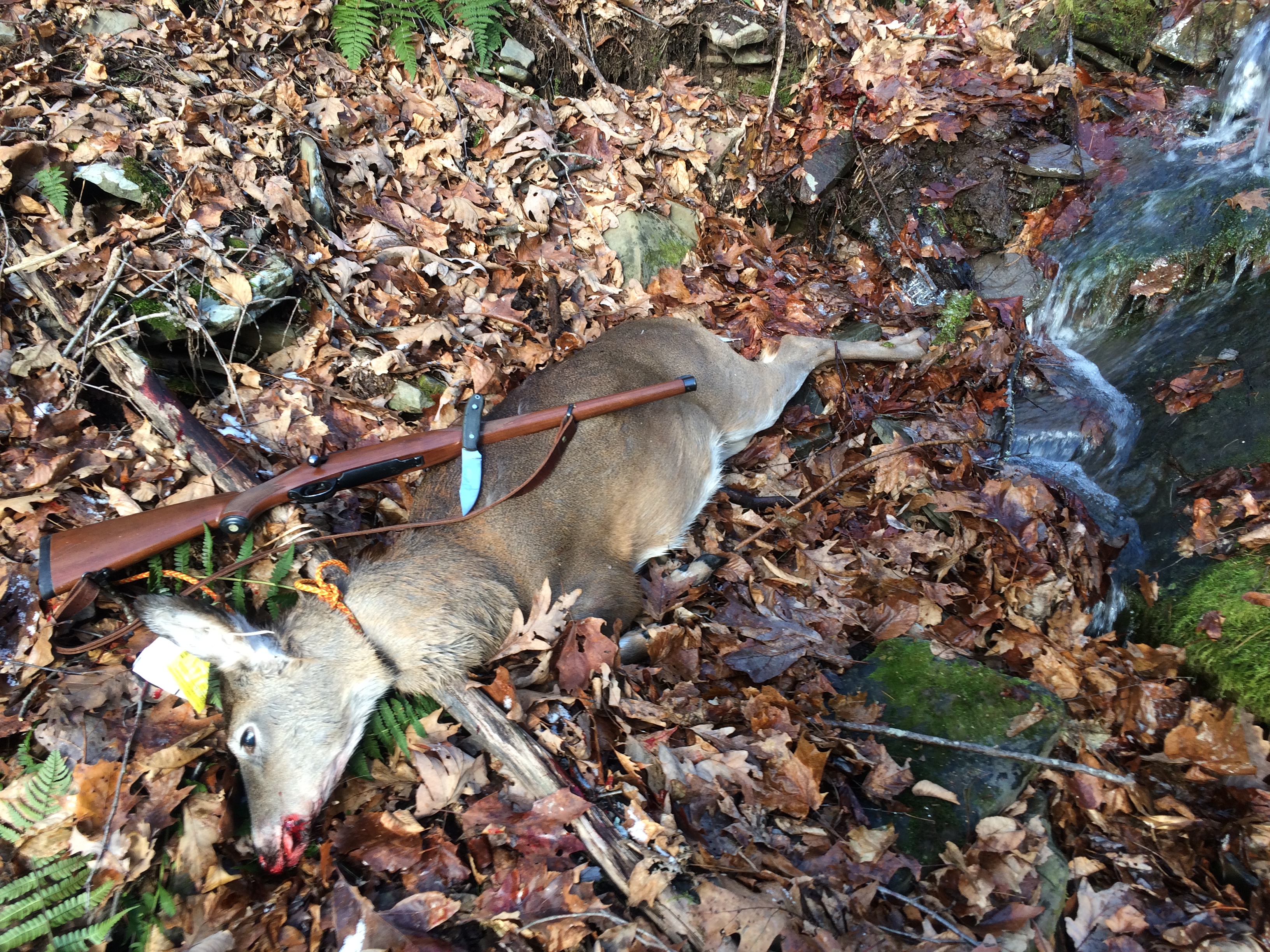
And so last deer season, on a steep hillside deep within the Northcentral PA state forest complex, all of those lessons and preparation came together in one quick, fleeting second. I did the Elmer Fudd thing all alone, quietly sidehilling into the wind, trying to live up to Dad’s dictum. One cautious, slow step at a time. Eyes scanning ahead, downhill, and especially uphill. Ears on high alert for any sound other than the wind in the leaves. Big bucks that are bedded down high above where the puny humans might slip, stumble, and walk, are most likely to flee to higher ground when one of us Pleistocene guys shows up too close for comfort. Deer might hear or smell us coming a long way off, or they might see us at the last second because we are being quiet and playing the wind right, but they know that within a hundred yards or so, we can kill them. So they flee uphill, and in stumbling up against gravity and slippery things underfoot they give us shot opportunities we would not otherwise have.
And so when the strange <snap> sounded out ahead of me, just over the slight rise that led into the large bowl filled with mature timber and rock outcroppings, and an odd looking animal bolted down hill almost bouncing like a fisher, I quickly backpedaled.
Anticipating where the deer would emerge about 130 yards below me, I quickly and also carefully walked straight backwards to where a natural slight funnel in the ground provided a clear enough shooting lane down through the forest to a small stream bed. Anything passing between me and the stream would be broadside at moments, providing a clear shot through heart and lungs if I took careful aim.
And sure enough, the big doe filled one of those spaces so briefly that I don’t even recall seeing her. All I do recall is how the rifle butt fit carefully into the space between the backpack strap over my shoulder and the thick wool coat sleeve, and how the open sights briefly aligned with her chest. The thumb safety had been snicked off already without thinking, and the gun cracked. I fired the gun instinctively.
Quickly raising the binoculars to my face, the doe was clearly visible way down below me, lying fully outstretched on the forest floor just above the stream bank, like in mid-leap with her front hooves and rear hooves completely extended ahead and behind, except she was not moving. She was laying still, her neck fully stretched out on her front legs like she was taking a nap. I watched her tail twitch a few times and then knew she was dead.
Sliding on my butt down to her was more challenging than climbing up to where I had been still hunting her. Northcentral PA mountainsides are the most difficult terrain for humans, in my experience. It is topped with a layer of slippery leaves, then wet twigs and branches waiting underneath to act like oil-slicked icicles, ready to throw a boot way ahead of one’s body. If the wet leaves and branches don’t make you fall down, then the rotten talus rock waiting underneath the leaves and twigs will slide, causing you to either do an extra-wide wildly gesticulating split, or fall on your butt, or fall on your back.
So I scooted downhill to the doe, tobogganning on my butt on the slick forest floor, cradling the rifle against my chest, keeping my feet out ahead of me to brake against getting too much speed and hurtling out of control.
Arriving at her body, I marveled at how she resembled a mule. Her long horse face and her huge body were anything but deer-like. Her teeth were worn down, and she must have been at least five years old. The single fawn hanging around watching me indicated an older mother no longer able to bear twins or triplets. This old lady had done her job and had given us many new deer to hunt and watch over many deer years.
Normally, in such remote and rugged conditions I will quickly bone out the deer, removing all of the good meat and putting it in a large trash bag in my backpack, leaving the carcass ungutted and relatively intact for the forest scavengers. But this doe was so big that I just had to show her off to friends, and so after putting the 2G tag on her ear, I ran a pull rope around her neck and put a stick through her slit back legs, and began the long drag out.
This hunt has stayed with me almost every day since that day. I think about it all the time, because it was so rewarding in so many ways, and emblematic of being a good hunter. Not the least of which was the careful woodcraft that led up to the moment where the smart old doe was busted in her bed and then brought to hand with one careful shot as she loped away, far away. Just as easily I could have been a hunter clothed in bucksin, using a stick bow and arrow five thousand years ago.
Thanks, Dad, for all the good lessons, the chores, the hard work, the restrictions and requirements that made me the man I am today. Without your firmly guiding hand back then, I would not be the man I am today. And what kind of man am I? I am a fully developed hu-man; a competent hunter with the skill set only a dad can teach a son, even if it takes a lifetime.
[some will want to know: Rifle is a 1991 full-stock Ruger RSI Mannlicher in .308 Winchester with open sights. Bullets in the magazine were a motley assortment of Hornady, Winchester, and Federal 150-grain soft points, any one of which will kill a deer or a bear with one good shot. Binoculars are Leupold Pro Guide HD 8×32 on a Cabela’s cross-chest harness. Boots are Danner Canadians. Coat is a Filson buffalo check virgin wool cruiser. Pants are Filson wool. Backpack is a now discontinued LL Bean hunting pack, most closely resembling the current Ridge Runner pack. Knife is a custom SREK by John R. Johnson of Perry County]
My comments to the PA Game Commission
The Pennsylvania Game Commission board of commissioners will be meeting this weekend, to set next season’s dates and bag limits. Like many other people, I submitted comments by email last week. From past experiences with this, I know that the commissioners read comments and requests from the public. Some of my comments, and those of my son, have received direct feedback from various members of the board.
A key to getting the commissioners to read and truly consider your comments is to submit them with plenty of time for the recipients to read them. If you submit comments a day or two before the meeting, it’s a very low likelihood of anyone having time to read them. Also, try to keep comments short, to the point, and sweet. Comments with prolonged bitching, whining, and playing biologist when you have no training or education or even a novice’s interest in wildlife biology, are all ways to ensure that your audience at best glances at your comments.
“Dear Commissioners,
Hunting should be fun, and therefore our small game seasons should run unbroken from their Fall opening to their February close. Whatever long gone reason for the on again-off again pattern of small game seasons, Pennsylvania must create opportunities for everyone. No biological reason exists for hiccup-style seasons. Few if any other states have this odd pattern. Let’s just let our hunters have fun and hunt.
In that vein, please consider allowing bodygrip traps on running pole sets in our most rural WMUs. The idea that a loose domestic dog is going to get caught in a trap in the middle of a state forest wilderness is preposterous. Same is true on private land. Same goes for allowing snares. We need all the tools we can get to manage coyotes. With now three years of crazy freeze-thaw-rain winter weather cycles, it’s impossible to rely on footholds. Cable restraints should be allowed throughout the whole season, and snares should be allowed on private land and or on public land in the Big Woods WMUs.
Finally, please put one of our Sundays on the day after the Saturday bear rifle opener, and another Sunday on the day after the Saturday deer rifle opener. This will create the most energy and excitement for our hunters. Even better, make bear and deer rifle concurrent!
Thank you for considering my thoughts,
–Josh”
Deer season is mostly over…now what happened?
Everywhere I checked, deer season (rifle) was just…off… this year.
The deer were off their usual trails, off their usual habits, patterns, just not cooperating. People hunting up in the Big Woods and down in the farm country all said that opening day was the quietest they had ever heard.
“When I was a kid, opening day sounded like a war zone,” says Ed, a product of west-central PA and lifelong hunter.
“This year, I heard nine shots all day. What the hell is that about?” he says emphatically.
And how could I not agree? Heck, I recall 2005’s opener, because I warned a flatlander non-hunting new neighbor that it was going to sound like “Bosnia” around their newly acquired country retreat. And it did. And it was a rewarding feeling looking up into the snow-covered mountains and seeing blaze orange dots sprinkled all over the landscape.
This year, we heard four or five shots on opening Saturday and maybe two or three shots on Monday, up in the Big Woods. And yet plenty of deer were moving. Talk about strange! Totally uncharacteristic.
Might be that our hunters are aging out in larger numbers than we anticipated, or that too many are part of the “professional whiners club,” never satisfied with the deer we have, but rather longing for the bad old days of over-abundant deer that we used to have. And therefore not participating in deer hunting, as a form of protest.
I don’t mean to pick on people, but it is disheartening and frustrating to hear the unfair abuse some Pennsylvania hunters heap on the Pennsylvania Game Commission and on anyone else who supports the PGC’s science-based wildlife management. No question, there are fewer deer…and so what is wrong with that?
And in fact, due to the hunters opting out because they say there are not sufficient deer to hunt, the deer numbers everywhere sure appear robust to me. They aren’t getting hunted very hard, so they are naturally reproducing quite fine. But the harvest numbers are down everywhere I hunt, in both the Big Woods and the farm country. Maybe we will be seeing longer deer seasons as a result.
–Some Reflections–
Deer drives: Like bear drives that are so popular the week before deer rifle season, deer drives are a necessity if hunters are going to see deer. Deer are adapatable, intelligent animals, and after 20 years of concurrent doe-buck hunting, they have changed their behavior. Gone are the days when a hunter could sit at Pap’s stand and expect to fill a buck tag. Now, the deer are moving around old stand sites, or staying hunkered down altogether. It takes a boot in their behind to get them moving, and once they are moving, deer begin to make mistakes. If hunters are ready enough, they can exploit those mistakes and start filling tags.
But just sitting is a very tough way to kill a deer any longer, under most conditions. So try deer drives. Even a two-man “leap-frog” drive is very effective. One hunter posts up in a good ambush spot, while the other slowly and quietly stalks into the wind or on some other trajectory, say for 300-500 yards. Then the driver becomes the poster/stander, and the former stander becomes the driver, moving around and ahead of the other hunter. Pennsylvania whitetails usually loop around and backtrack, so it is common to bump deer that will try to get around behind you. If you have a buddy standing back there, the deer will often present a great shot while making their “escape.”
Deer scents & lures: If every other hunter is spraying a gallon of doe pee all over the landscape every time he or she goes hunting, what kind of effect do we think this will have on the deer we are targeting? If you think it is very confusing to the deer to be bombarded from every side by olfactory lures, then you are correct. Americans like everything BIG – guns, cars, trucks, competitive sports, homes, etc., and deer scents are no different.
A lot of hunters approach deer estrous scents like “Heck, if a few drops on a tampon hung in a tree branch is good enough, then a whole 2-ounce bottle should really do the trick!”
This is wrong thinking, because it is a total overdose. More is not better. Deer cannot handle the overdose. Now I am encountering hunters using “Buck Bomb” cans that are the size of a bathroom fresh scent can; that is, enough snoot material to wipe out a city. Problem is, deer are just single animals, and like humans, when they are carpet-bombed by too much estrous scent everywhere all of the time, they become confused, even spooked, and the scents lose their effectiveness.
So use your estrous scents sparingly, only at specific times, when the rut is at its highest. Like October 25th through the end of archery season. And maybe a few drops during the late season, because some does do come back into heat. The less you use, the more effective it will be.
Quality hunts: For better or for worse, right or wrong, killing a buck is the goal of most deer hunters. A buck is the ultimate symbol of hunting prowess, or good fortune, and the bigger the rack, the bigger the bragging rights. So far I have not killed a buck this season, and I doubt I will. But I am cheerfully accepting my fate, because I did take a big old matriarch doe on state forest land that sees little hunting pressure.
Long hike in and up up up, then a J-hook turn into the wind and sidehilling very slowly, carefully, trying not to fall loudly or too often in the wet leaves and rotten rock, brought me to a big old doe in her bed. She jumped up at the sound of a twig snapping under my boot, and ran around trying to figure out what it was. Within moments she was loping downhill at an angle, and at a rather longer distance than I had anticipated, I put a .308 150-grain slug through her lungs. No sign of the buck I was sure was hiding way up in that remote and vast wash, but the old doe was a pretty tough quarry, too. And so I consider this a real quality hunt, fairly won with hard work, good woodcraft and good shooting in a beautiful environment (Nothing like solo hunting the big woods. My favorite thing). This for me makes my season a good one, buck or no buck.
See you all at the Great American Outdoor Show in early February, where I will be volunteering with the PFSC (Pennsylvania Federation of Sportsmen and Conservationists, formerly Clubs) a lot. Please come by and say hello.

Marc and Robb enjoy the fruit of a long day’s hunt in the Big Woods
Some thoughts on PA deer season
We are already halfway through our two-week deer season in Pennsylvania, and already many hunters are discussing the merits of the first-ever Saturday opener. Pennsylvania has had a Monday opener for many decades, and where I grew up not only did the schools close on that Monday, there was a festive atmosphere that was palpable for the week leading up to it.
Gotta say, both Saturday and Monday were the quietest first days of deer season that I have ever heard. Very few shots heard either day, an observation made by a lot of other hunters.
One cannot help but wonder if the holiday atmosphere and the special quality of taking a work day off to gather together with family and friends to hunt has been lost with the Saturday opener. Yes, it would be ironic, because the change was done to expand hunting opportunities, given that most people do not work on Saturday like they do work on Mondays. But for many hunters it seems that having deer season now begin as just another weekend event of many other weekend events caused it to lose its specialness.
We shall see from the deer hunting results!
Separately, Pennsylvania now has a both a new trespass law and a new private land boundary marking law. Private land can now be marked “POSTED – NO TRESPASSING” by simply painting a vibrant purple paint stripe at least eight (8) inches long and one inch wide every 100 feet along the boundary of any private property. Seems that I am not alone in having my Posted signs ripped down by jealous jerks. Seems like I am not alone in working really really hard to create good whitetail deer habitat on my land, only to have some jealous people decide that it is so unfair that they can’t take advantage of all my hard work and also hunt there. So they rip down Posted signs and help themselves to my land and the land of many, many other private property owners.
Last Saturday we experienced a hunter trespassing on us, along with his young son. Why they would expect to be allowed to pass through the middle of our property, a place we hardly ever go because it is a deer sanctuary, is beyond imagination. They literally walked right through a long line of Posted signs, as if they did not exist. Their thinking seemed to be “So what if we ruin your hunting? We are simply trying to have a good hunting experience ourselves.”
But someone’s good hunting experience should never come at the expense of someone else’s hunt, especially if it results from trespassing on their property.
Think about it this way: A property owner spends all year toiling to make his property attractive to deer, and he creates sanctuaries around the property where not even he will go beginning in September, so the deer can relax there and not feel pressured. And then someone else who is not invited decides that they either want to hunt on that same property, or they want to pass through it to get to some other property, like public land. When they pass through, they disturb the deer and greatly reduce the quality of the hunting there.
Is this OK behavior?
As someone who works hard on his property to make it a quality hunting place, I can say that it is not OK behavior. It is a form of theft; trespassers are stealing from private property owners.
Dear trespassers – do you want people stealing from you? No? OK, so then you know how we feel when you steal from us. Don’t do it!
It will be interesting to see how the new trespass law and the new boundary marking law begin to change one of Pennsylvania’s least desirable cultures – the culture of defiant trespass. That just has to change.
Hope everyone has a productive, fun and safe rest of the season. When it is over, we begin our trapping season and small game hunting.
Cabela’s-Bass Pro merger = Lower Quality for Sportsmen
[UPDATED SEE BOTTOM for IMPORTANT DETAILS] Cabela’s hit its stride about ten years ago. A national, trend-setting family-owned outdoor business, the company took from the best and discarded the rest. Innovation there never stopped, as they improved on Zeiss-quality optics made for price-pinched Americans, and innovated rain-proof soft fleece parkas suitable for stalking deer with a recurve bow in wind, rain or snow, and all combinations thereof.
No one else made these products, and certainly not at their prices.
Some might say that Cabela’s took the best names and put their own name on it, and there may be some truth in terms of boots and optics. But when it came to outdoor clothing, the company did its own thing, making outdoor sports so much more fun. Every now and then they would do a run of virgin wool hunting shirts. Outside of Filson and Pendleton, it is tough to think of virgin wool shirts being offered anywhere else. While the Cabela’s shirts were not near the quality of the Filson or Pendelton, they were not anywhere near the price, either. These were true working wool shirts for a fair price that you would not regret tearing or getting soaked in bear blood.
Perhaps there are some industry insiders with a tale to tell here, and I would stand corrected if proven wrong.
Along came competitor Bass Pro a few years ago, and bought out the Cabela family. The merged Cabela’s-Bass Pro union made little sense for innovation, and those outdoorsmen who greatly benefited from Cabela’s unique service held their collective breath. Bass Pro has been known for marketing all the usual stuff, plus a lot of Chinese junk, and also their own RedHead label clothing and some equipment.
RedHead has been around for a long time. An LC Smith 20-gauge double barrel in my care came in its apparently original Red Head canvas case. Nicely made, quality product. From the 1940s, when just about everything was made with pride.
Fast forward to now and RedHead is not known for high quality, or for innovation. It is mostly slapped-together variants of better-made products by Cabela’s and others. I guess the wool socks are pretty good. But most of it is not high quality. At all.
So fast forward to me getting on-site freezing-rained out of a distant hunting trip I had planned all year. All of the usual high quality equipment that has worked for me all these many years would not have worked under the unusual wet and very cold conditions I found myself in; in fact, had I stayed out there in that freezing rain, I would have undoubtedly gotten hypothermic and probably died. My kit was not designed for that unforeseen situation, and so I hightailed it out of the back country and glumly slunk home. No deer is worth dying for.
But I feel determined to never have this happen again. We get so few of these opportunities as it is; once we are out there in the middle of nowhere, we must take advantage of all the hunting time there we can make.
Subsequently looking for new clothing and kit capable of both light weight and all the other properties has left me slack-jawed. The Cabelas-Bass Pro merger has resulted in a really narrowed field of high quality outdoor clothing and kit. Instead of maintaining Cabela’s high standing products and focus on continuous unique product development, Bass Pro has cut off the innovation pipeline, used inferior materials in successful old product lines, and substituted other more expensive makers like Sitka and ScentLok for the old standby Cabela’s brands.
Very few of the high quality products that Cabela’s made, like lightweight, waterproof, silent parkas in different camouflage patterns, are available any longer.
So it seems that the merger has not benefited sportsmen, and that Bass Pro is just slowly squeezing whatever value it can get out of Cabela’s before it eventually shuts it down and forces sportsmen to consider the solely mediocre stuff that Bass Pro specializes in.
So for those of you who enjoy shopping for high quality outdoor gear, get ye to a local Cabela’s store soon. Look on the closeout racks for the stuff you used to take for granted; it won’t be coming back. Buy the old Cabela’s stuff before the company is openly yet one more victim of short-sighted corporate greed and sloth.

OK, so click on the old Cabela’s button for their amazing “Instinct” hunting clothing…

you clicked on the Instinct button and….and there is nothing there. Under Bass Pro ownership, Cabela’s is abandoning its long history of gear innovation and product design specifically done for serious hunters.
UPDATE 12/15/19: Turns out there was a much bigger reason for the downfall of Cabela’s. Here is the kind of in-depth reporting that Americans deserve: https://youtu.be/UatnTSwEUoc
The Ups and Downs of Pennsylvania’s Status as Trophy Hunting Destination
When I was a kid deer hunting, you would find a comfy seat somewhere under a hemlock or on a stump, and wait for the deer to storm by. The deer would eventually pass by in herds like caribou on the tundra, so many that you often lost count. Almost all were does, which were mostly off limits to hunting back then, and what you were looking for were any signs of antlers. Any flash of white on top of the deer’s head meant it was a buck, and therefore legal for harvest.
No matter how puny, how scrawny, how insignificant the antlers were, “getting your buck” was the goal, and several generations of Pennsylvanians were raised hunting in this low quality atmosphere. Herds of deer far beyond the carrying capacity of the landscape were the norm, as were pathetic excuses for a trophy, usually spike bucks or Y four-pointers, at best.
Fast forward forty years and Pennsylvania is now a true trophy hunting destination. It is unbelievable, really, the incredible successes in wildlife management our state has had. And every one of these achievements has come from outstanding planning by state wildlife biologists over decades.
For example, every year for the past fifteen years we have had bear harvests ranging from 3,000 to 4,000 animals, mostly taken within a three or four-day season. Some of our bears, a fairly high proportion, are gigantic, weighing from 500 to 800 pounds. These are eastern black bears the size of western grizzly bears; but they taste a lot better and they lack the aggressive personality of grizzlies.
Other examples of our wildlife management success are the trapping opportunities for otter, fisher, and bobcat, all of which were exotic, unimaginable, almost alien creatures when I was a kid. Someone you knew had seen one at some point in the woods, but they did not show up in traps, or dead on the roadside. Now? These three charismatic, very cool predators are either common or becoming common across Pennsylvania. There are enough of them to begin to alter prey populations, and forest growth, which means there are surpluses for sportsmen to pursue.
And our wild elk! Other states like Kentucky may have newer, much larger herds of wild elk than Pennsylvania, but they do not have the large human population or oversized road system we have here. Kentucky and the other states that have recently added wild elk can sustain larger herds. Nonetheless, Pennsylvania sees about 100 elk harvested annually, many of which are gigantic trophies on par with the best of western herds.
Finally, the biggest wildlife management success is our deer population. And it is our most controversial.
I have had a good deer season this year. Really, an outstanding deer season, in every way. Quality, quantity, time afield, hunting companionship, family time, scenic and remote places…what a fantastic few weeks it has been. How fortunate am I to have had this time, and it is only possible because Pennsylvania Game Commission biologists have done such an outstanding job of managing our deer populations (Quality Deer Management Association recognized the PGC this year with an award for its incredible deer management).
Here is an example of the controversy surrounding deer hunting here. After sending a photo of one of the deer I took, using a beautiful 1935 German double-barreled rifle made at the peak of German sporting arms engineering, my older friend Jack wrote back to me “If you are not careful, you will clear your mountain of all game.”
In past years Jack has hunted with me at our place and would testify to the high quality deer we have cultivated there. Nonetheless he is anxious about harvesting “too many” deer.
And right there in his statement is the rub, the issue, the friction in our wildlife management here, overshadowing all other successes. Older generations tend to see does as sacred cows, off limits to harvest, whereas the younger generations tend to view deer management through the lens of biology, mathematics, and both habitat and social carrying capacity.
Never mind the other species listed above, just the high quality deer hunting alone makes Pennsylvania a true trophy hunting destination. People are now harvesting gigantic bucks unimaginable fifteen years ago, and that are big enough to hold their own against the long-time trophy deer hunting states like Kansas, Iowa, Illinois and Ohio. Pennsylvania’s deer management is working incredibly well, giving hunters a quality-over-quantity choice that works for today’s hunters and that rankles older generations used to “more is better.”
Deer hunting has gotten so good that, despite much stronger anti poaching laws, people are still going nuts trying to illegally hog up trophy bucks, afraid that if they do not get it, someone else will. Not too many years ago a fine young game warden was gunned down by a night poacher who was determined not to go back to jail (he did). Last week two 57-year-old men were caught shooting at deer from ATVs, and their reaction was to badly beat the deputy game warden and take his gun. They, too, are now in jail.
Older Pennsylvanians seem slow to catch on to our new status as a trophy destination. They act as if does must still be protected (they need not), and as if there are only a couple trophy bucks that must be poached before “someone else steals my buck.” In his recent book To Conserve and Protect: Memories of a Wildlife Conservation Officer, retired game warden Steve Hower recounts some of his experiences dealing with this backwards mindset.
Past PGC executive director Vern Ross used to say at every opportunity he had “Now, today, is the golden age of hunting in Pennsylvania!” Vern was correct then, and even more so now, as hunting opportunities are even better than when he was at PGC.
At some point the vast majority of our hunters will recognize and appreciate what an incredible thing we have now, right now, and instead of complaining about it, they will enjoy it and do what they can too support the PGC.
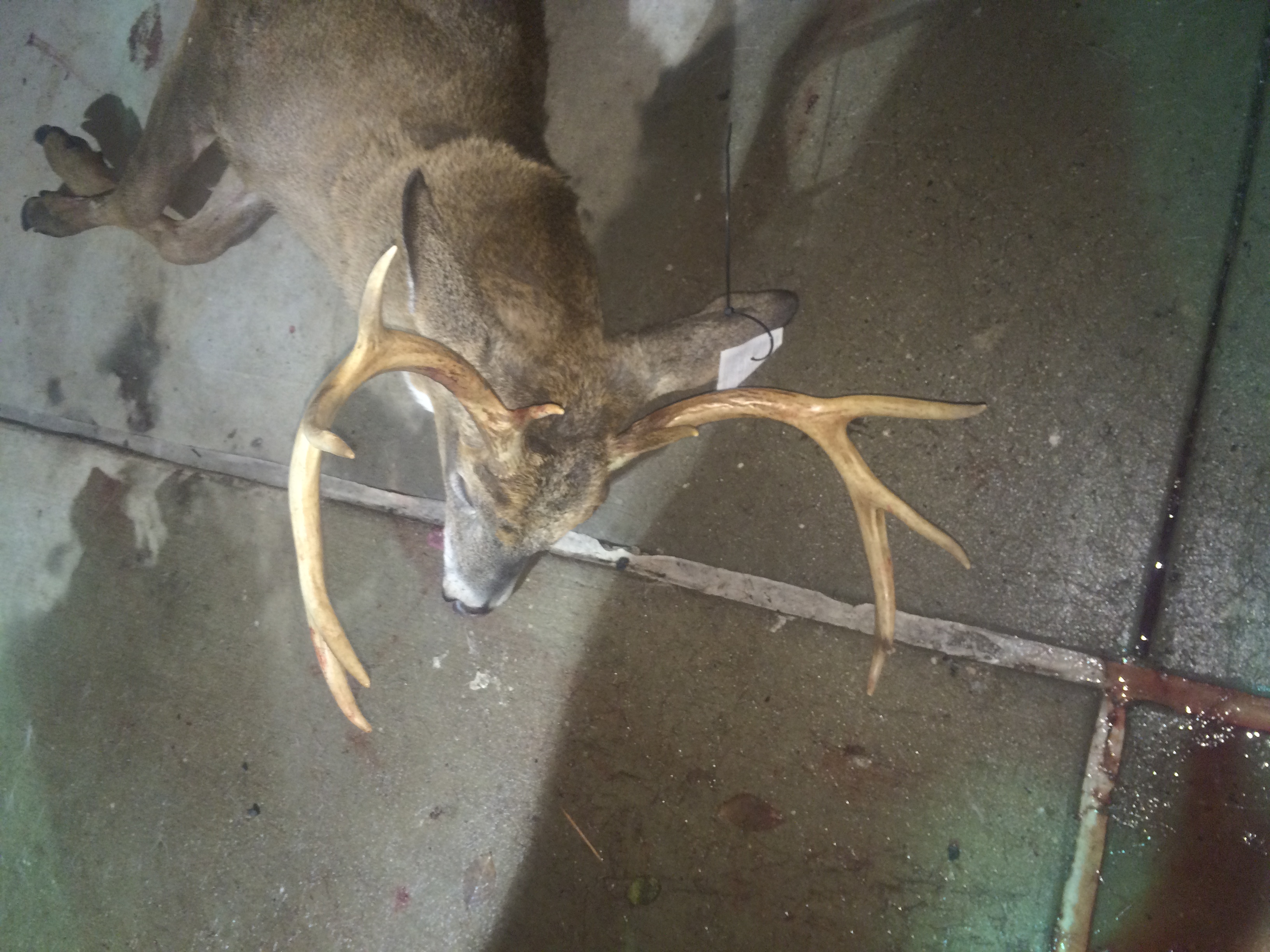
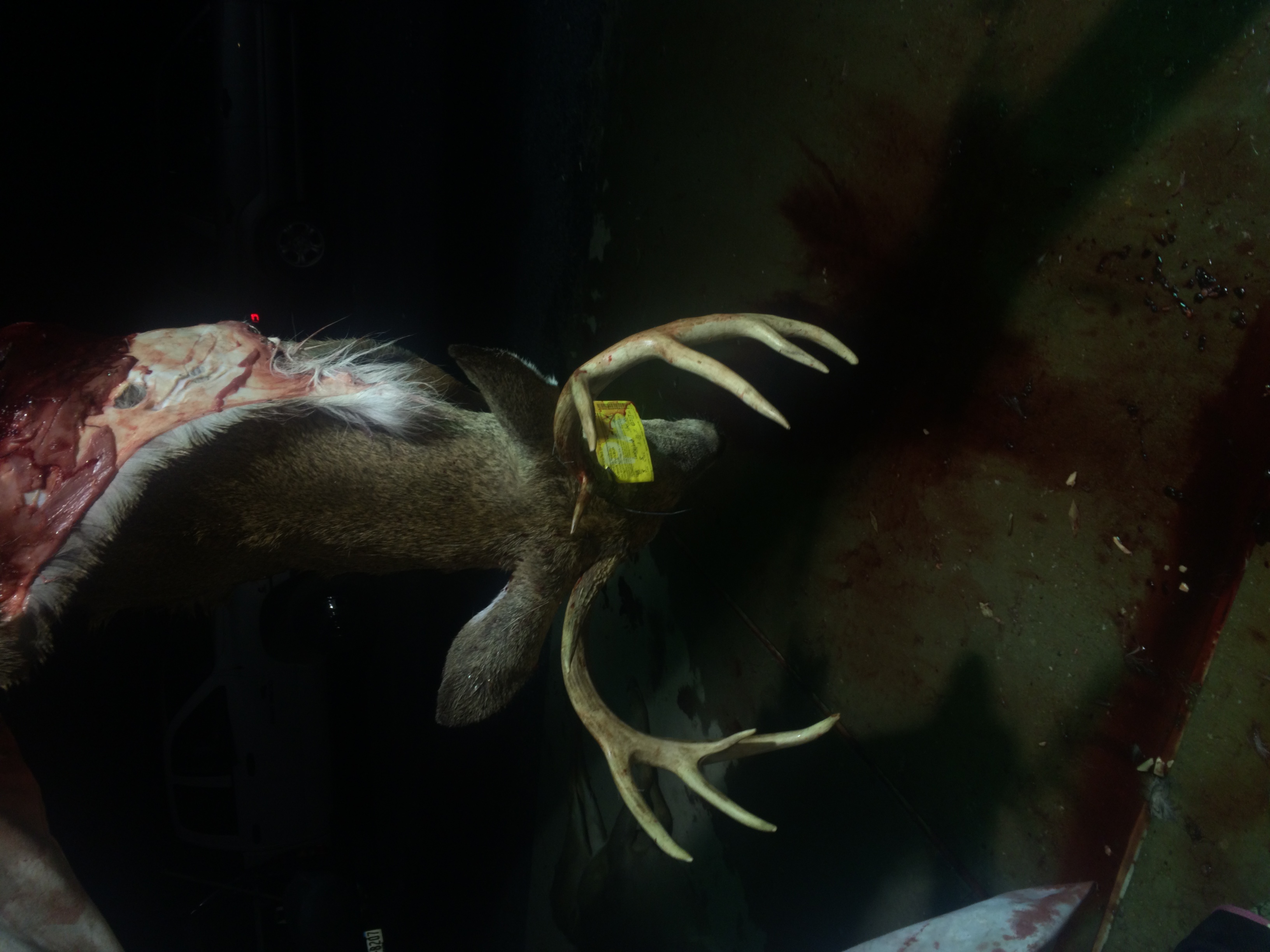
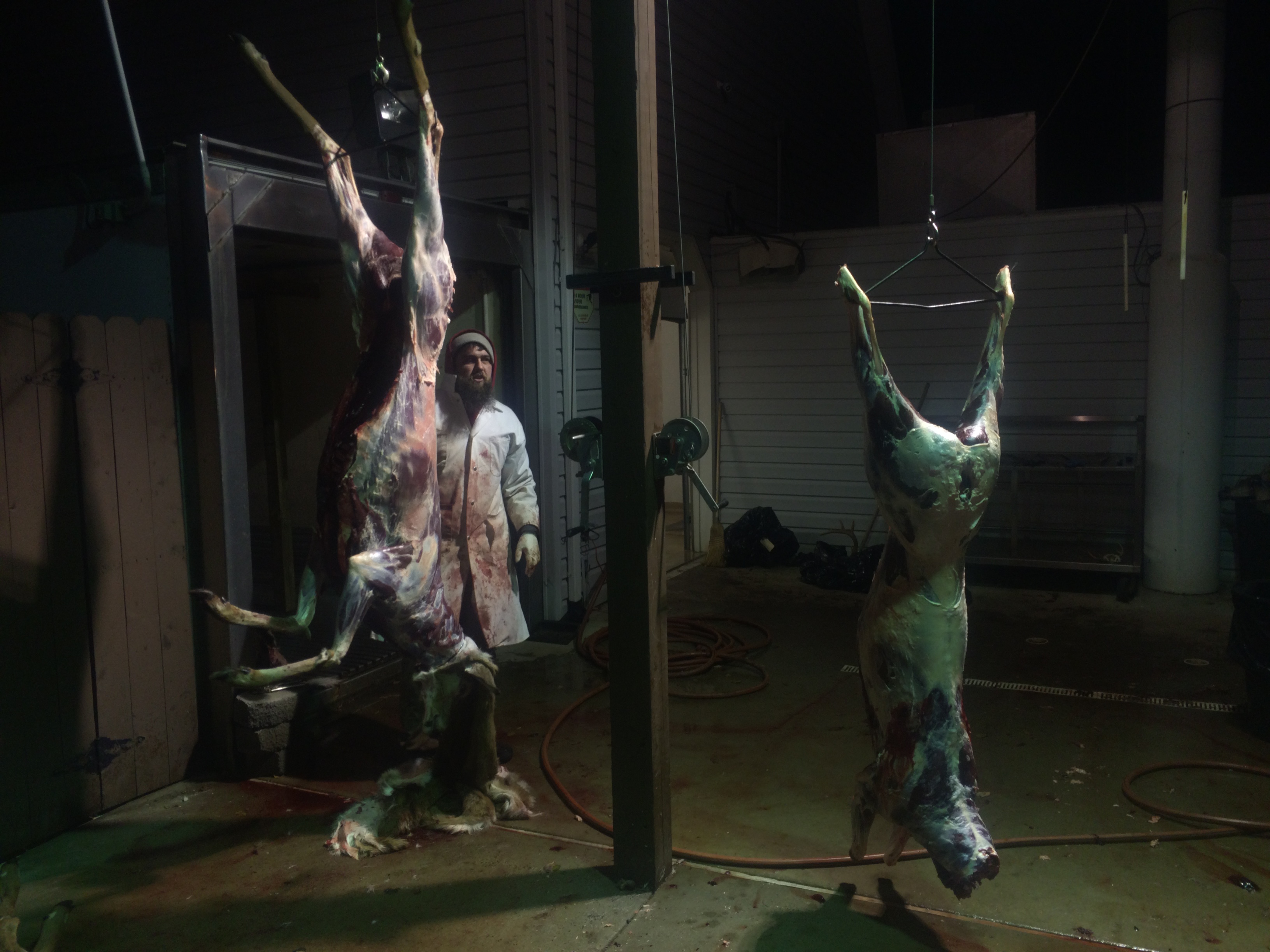
Some photos below from our bear and deer seasons; the buck photos are from the five minutes I was there on the second night of rifle season at Blue Mountain Deer Processing in Enola, PA. Just look at those incredible heads and huge steer-like bodies! Wow. Unthinkable not too long ago.
“Think those are big? You should have seen the huge ones that poured in here yesterday, on Opening Day,” said Dean Deimler, owner of Blue Mountain Deer Processing.
I have heard of several 160-inch and bigger racks being taken in the mountains, where too many people say “there ain’t no deer.” Like a lot of people, I would rather have a shot at a lifetime trophy buck of 160 inches than see a zillion scrawny spikes and forkhorns.
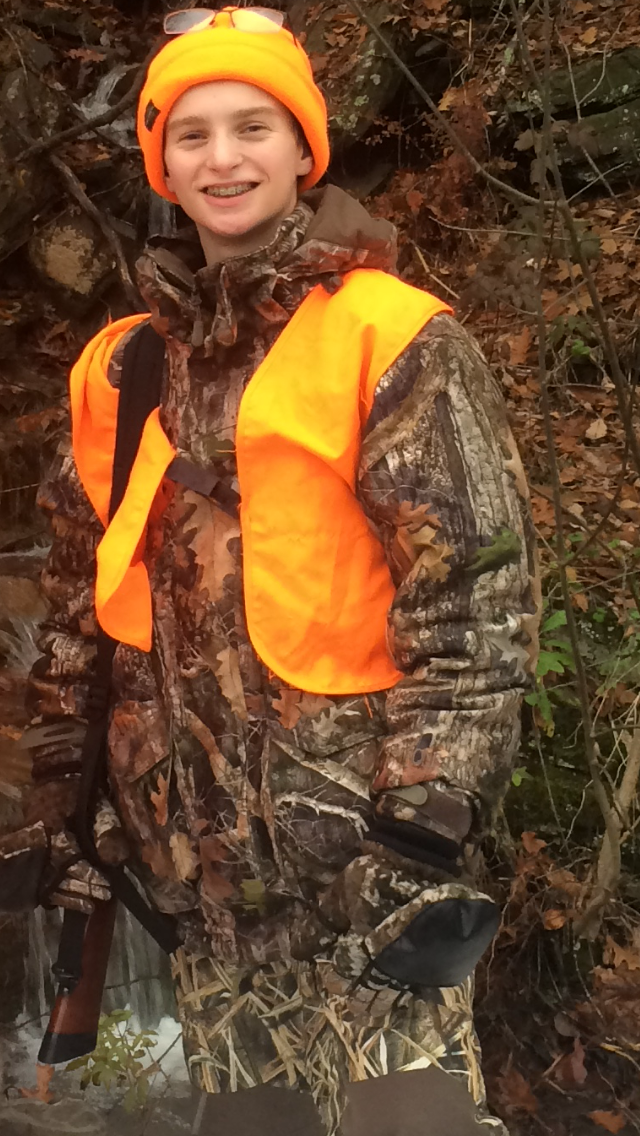
The young man is my son, who climbed high and steep right along with the adults, handling his firearms expertly and safely, himself taking three deer in two states this season and hunting bear as an adult for the first time. And that is the other ‘trophy’ from deer hunting…watching that next generation grow into an activity as old and as natural as our species.


Hunters Sharing the Harvest sets the Holiday Season tone
Pennsylvania is a long time big time hunting state, with such a great and famously known outdoors sports tradition that the iconic red and black “buffalo check plaid” wool coat made by Woolrich, Filson, and other long established wool clothing manufacturers was dubbed the “Pennsylvania Tuxedo” back in the 1920s.
Today our clothing may have improved since then, or may not have improved, depending upon whether you like your hunting pants to be flammable, or not, and I do not (which means I prefer wool in all outdoor clothing), but one thing remains steady: Pennsylvanians rightly love to hunt.
And just as much as we love to hunt, we are also generous with the fruits of our time afield. We have a long tradition of sharing the fruits of our hunting labors.
Well do I recall as a kid waking up in late November or early December to find some fresh venison left on our doorstep by one or two of our neighbors, all of whom had big farms and all of whom were big time hunters.
Back then in that area, kids brought fresh venison jerky to school to share and trade with other kids during and right after deer season; everyone had their own proprietary jerky recipe that they liked and were proud of. Sharing venison is a real longstanding Pennsylvania tradition.
Back in 1991, local hunter John Plowman had a vision to harness that generous spirit among Pennsylvania hunters and use it to provide for the needy. He started Hunters Sharing the Harvest, which today annually supplies well over a hundred thousand of pounds of fresh, free range, wholesome, lean, natural, organic meat to Pennsylvanians in need. That translates into about 667,000 annual “meals” for individuals and families in need.
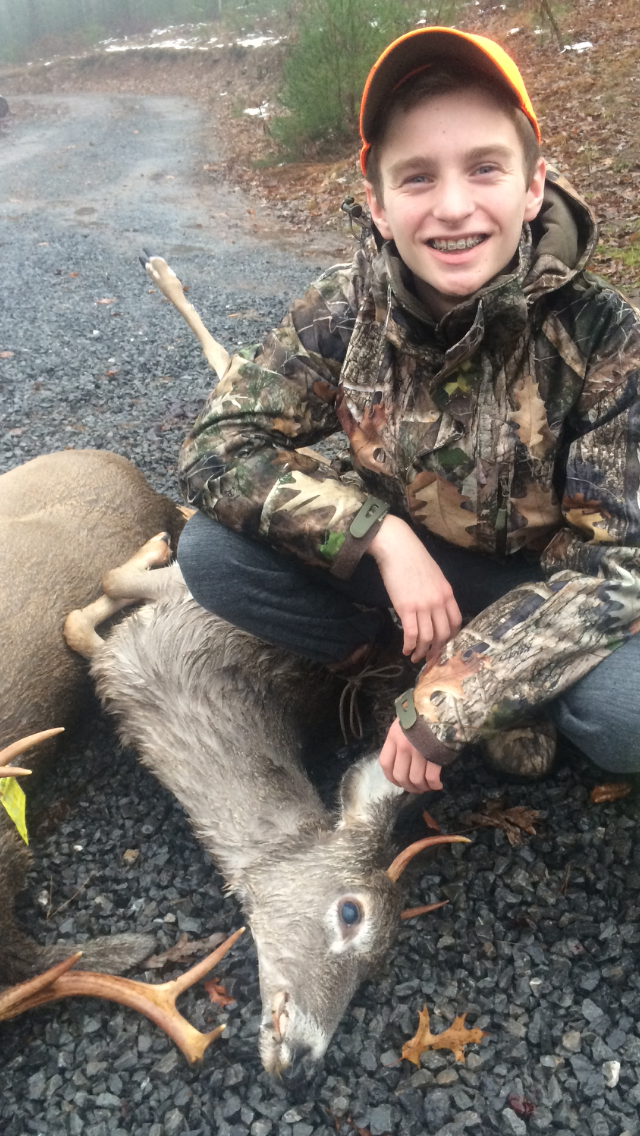
Yesterday my son “harvested” his first Pennsylvania deer (see photo below), a young spike buck that junior hunters are allowed to take, as the rest of us are limited to bucks with at least three points to a side of the antler rack. As we had incredible good fortune yesterday, and took other deer, my son decided to donate his deer to Hunters Sharing the Harvest. My boy is enjoying the act of charity and contributing towards the basic welfare of his community.
Both Deimler (Cumberland County) and Sensenig (Dauphin County) are deer processors close by our home, so either one would be the logical place to drop off the young buck. But Deimler has the advantage of being right down the road from Johnson’s Furs, where we have our furs tanned and where we buy our trapping supplies, so that is where the critter has been dropped off. Mutli-tasking, ya know?
And that is the neatest thing about this Hunters Sharing the Harvest option: We get to share our cake, and eat it, too, in the charitable spirit of the Holiday Season.
PA deer hunters…spending 40 years in the desert
Last week, a guy in his late 50s posted a complaint on social media. He was both complaining about “not enough deer” to hunt in Pennsylvania, and also boasting about how he buys up as many doe tags as he can get, and then he tears them up, and then he uses them to file false deer harvest reports. He hopes this all will influence Pennsylvania’s science-driven deer management. One result of all this complaining by guys like this man is that the PA Game Commission is unable to get the license fee increase from the legislature that the PGC and most hunters want.
On the one hand, this self-defeating complaining and tearing up of doe tags is pretty much insane behavior, and a complete waste of one’s own precious time on Planet Earth.
On the other hand, that someone is so passionate about hunting and wildlife is a good thing. The question is, can this guy and the thousands of other unhappy hunters like him be educated about scientific deer management? Or are they so close-minded and emotional about this subject that they are immune to empirical evidence, logic and reason?
One result of our state’s scientific wildlife management is that we are now a major trophy hunting destination. Previously unthinkably enormous bucks and gigantic bears are within reach of those who are willing to hunt hard and smart. Bucks that rival and surpass those of the “best” whitetail states in the Mid-West. Black bears that are as big as Alaskan grizzlies. These are tangible signs of policy success, and that Pennsylvania is now an outdoor Promised Land after decades of hunters being happy with a pathetic forkhorn or even a spike buck.
On my westward drive along I-80 last week, and my drive south yesterday, from northwest Lycoming County down to Dauphin County, I saw dozens of dead deer littering the sides of the roads. Actually there were so many that I lost count. There may have been a hundred dead deer along the roads. Including along very rural roads in areas where many older guys complain there “ain’t no deer.” Obviously there are a lot of deer in these places, because they are not all being killed on the highway. These dead deer are the fruit of deer-car collisions, a very expensive and dangerous result of an overabundant deer population.
To be fair to the complaining hunters, the PA deer population in these places may be too high for the road system and not high enough for hunters’ desires. That is a very real possibility. It may be that the Pennsylvania road system is just too big, too widespread into rural areas, to allow many deer to survive into the Fall hunting season.
No, we are not going to shut down the public roads to stop the carnage, though it would make sense for Pennsylvania to put a moratorium brake on road building. We taxpayers cannot afford the operations and maintenance costs on the roads and bridges we have now, let along on any new roads and bridges. PennDot must re-direct its energies into safely maintaining the infrastructure we already have, like how about wildlife tunnels? And if the deer-car collisions are any indication, our public road system has been poorly planned and badly implemented; it has spiderwebbed out into the most rural areas and wildlife habitats. Thereby inviting expensive car collisions with wildlife.
I think this unhappy hunter situation is going to be like the ancient Hebrews’ 40 years in the desert. The older generation that cannot adapt to changing habitat, changing deer behavior, changing land use patterns and changing hunting methods is going to have to die off. Then the younger generation can get in the driver’s seat on deer management policy.
The younger generation understands and values science and biology in setting policy, like doe harvest tags, the crucial importance of getting buy-in and acceptance from the larger society around us (people unhappy about hitting overabundant deer; in Europe hunters are personally responsible for keeping wildlife populations at safe levels), the need to be multifaceted and flexible when hunting deer, etc. These complaining hunters represent the ex-slave mentality of those Hebrews who left Egypt and who could not learn to live as free men. Moses could not let them enter the Promised Land because they would infect everyone with foolish ideas and weakness. That would put the entire effort at risk. So he kept them wandering until that generation died out.
Sorry, old complaining guys, you are living in a broken past. You are slaves to an unproven, non-scientific, failed approach to wildlife management. If you cannot change your mindset and embrace reality, then you will be remembered as the lost generation that stood in the way of success and happiness.
And to be fair, this same broken thinking has haunted the Pennsylvania Farm Bureau’s approach to Sunday hunting. The older generation there has successfully blocked a 50% increase in hunting opportunity for decades, just because they think it is “wrong,” for no good, defensible reason. But that also is about to change, soon, as the fed-up younger generation of farmers, including religious Mennonites, takes this important policy issue in hand and directly bucks the older guys standing in the way of family success and happiness.
To enter the Promised Land, you must shed your slave mentality. I hope the anti-science hunters and the anti-freedom PA Farm Bureau folks will join us as we enter a glorious new period in Pennsylvania’s outdoor heritage.