Posts Tagged → deer
Why do people trespass on private property?
During one of his many temporary incarcerations, infamous bank robber John Dillinger was asked by a news reporter why he robbed banks, and he famously quipped “Because that’s where the money is.” Funny enough, true enough, but Dillinger eventually ended up being shot to death by both civilians and a ragtag assortment of law enforcement agents who were fed up with his lawlessness.
I have been similarly wondering: Do people, particularly hunters, trespass on private property because that is where the wild game is? Or is there some other reason that turns otherwise normal people into lawless jerks who instigate their victims into acts of violent retaliatory fury?
My observation and experience is hunters, in particular, trespass on posted private land, and end up poaching wildlife there, because they are drawn to the mystery and promise of new territory. They think that a plot of private land that is carefully cultivated wildlife habitat must have some really nice, abundant, maybe even trophy wildlife on it. And sometimes these outlaws do, in fact, stumble into a kind of bank vault of wildlife, where they feel like they have hit the jackpot.
The problem with trespassing on posted private hunting land is that someone else, the landowner or a club that leases from the owner, has probably spent a lot of time and resources maintaining that land. Paying the real estate taxes on it, managing it, making it a sanctuary or haven for wildlife. All year long that landowner runs chainsaws, plants and prunes fruit trees, sprays herbicides, clears trails, plants various crops like clover that most wildlife find attractive.
These considerable efforts are done for the benefit of the landowner, his family, his friends, or for the club members who pay him for the opportunity to exclusively hunt there, in a very brief window of time. Hunting seasons are usually just a few weeks long. This investment of time and money is like any other investment, say, a savings account at your local bank. Or your retirement pension.
Trespassing and poaching are not victimless crimes. A landowner’s entire year’s work can go out the window from it.
Trespassers enter into the private property and, purposefully or by mistake, disturb the wildlife, maybe scare it away and off the property; poachers kill the wildlife. These disruptions come at a great cost to the landowner, who for 50 prior weeks has been working hard, husbanding the land’s natural resources, and suddenly finds himself at a disadvantage when he should be reaping his just reward.
Someone else has come along and taken advantage of all his hard work and investment, someone else has claimed his reward that he was looking forward to. Most often, the trespass intrusion and poaching so greatly disturb the property’s carefully arranged balance, that the landowner gets little to nothing of what he had worked so hard to attain. And hunting seasons are so brief that there is no time to wait out the disturbance.
This is exactly how both trespassing and poaching are forms of theft. Thievery. Scumbag-ness. Dirtball-ness. A-hole-ness. And when someone has stolen something from the landowner, the landowner can get angry about it. Sometimes really, really angry. Especially if the thief acts like the whole thing is no big deal. Because it is a really big deal to screw a landowner over and steal away from him his hard work and promise of success.
Confession time: I have been a scary person when encountering trespassers and poachers (scary to them and often to me). Not long ago a warden asked me to consider becoming a deputy warden, and I responded that I could not do that, because I get so angry at trespassers and game thieves that it would be unbecoming to see someone in an official uniform lose their cool. Yes, I have had people charged in court, but often my hand tightly around someone’s shirt collar while they get roughly dragged off the property is enough to convince trespassers that other venues hold more promise and less danger. I don’t know if many other landowners operate this way, but I am super old school. A facility with firearms and knowledge of the law also helps build confidence when dealing with armed trespassers and poachers.
As one state trooper said to a trespasser I had roughly collared, “Yes, Josh is armed. But YOU are armed, too. Is he supposed to let you shoot him so you can make your getaway? Here is your citation, do not come back here.”
Some people trespass because they are looking for things to steal, including rare plants or animals, or to drive off wild game they don’t want the landowner to get. Others trespass so they can poach wildlife through illegal hunting. Others may simply get a jolt of excitment, or are simply curious.
Folks, trespassing and poaching are a really big deal. Some landowners make a significant income from leasing their hunting land, and poachers undermine that investment. Some landowners treasure their privacy, and seeing an armed thief skulking around their property makes them feel directly threatened. So don’t do it. Don’t think it is no big deal to slip past the No Trespassing purple paint or sign and “just take my gun for a walk” or take a Sunday drive up that posted driveway.
That walk that comes so casually to you, the trespasser, comes at someone else’s expense, even if you do not see it right then. And it could end up costing you everything. No wild game animal is worth getting in trouble over, and certainly not losing your life or mobility for.
The answer to the temptation to trespass on private land is to listen to that little voice in the back of your mind warning you not to take the chance. Go to public lands for your hunting and fishing adventures. Here in Pennsylvania, public lands are super abundant. If you don’t like sharing public lands with the general public, why then, go buy yourself a piece of land and make it your very own wildlife sanctuary.
Had the once popular John Dillinger stopped robbing banks when he made that cute quip of his, he could have easily slipped away into anonymity and comfortable living, or even into celebrity and wealthy living as a free man. But he pushed it too far, and paid the ultimate price. Like too many thieves pay every day….Guys, don’t trespass and don’t poach.
And yes, baiting is a form of poaching and wild game theft. Don’t do it.
********
UPDATE December 2, 2024: Today I was sitting on a remote hillside in Northcentral Pennsylvania, with a rifle across my knees, overlooking private land surrounded by about two million acres of public land, enjoying the snow-covered serenity. Suddenly, loud voices approaching from behind grabbed my attention. Through a normally silent piece of state forest emerged four young men, in hunter orange and preparing to drive off the piece of private land.
Looking at the leader, who was giving specific directions about how to spread out and push the deer off the private land, I turned to face all of them and asked “Did we grant you permission to hunt here?”
“I mean, we have a bunch of people down in there right now, deer hunting, and they don’t expect to have anyone walking through.”
The curse-word filled abuse heaped on me caught me off guard. Me, easily the age of the fathers of these four young men, very much their elder and merely a private landowner asking an elementary question that any landowner would ask of uninvited guests, was now the bad guy.
“Eff you” Eff this” “Eff him” “Eff that” were the nicer things said to me as the young men checked that the boundary was clearly marked and backed up and regrouped.
I do not know or understand who raises such poorly behaved and aggressive young men, but for those who are inclined to ascribe poor behavior only to people with dark skin, I am here to tell you these were four white guys. Out in the middle of the big nowhere, armed with rifles, and acting like a criminal gang. With all their anger, I wondered if one of them was going to shoot me in the back.
They had already loudly walked a half mile from their remote parking spot (that itself is a long and arduous drive to reach) through laurel-choked oak woods that normally is full of deer, as the abundant deer tracks in the deep snow attested to. What if these four “hunters” had done a silent deer drive from their vehicle out to the private land they intended to sneak on? They might have already bagged a deer. Instead, they talked so loudly, so boisterously, for so long, that I thought they much have been forest workers. Never in my life have I heard hunters this loud in the woods.
Their behavior makes no sense, unless their goal was simply to spoil the posted private land that they already know is off-limits and that they were jealous of and wanted to ruin for hunting by anyone else….
Good luck, deer hunters
Practically a religious holiday event, Pennsylvania rifle season for deer starts tomorrow morning, and I want to wish everyone who participates a hearty Good Luck. Up north, where poor to no acorn crops this Fall seemed to be widespread, finding deer is probably going to be more difficult than usual.
All the reports I heard from bear hunters across the northcentral region here is that acorns were nonexistant. But deer are spread all over the state, and they are doing better than just OK in places with farm fields and suburban lawns. If you just want to kill a fat buck with a nice set of antlers, you should go sit on my buddy Mark’s porch in Camp Hill/ Mechanicsburg. I am sure you can easily nail one of the stud bucks that casually lay about and wander around Mark’s yard every day, with a crossbow. Mark is not alone, as anyone who lives up on Blue Mountain north of Harrisburg will tell you. Deer are everywhere in these urban/surburban places.
Pennsylvanians traditionally like to hunt in the Big Woods because it is, well, big and woodsy, and quiet, serene, magical, inspiring. Wilder places have always been where religions start, where the voice of God is easiest to hear. People are drawn to the mountains to hunt, not just to hunt, but to hunt surrounded by beauty. This is where I like to hunt. Add to that a mix of beautiful antique and black powder firearms, and life is just fiiiine, even if a skunk is all I encounter.
This year, I suspect our deer hunters up north are going to get a lot more beauty and less deer. Hope I am wrong. Fortunate am I that I am easily amused by fondling blued steel and aged walnut while sitting on my can in the cold.
Good luck, shoot straight, and have a fun, safe hunt, everyone.
PA is at Peak Rut, so just do it
I drove through farmland, mountains, and valleys a couple days ago, and I swear to you, no lie, I saw a huge stud buck out in every field I went by. Half were alone, half were with a doe. Some of these monsters were standing close to the highway, which explains why the highways I drove on were littered with dead bucks from car collisions.
We have deer literally coming out of our ears. And not just any deer, but freaking huge trophy bucks that were unimaginable when I was a kid, and an adult. These are trophy animals by any standard, whether you hunt in Illinois, Ohio, Iowa, or Indiana.
Twenty four years ago, Pennsylvania entered uncharted waters and started a new deer management program. I was peripherally involved as a mostly bystander with field level fifty yard line seats. The PA Game Commission’s new deer management methodology was biologically sound, but untested in modern times. And because it involved axe murdering about fifty percent or more of the standing doe population, and setting aside all the small bucks, almost every old timer hunter went into a kiniption fit.
Families fell apart, PGC commissioners and staff wore bulletproof vests to PGC board meetings, people’s tires were slashed, hunting clubs dissolved, and for about fifteen years PA’s political map was turned upside down. Go ahead and laugh all you flatlanders, go ahead, yuk it up. What a bunch of rubes, what a bunch of rednecks and hayseed hillbillies…who in their right mind cares about deer management so much that literally our state politics got turned upside down?
Fun fact: Hunting in Pennsylvania is about a $1.5 Billion annual industry, and maybe more than that. Hunting is a sustainable, renewable, ecologically sound industry. For just a few months a year. So a lot is at stake when changes are made to the hunting system. It isn’t just hillbilly farmers who like to hunt who are impacted by hunting regulations here, it is literally every small rural town that has a restaurant or two, the deer processors, the hunting clothing manufacturers. Hunting in PA is big business.
So when I say that I saw all these huge bucks the other day, it means that the PGC deer management program, which began with a small mushroom cloud in 2000, is now working as planned like a Swiss watch. You don’t get to see government actually do positive things very often, or implement policies that work, but in this instance we did, we do. The PA Game Commission deserves a lot of credit for both using sound biology AND stoically enduring the brutal politics that followed.
Right now PA is at peak rut, meaning the bucks are in full rut, horned up and lookin’ for love. Like all stupid men chasing tail, huge bucks that are otherwise almost impossible to get near (because they are smart as hell) can now easily find themselves broadside to a bow and arrow at fifteen yards. So go do it, git yerself sum.
May I recommend a few things?
First, whatever skills you developed in the early archery season, they are now only partly applicable. Because rutting bucks are wanderers, the bucks you scouted and marked down in October could be the next county over. This means that you cannot just set up over a trail and wait. You need to lure in the wandering bucks, and that can be done with doe pee (https://kirschnerdeerlure.com/ get the SilverTop), a sparingly used grunt call, or rattling antlers. This also means that bucks from the next county over will be wandering around where you hunt.
Second, work hard on concealing your blinds. Especially your ground blinds. Man, nothing is more garish and glaring than a poorly concealed ground blind. I see guys just setting a blind out in the open and hoping a deer won’t notice. But guys, come on, the deer might now see you inside the blind, but THEY CAN SEE YOUR BLIND and they are spooked by it. It is an unnatural thing on the landscape. So tuck your blind back into the edge of the woods and brush it in well, so that it blends in with the surroundings.
Happy hunting, and just do it, get yourself one of PA’s unbelievable trophy bucks wandering around hill and dale right now. And do not forget to thank PGC personnel when you see them, because they are the ones who implemented the outstanding deer management policy that we are all benefiting from now.
PA Game Commission changing leadership
Kind of a wildlife management wild ride here in the Keystone State, though it is tough to tell if anyone really noticed or if anyone really cared. I care. People who care about animals should care.
In just a few weeks the Pennsylvania Game Commission has gone from from a very traditional conservation leadership style and background to a new style and background we have not seen in over a hundred years. I think this is a good thing, though I am sad about how it happened.
Recall that several months ago, attorney Steve Smith was promoted from director of the PGC’s Bureau of Information to deputy director of the agency, second in command to executive director Bryan Burhans. A good choice, as Smith is the very image of the dutiful, honest, earnest, hard working, straight shooting, unemotional, careful, procedurally diligent government employee. While PGC is a long way from the colorful Wild West frontier culture it once had, it still has a shadow of a bunker mentality and insular culture that do not serve the agency, its employees, or the public, and Steve is not representative of that.
Where Bryan Burhans had worked at the American Chestnut Foundation and other iconic conservation and wildlife management groups, with direct personal contacts in the nonprofit and foundation world, Steve Smith is an attorney who just happens to hunt, fish, and trap, and of course share the wildlife and habitat conservation ethos that animates hunters, trappers, and “fisherpeople” everywhere.
A devoted family man, Smith worked in private legal practice before joining PGC’s legal staff about 16 years ago. Where Burhans carried the mail for nonprofit advocacy groups both out of PGC and in it, which is the traditional model for wildlife management agency leaders across America, Smith has been long focused on public agency nuts and bolts. Dotting I’s and crossing T’s in the shadow of big speeches and public policy debates.
There is a gigantic world of difference between these two men, Bryan and Steve; their backgrounds, personalities, and outlooks could not be more different. Again, we are going from strength to strength with the change.
Bryan Burhans gets tons and tons of credit for gently, sometimes assertively molding the PGC into a more publicly accessible, publicly responsive public agency. Unlike most of his predecessors, Bryan was not a former Game Warden. And so from his own get-go seven years ago he was less insular, less committed to the law enforcement view of all things wildlife.
Yes, if you read some news reports about Bryan’s departure a couple weeks ago, you will then read about some state lawmakers griping that the agency is still not as accessible or responsive as the PA Fish & Boat Commission. I am sure that is true, and for good reasons. But compared to where the once insular and bunker-mentality PGC was, say, ten years ago, or especially twenty-five years ago, it is light years better now. Much improved. And, gasp if you must, the PGC actually now employs women in senior positions. This may be not big news to most people, but it is a fact that wildlife agencies are notoriously hide-bound and ultra traditional, the PGC having rung the bell in this regard for a long time. Celebrated wildlife biologists like Mary Jo Casalena may work for PGC, but it is as rare as hen turkey teeth that they also then get into senior management positions.
What is interesting about Steve Smith’s elevation to executive director upon Bryan’s departure is that we are actually seeing Pennsylvania wildlife management style return back to the days of Kolbfus and Pinchot – Americans without the supposedly key wildlife science “credentials” who simply care very much about wildlife, environmental quality, and habitat, and who have the intellectual capacity and personal management skills to implement the necessary policies.
PGC’s executive director is going from an outspoken advocate (albeit occasionally for things unrelated to wildlife management) to a quiet, humble, careful, almost reticent thinker. I am lamenting Bryan’s good-bye, because he did an outsanding job, and I am also really welcoming Steve’s hello. I believe that the many passionate watchers and stakeholders of PGC will be happy with Steve’s leadership there. Of course, those hunters who demand more deer than the landscape or society can sustain will never be satisfied, and I feel sorry for those people.
Update: Long and interesting interview with new ED Steve Smith is here.
Some wonderful people gone
Jokes abound about aging, and quite a few are about those friends and family members who do not age with us, but who leave us all as we continue our own trajectory. Well, I am now definitely in the “aging” category and I am increasingly surrounded by people I enjoy and love who suddenly depart from this life. Recently two people here in Pennsylvania have left us all, and moved on to the spirit world, who I would like to mention. And it’s no joke, this dying thing. No matter what age a person is when they depart this life for the next, there is nothing funny about it.
Except maybe the last day on earth of European-Mexican artist Frida Kahlo, whose wild and often debauched Marxist Bohemian lifestyle made for intriguing movies and books. While some or maybe even a lot of the facts of Frida’s life may be funny depending upon the person considering them, her actual physical departure from this planet really is funny. I think.
After Frida died relatively young from cancer, or whatever it is that eventually afflicts the heavily debauched, her friends had her corpse dressed beautifully in her most customary colorful and flamboyant way, and prepared themselves all for a formal cremation send-off party in whatever crematory was present in Mexico City at the time. Her friends gathered in the crematory room while Frida’s corpse was ceremoniously loaded into the burn chamber, and as the roaring natural gas flames came to life, they all raised their glasses and toasted Frida.
And then the room erupted in gasps, cries, and people running for the exits, because suddenly Frida’s corpse stiffly bent at the waist, sat up, and made a wicked grin as her abundant hair caught on fire and created a demonic flaming halo around her yet untouched face. She wasn’t actually gone!
Yes, this was all her body’s muscular reaction to the sudden burst of 2,000-degree heat enveloping it, but apparently if you knew Frida, you kind of didn’t expect her to just die, you know, lie still and never move again. And indeed, she had lived up to all the hype about her, even while lying quite dead in the cremation chamber. I think this true story is funny, even though I did not know Frida and was not present at her cremation.
What is not funny and yet is not unexpected is the recent departure of Jim Brett, of Lenhartsville, PA, which for our geographically challenged readers is just north of I-78 and just south of Blue Mountain in Berks County, PA. Still confused where Lenhartsville, PA, is? OK, yes, it is the equivalent of East Succotash, PA, Nowheresville, PA, etc., and it is just about next to Hawk Mountain, the internationally famous sanctuary devoted to conserving birds of prey, especially on their annual migration south. There, solved this location question for you.
Hawk Mountain started as a simple land purchase to keep the shotgunners from standing on Blue Mountain’s highest Tuscarora sandstone boulder ridgetop and mindlessly swatting down out of the sky nearly every raptor that flew by on its way to South America. And in short order, more land purchases were added to what is now called the Kittatinny Ridge migration corridor. Hawk Mountain eventually became an educational organization and a destination for birders.
In the 1930s, birds of prey (hawks, owls, eagles, kites, vultures) were considered pestilential nuisances to farmers’ chickens and the rabbits and pheasants hunters enjoyed pursuing. In time, around the 1930s, raptors gradually became understood by some Americans as an important part of a healthy and properly functioning ecosystem, just as balanced populations of wolves, bears, mountain lions, bobcats and fishers have been subsequently understood today.
Hawk Mountain is now the world’s oldest continuously functioning conservation organization, but from 1934 to 1966 it was kind of a hidden gem, a hole in the wall of Blue Mountain that only certain initiates knew about or appreciated. It became much better known and more widely appreciated and much visited after Jim Brett became its second “curator,” as the chief executive position there is uniquely called.
As its leader, Jim Brett elevated Hawk Mountain to international status, built lots of buildings, hired lots of staff, attracted a lot of visitors, raised a lot of money, and he became a leading voice in bird conservation around our little blue and green planet.
On the outside, Jim Brett was a colorful Irishman, full of naughty jokes and a singular ability to imbibe liberally (often of his own make) and then hold forth to a captivated audience about biological and ecological science. But because Jim’s mother was Jewish, he had a separate interest in Israel, which, because it sits on a physical crossroads, is a lot like Blue Mountain. Israel is a birding Mecca.
A “sh*t ton” as Jim would say of raptors, storks, and other incredible and rare bird populations migrate through Israel, and Jim made their conservation from one end of their migration to the other one of his life’s missions. His Jewish half worked well with the Israelis, and his Irish half worked very well with the surrounding populations. One of his crowning achievements was working with Yossi Leshem to resolve bird strikes on Israeli fighter jets.
By finding ways to greatly reduce large rare birds being suddenly introduced to fighter jets at 1,000 mph, Yossi Leshem & Co. were able to save the lives of said rare birds, said giant titanium war eagles, and unsaid but implied young fighter pilots. It really was one of the great wild birds-living-with-modern-humans conservation success stories.
I met Jim Brett in 1998, when I had started working at PA DCNR in Harrisburg (having fled the corrupt and destructive US EPA in Washington DC). He was giving a presentation at an environmental and conservation education conference in Harrisburg, PA, and as the DCNR director of said polysyllabic educational field, it was my duty to both speak and to listen. Jim was standing up on the stage showing ancient stone tool artifacts and explaining the nexus between primitive hunter-gatherer lifestyles and the conservation or decimation of wildlife. I was hooked immediately.
Jim and I maintained a close personal and professional relationship until Fall, 2009, when I ran in a congressional primary (I was prompted to run by the devoutly corrupt and evil Manchurian Candidate Barack Hussein Obama, then president for nine months). My expressing my long quietly held political views educated not just Jim, but a sh*t ton of my “friends” and fellow conservationists alike about my true self. Gasp. Turned out that Jim did not know how conservative I was, and I did not know how liberal Jim was, and despite my desire to remain close, Jim had a hard time with it.
After 2009, our relationship involved less and less personal time, and fewer phone calls. I still have a generous gift that Jim gave me, which I occasionally take out and look at, admire, and then put it back in its safe place.
Jim and I stayed in touch through mutual friends for many years, including those who went on his African safaris he led. I can still recall Jim describing the funeral rite for a young son of a Maasai tribal leader, which he witnessed some time in the 1980s, I think: The boy’s body was ritually washed and then slathered in lamb fat, then put in the chieftain’s hut. The entire village was then evacuated and moved to an entirely new location, where a new settlement would be constructed. After the hyenas had entered the old village and consumed the boy’s body, the entire place was torched and left to become natural ecosystem thereafter.
Jim’s bright blue eyes flashed as he told this story, as indeed one would expect from someone so in tune with the endless hidden vibrations of our magical natural world. Though I know his spirit is now soaring with the majestic raptors, I doubt Jim’s liver will ever go the way of the hyena, Frida, or any mortal flesh for that matter. His official obituaries are here and here.
A second loss is someone I knew less closely, but with whom I shared a great deal in common and with whom I filled my buck tag this season: Phil Benner of Liberty, PA.
Until he unexpectedly died of Covid several days ago, the incredibly physically fit Phil Benner was a devoted father, a devoted husband, a devoted brother, a devoted uncle, a devoted son. He was a hard working small business owner, a risk-taking entrepreneur, and a pastor who saw God and felt Him deeply in the natural world around him, including the leaves rustling in the winter tree branches, and the quiet tinklebell sound of a small mountain stream’s clear waters falling over boulders. He appreciated everything and took nothing for granted.
Not only will I miss Phil Benner, the world will miss Phil Benner, because the world needs a billion more gentle, charitable, loving, devoted, kind, tolerant, peaceful Phil Benners. His loss is huge.
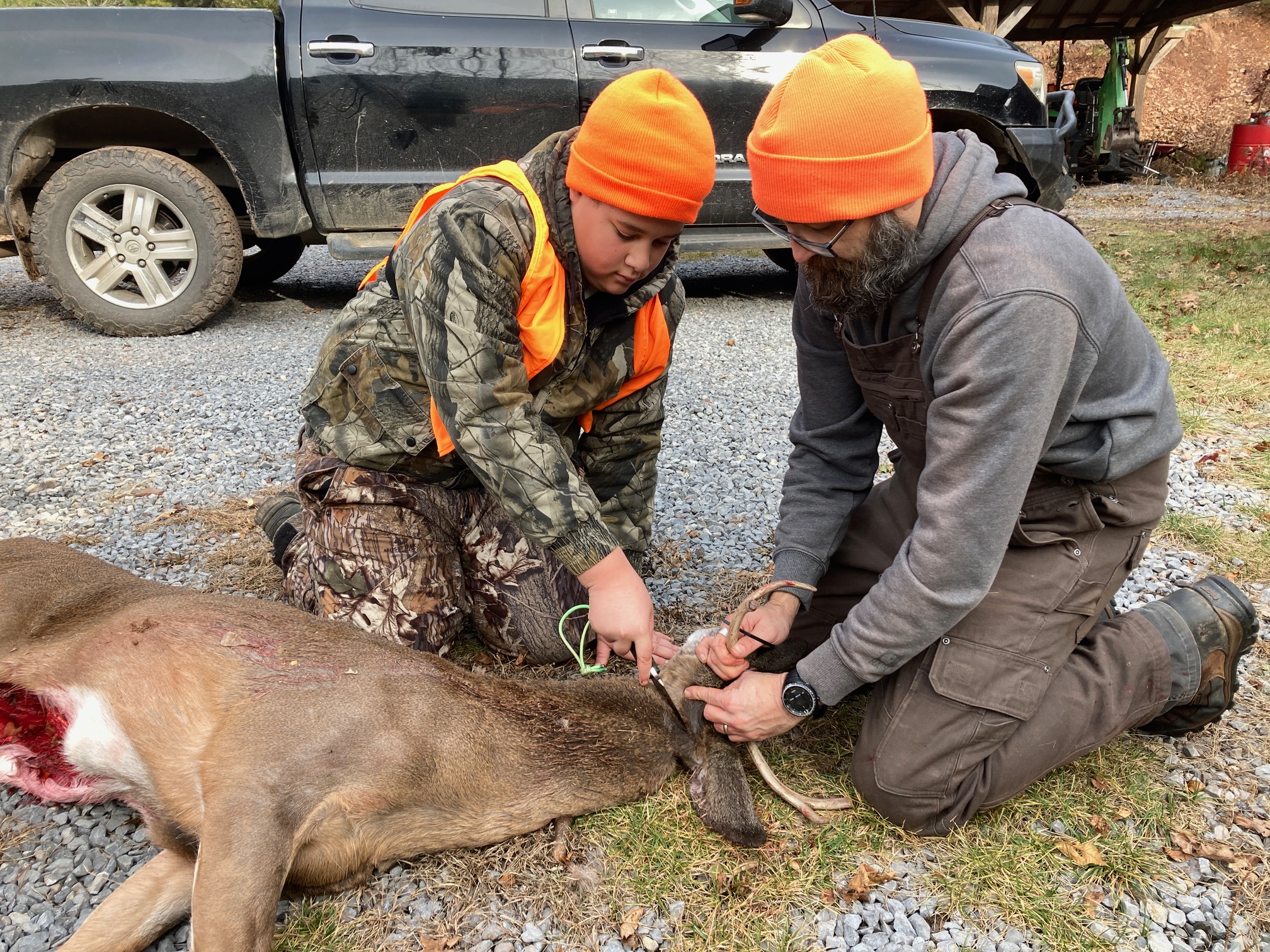
Phil Benner showing his son Nate how to remove a buck’s head with a large and sharp hunting knife
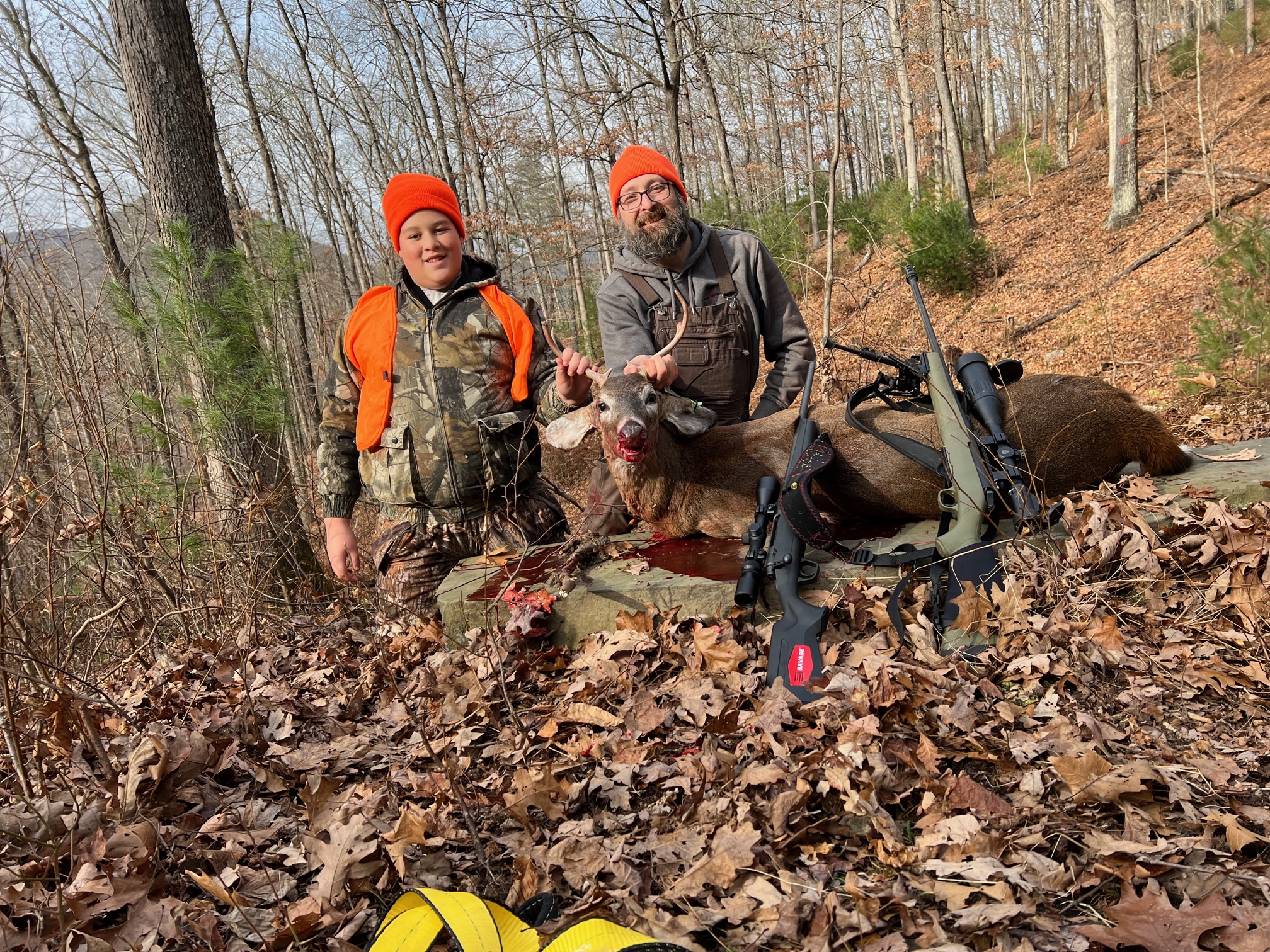
Phil Benner and his son Nate with a large bodied six point buck taken in Pine Creek Valley in late November, 2023
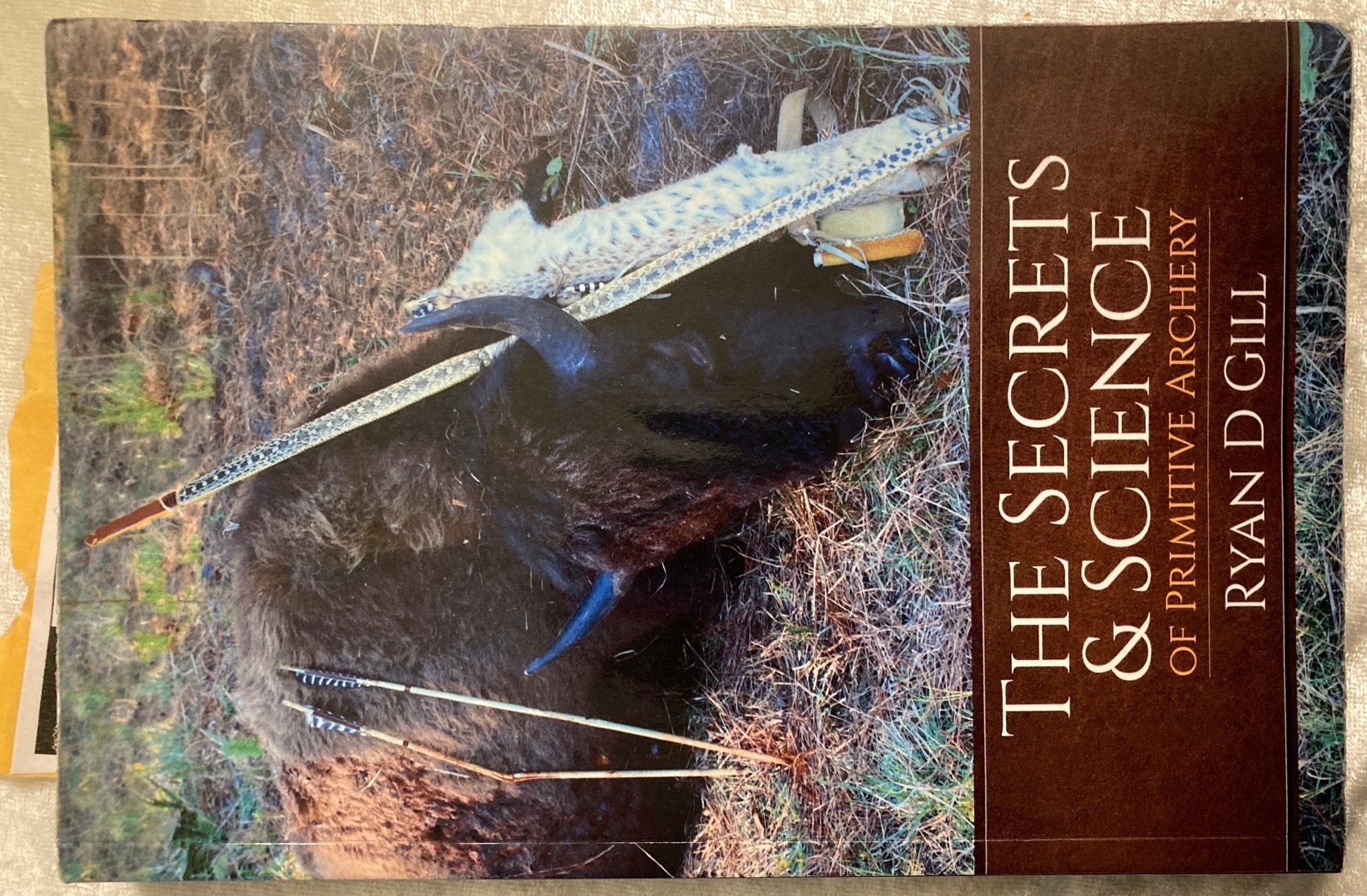
Book review: Secrets & Science of Primitive Archery
Ryan Gill’s book, The Secrets & Science of Primitive Archery, is a must-have for all stick bow hunters. You cannot find your way in the dark without a light, and this book is the illumination every traditional and self-bow hunter needs. I don’t care how long you have been hunting with your Osage orange self-bow or even a traditional bow by a small maker. If you hunt with something that does not have training wheels, then you need this book.
I must admit that I am almost ashamed it has taken me over a YEAR to review this book. Actually almost two years. Author Ryan Gill deserves much better treatment for all the hard work he put into this book. What can I say, Ryan. America has had a lot of ups and downs since 2021, and for political watchers and commenters like me, practically every day has felt like an all-hands-on-deck. All the political stuff has taken up the blog space. I am sorry, buddy. Hopefully I finally give you and the excellent book your due here.
As a traditional archery hunter since I was about fourteen, I have been enamored of bows made of a simple stick and a string. When us kids made our own bows out of saplings we cut in our woods (fifty years ago…), we would tie on a piece of baling twine and shoot arrows made of tree branches, goldenrod, whatever we could get our hands on, and practice with what we had. As the years went past, some of us were gifted compound bows, and others got simple recurves. I got a recurve, and some pretty sorry secondhand Easton aluminum arrows, to which I attached basic Bear broadheads.
If I had a nickel for every deer I collected hair from, I would have enough to buy a malted milkshake at the Lewisburg Freeze, which was fifty cents way back when, and costs five bucks now. That is to say, I never killed a deer with a bow, but missing didn’t stop me from trying.
Fast forward and I had my own kids, all of whom enjoyed shooting little fiberglass kid bows. When the boy attained the age of about seven, he demanded a “real bow,” and so off to the Eastern Traditional Archery Rendezvous we went. There we located a nice faux curly maple kid recurve with about 20 pounds of pull. Enough to skewer a squirrel or ball up a bunny in the back yard, which the boy kept after. Many years later we would go back to ETAR to get his real Big Boy bow, a reflex-deflex by the Kilted Bowyer. At 43 pounds pull weight at 26 inches, this is a true hunting machine, pretty, yes, but in all the clean simplicity a true bow should have.
But in between the little boy bows and the last big boy bow there were a lot of experiments over the years. Saplings cut, strings attached, arrows made, trials run. Like I did when I was a kid fascinated with the basic but powerful physics of archery. And this is where Ryan Gill’s fascinating book enters the picture.
Ryan Gill came to our attention by his YouTube videos. Because we were naturally looking for information about what we were doing right and doing wrong. Ryan doesn’t just cut saplings, attach a string, and shoot some crappy home made arrows. Au contraire! Ryan makes all kinds of powerful self-bows from all kinds of different woods, including Osage orange, hickory, black locust, and others, that will kill deer, bear, wild hogs, and even huge bison. And then Ryan strings the bows with real animal gut. And then he makes real cane arrows, tipped with real flint and chert heads that he himself knapped. Talking the real deal here. And through it all in his videos and his book, Ryan explains how primitive archery really worked tens of thousands of years ago, and how it can work really well for us today.
I learned a lot from this book.
Because I am a numbers guy, Ryan’s statistical analysis of his different bows, using different strings (animal and plant fiber), using different arrow shafts (river cane, wood) etc, really speaks to me. He does a great job of tabulating his data, which, when all his testing is said and done, tells us exactly where to go: Osage orange bow stave that is dried daily, using either a modern bow string or an animal gut string, and shooting properly made river cane shafts fletched with goose feathers and tipped with the proper and surprisingly small stone arrowhead, that go at least 130 feet per second, with 150 fps or better being the best and most likely to catch an unaware deer standing flat-footed.
If you are at all a traditional or aspiring primitive archery person, you need this book. This is a must-have resource that you will find nowhere else. It has an incredible amount of fascinating and directly applicable how-to information to every step and facet of primitive and traditional archery, as well as the historic and anthropological background to how primitive archery evolved. I read it twice before I felt qualified to write about it here, and I highly recommend it.
Welp…there is always the late deer season
The 2023 deer hunting season is probably going to be remembered in most parts of Pennsylvania as a strange time. For reasons already written about here previously, the deer just have not been available to the hunters in ways and numbers that hunters are accustomed to. On properties I hunt all over Central PA, deer were either invisible or invested with magical disappearing powers. Everywhere I am familiar with, the deer moved up hill, as far away from human activity as possible.
To say many hunters are frustrated is a big understatement.
All I can say to all this bad luck is that at least we have the upcoming late flintlock and archery seasons to try to make up for the low productivity of our regular season. And in at least one area designed to reduce Chronic Wasting Disease, DMAP 6396, we have a continuation of rifle season for antlerless deer only until late January. I intend to take a new rifle afield for that season in that area.
Folks, for the next ten days, practice, practice, practice with your flintlocks. My biggest challenge with flintlock hunting is the huge flash going off in my eyes. Once I get used to that, I am deadly steady with the old smoke pole. Probably takes me ten to twenty flashes to begin staying stone cold steady.
Late last year after a bunch of really lame close-range misses, I began practicing shooting my flintlock rifle with only priming powder in the pan, and nothing loaded in the barrel. Repeated trigger pulls with explosive flashes in my face helped me overcome my natural reaction of flinching and pulling my head back and away from the flame. Needs no explanation that moving your head off the gunstock is going to ruin your accuracy and aim, which means you probably won’t hit what you thought your gun was aimed at.
Ah yes, the well-earned moniker “flinchlock…”
Couple of recommendations: Go high up, because that is where most of the deer are, and try to hunt in groups, either as actual drives or as organized approaches to hunting the same area together.
Remember to go afield with a brand new sharp flint on your gun. If you take the old, dull flint that you have been practicing with this year, you stand a good chance of hearing “klunk” when you pull the trigger as the rounded flint then hits the frizzen without any sparks, and thus yields no primer ignition, and thus there is no ka-boom coming out the end of your gun barrel.
Though quite often the deer will be fascinated by the weird klunk sound, staying riveted in their spot staring intently in the direction of that odd sound. You might get a second or even a third trigger pull during this stare-down period.
Good luck, folks! Shoot straight and walk tall.
Do deer processors give you back your own deer?
Pennsylvania rifle season for deer is nearing the end of its second and concluding week. On average, Pennsylvania hunters annually kill 400,000-500,000 deer, and I would just hazard a guess that 2/3 of those carcasses are taken by the hunter to local deer processors.
Tonight, deer processors across Pennsylvania are working triple-staffed and double overtime to process the hundreds of thousands of deer being brought in by successful hunters.
A perennial question asked by both new hunters and well seasoned is “When I pick up my deer from the processor, will it actually be my deer I am getting, or will it be someone else’s deer?”
There are two certain answers to this question, and I base these on my own experience and the experiences of many friends and acquaintances.
First answer, Maybe. Depending on what you want done to your deer, you might get back 100% of your deer or you might get back 75% of your deer, with the 25% difference being parts of other people’s deer. If you just want real simple cuts, basic steaks from the backstraps and the hams, and roasts from the neck, leg, and shoulders, then you stand a better chance of getting your deer back. This is because it is almost as easy for the processor to cut your deer up into these basic cuts with a bandsaw and a boning knife as it is to grab whatever oddball cuts he has on hand to fill your order.
Second answer, when ordering sausage and hamburger, is absolutely No. This is because deer sausage, pepper sticks etc. are made from various trimmings and random pieces of deer as they are brought in from the very beginning of the archery season, based on the kind of demand that processor has experienced in the past. Additional batches of sausage are made as demand increases towards the end of archery season and into the rifle season. There is just no way that your deer can be turned into its own sausage mix. Your deer might be contributed to a big pot of deer trimmings destined for sausage, and you might be getting your portion of that sausage, but that sausage just isn’t going to be yours and yours alone. It will be a mix of various deer brought in the same time as your own.
I cannot tell you how many times I have gone through the expense of having my prize deer turned into beautiful shrink wrapped cuts at a processor, only to discover that the cardboard box I received my order in is short at least ten to fifteen pounds of venison (from a huge buck). And worse, some random pieces have been thrown in a try to make the balance, as the processor guesses it. And some of the packages have been frozen a long time. And the same cuts of meat are colored differently, as though from different animals.
The truth is that if you want to eat your deer, then you must either butcher your deer yourself, or get together with buddies and butcher all of your deer together.
Butchering a deer by yourself is much easier than most people think, especially if you are willing to cut up the backstrap and hams into basic steaks, and then grind up everything else for hamburger or sausage. In fact, I am about to take a deer I shot today over to a friend’s house where we are going to butcher it in his garage. This is going to be his first experience doing this, but I am sure it will not be his last time.
With buddies, you can pool your odd trimmings and leg meat for sausage. One or two guys or their wives run the sausage/ hamburger grinder and filler, and by the end of the weekend the sausage has been cooked/smoked, and everything is all done simultaneously. I have seen a historic hunting camp in Elk County that had the most impressive kitchen and butchery set-up, including scales for weighing both the whole deer and the various parts and cuts. This is nice so that the guy who shoots a 60-pound yearling gets his deer, and doesn’t unfairly get a bonus pay-out taken out of someone else’s 120 pound deer. Unless this is the way everyone agrees to work together: Everyone goes home with more or less the same amount.
Nothing against the deer processors, they have an important role to play. But the question asked in the beginning can only be satisfactorily answered by doing the job yourself, and I can say from long experience that butchering a deer is easy and gets faster and easier the more experienced at it you become.
Ok so how is your deer season going?
You wait all year for these two weeks of rifle season in PA, and then after a restless night the opening morning arrives. Five days in, and hardly a shot heard each day, no deer seen, hardly any sign encountered, and you are wondering what the heck is going on.
Don’t sweat it, you are not alone. You are in very good company. A lot of Pennsylvania hunters are grousing to each other tonight about not seeing any let alone many deer so far, not getting shots at deer, not even finding sign of deer, like poop or tree rubs. Not even hearing shots. Apparently Wisconsin is also seeing a real drop in their deer harvest in firearms season, too.
Something is amiss, especially in the Big Woods, no question.
Are we witnessing some mass die-off from disease, like Chronic Wasting Disease, or Epizootic Hemorrhagic Disease? It is possible, but I have not yet seen any deer skeletons lying randomly in the woods. Maybe they are out there and I just haven’t found the graveyard yet. In 2005 northcentral PA had a huge deer die-off from late season snow and ice that made the mountains impassible. The deer could neither walk on the surface for weeks, nor could they dig through the compacted ice and snow to reach food. We did encounter random deer carcasses everywhere during the spring that year.
Maybe black bears ate more deer fawns than we anticipated (I witnessed a large black bear catching, killing, and eating a young deer this May, which is cool). Same can be surmised for coyotes, which are renowned deer eaters. After several years of purposefully hard harvests, there are now fewer bears in PA, by design, and theoretically less bear depredation of fawns in 2023. But there does seem to be an awful lot of coyotes. Everywhere.
Up north, we have no acorns to speak of. Late spring frosts killed our acorn flowers a couple years in a row, and gypsy moths have been terrible year after year. Any acorn flowers that survived spring frosts were eaten by the gypsy moths, whose egg masses are visible everywhere up here. So there is very little to no food in the Big Woods, and as a result, most wild animals seem to have flown the coop. Bear hunting last week was impossible. And so far this week, deer hunting has been tough.
Yesterday I was fortunate to set up in a natural funnel and catch two does transitioning from feeding areas to bedding areas. And today, with the help of friends on a small and carefully targeted drive, I filled my buck tag. Based on what I am hearing, I am incredibly lucky this year. Most hunters are struggling just to see deer tails bouncing off into the distance.
So if you are one of the PA hunters who is feeling dispirited right now about the apparent evaporation of deer this season, here is my best advice: Go hunt places you don’t normally hunt, and where you think others probably don’t hunt often, either. Steep hillsides are great locations for hiding deer. Play the wind, keeping it in your face as much as possible. Go slow, and quiet. And have a friend or two join you for a two-man push or leap-frog, or a two-man push with one stander. And then the stander becomes a pusher and the former pushers take up stands.
Remember that whitetails like to loop around behind their pursuers. If one guy is pushing and another guy is quietly lagging behind a hundred yards or more, he has a good chance of getting the deer that snuck off and went around the pusher. Again, make sure the wind is in your favor (blowing from the deer to you, not from you to the deer), and be as quiet as possible.
Switch up your game this season, because it seems that just sitting and waiting for animals to come out and present themselves broadside is not happening a whole lot in 2023. We gotta get in after them, and make our own action.
Good luck!
A simple request of PA hunters
A simple request for our Pennsylvania hunters: Be hunters, not assassins.
Relying on technology to obtain an animal whose senses you cannot defeat within fair chase distances because your hunting skills are stubby is lame. Killing animals from far outside their hearing, smell, eyesight is not hunting, it is just killing, an assassination. This is not fair chase.
If you are strictly subsistence hunting, I understand, but if you are adhering to fair chase and sporting chances, this long distance stuff ain’t sport hunting. It is ultra cheeseball. Yeah I know, this whole obsession with long range sniping and ultra accuracy that came out of our military experience in Iraq and Afghanistan is cool. But it is not hunting.
A person who is sniping wild animals at hundreds of yards has expended zero skill or effort to defeat the animal’s natural defenses. You might as well drop a hellfire on it from a drone. And yeah, there’s probably a lot of “gamers” who will claim that that also takes “skill” and is “hunting.” Stop it. You are debasing yourself with this crap. Pick up an open sighted 30-30 lever action and learn what hunting is again or for the first time. You deserve it, the animals deserve it, the sport deserves it.
Good luck out there this deer season.