Posts Tagged → buildings
Dear Labor Day: Make Appliances Great Again, please
How sad that our national holidays have become more about appliance and mattress sales than about the original purpose of, say, President’s Day, or Labor Day. But if I were to set out to write an essay about labor, and what working and worker’s rights mean to me, I would die of boredom trying to write it long before I finish it, and long before anyone might stumble onto it while cruising the internet at 3AM, and stay on it til the end. No one would read it, and even if someone might, I would never write it.
So appliances it is on this Labor Day’s essay, and we begin by asking Dear Labor Day, please make appliances great again.
If America is going to have this huge orgy of heavily advertised consumerism around this national holiday, can we at least have appliances worthy of their hallowed, legendary names and high advertising costs?
One must ask, because planned obsolescence is no longer a sideways joke among a handful of Americans who got burned once; today, everyone I know hates modern appliances. Because modern appliances are craaaaaap. All of ’em.
Got yourself a fancy, expensive WOLF stovetop, do ya? Guess what? It has the same exact cheap crap under the hood that the BOSCH has, that all the other ranges have. A little blue cartridge, some same wiring, some aluminum tubes to carry the natural gas, and four or five little piezo starters that are interchangeable among all of the gas stovetop ranges for sale today. And when the WOLF components go bad is about the same time as the BOSCH components will go bad, because they are all the same components. Just the names and a little bit of visible construction is different among the various makers.
How do I know this? Because I have been the ubiquitous frustrated husband who vows “Oh no ya don’t!” when the expensive appliance stops working, because some small electronic gadget way in the back in it goes bad, and I am faced with the bad choices of either bringing in the technician to fix it at nearly the price of a new appliance, tossing it and buying a new one, or trying to fix it myself, while our entire home just about shuts down until the problem is solved.
And I have now fixed enough of these various types of appliances to know the deal, the score, the trap that we are all presently in.
Recently, I bought a new clothes washer that has zero bells and whistles, does not connect to an application on a phone, has no lid lock, no digital display, no buttons. Quite the opposite: It has some old fashioned dials, an aggressive agitator that will rip your arm off, and is made in America. Smaller than most, by any measure, it cost much more than the fanciest washers for sale.
But it also has a waiting list, because Americans are sick and tired of crappy washing machines that put more emphasis on “efficiency” than they do on just washing clothes. Real market demand is bringing back ye olde fashioned washer.
I don’t care about efficiency when it comes to washing my clothes. I just want my clothes to be real clean, and not take all afternoon to appear clean. No low-energy impeller, a high-energy-suck powerful motor spins the agitator, and creates real water turbulence. The new Speed Queen starts and finishes in about twenty minutes total, and if the clothes survive the ride, they are real clean. You may also end up with very clean rags. This Speed Queen model is marketed to farmers and loggers. Think about that.
We Americans used to buy appliances by name brand, because name brand once meant something real, something substantive. Different brands offered different quality levels, different warranties, different life expectancies. Not anymore. Those days are long gone, far over, and I believe Americans all know it. Everything is now made by cheap whores for cheap whores, and tarted up with fancy shiny things and bold name plaques that are not worth the oxygen molecules you will breathe heavily around them as they are being initially installed in your home.
All are made somewhere far away from where legendary American brands started, out of the same crap internals. All of it, every name brand, all is cheap junk whose cheap junkiness will become revealed to you moments after the warranty runs out.
The places that once employed labor forces of American men and women to make the original name brand models, back in the 1940s, 1950s, 1960s, the 1970s, they are today deserted ghost towns. Elmira, New York, Utica, New York, half of Ohio, Philadelphia, PA, Pittsburgh, PA, these places are overloaded with empty, crumbling brick buildings that once housed the original manufacturers of the famous name brands we so treasure today.
But today, most appliances are made in Won Hung Low, Long Duk Dong, and Chee Ho, China, and they are all crap.
I know that a lot of American husbands think like I do, are probably battle scarred like I am, and they would also happily spend double the price on whatever the appliance is, if they know it was made in America, by American workers, out of sturdy, reliable, long-lived American-made components, and will not require us to make an impossible choice of fix, toss, or replace while our whole home life stalls out in mid-air, waiting.
Can we please make appliances great again?
(Side note: Author-poet-farmer-philosopher Wendell Berry died the other day; he changed a lot of lives for the better. Gil Freedman, whose father built my home address in 1939, and whose bedroom was long inhabited by one of my daughters, died earlier this summer, from Parkinson’s Disease. Gil was an engineer, and also a conservationist and clean streams volunteer; a gentle person. Nicest guy you will ever meet pharmacist and SCUBA SAR volunteer Steve Markowitz died real young last week, of a cancer he only found out about in July. Folks, do not waste your limited days on anything but moving the ball down the field. Because the older I get, that you get, the shorter and shorter the field appears to get, and we are all running out of field to run down, I don’t care how young you think you are. Spread love, be kind, be good, make our shared planet a little bit better. Editor over and out)
Portrait of an American Man
Across America, tourists visit all kinds of special places, built and natural. Across America, university campuses are home to special academic buildings, donated by successful business people who graduated from those same colleges. Probably everyone who visits and studies at these places take them for granted, except the conservancies, land trusts, and other caretakers charged with the operations and maintenance jobs.
Here today, we look at one of these historic donors, who built and donated one of America’s most famous architectural statements. He was a successful businessman from humble beginnings in Pittsburgh, Pennsylvania.
Back in the 1920s and 1930s, the heyday of department stores, which were the internet/ Amazon/ eBay of their time, his family went from owning small clothing, fabric, and hat stores to one big department store in downtown Pittsburgh. The enormous store was famous for carrying everything that every household required, in grades, qualities, and prices that every household could afford. Foods, clothing, fabrics for making clothing, pots, pans, utensils, firearms and ammunition, fishing gear, shoes, work boots…the list is endless.
Incidentally, in the 1970s State College, PA, where I grew up, the O.W. Houts department store, out at the Western very end of College Avenue, carried everything a family would need, including old coins, stone arrowheads dug up in the local farm fields, records, a wide selection of utility-grade firearms (where I got my first .22 single shot rifle and a 16 gauge single shot shotgun), clothing, shoes, food, etc. Next door was the Houts Hardware store and Lumber Yard. They sold nails by the pennyweight, tools, keys, and of course all kinds of locally sourced lumber.
Despite its relatively small size, the O.W. Houts department store and hardware store were absolutely core parts of the State College area lifestyle. And so we can imagine what the gigantic Kaufmann Department Store was like in Pittsburgh, many many times the size of Houts. The wives and daughters of coal miners shopping for calico two aisles over from the wives and daughters of coal mine owners shopping for lace and fur trimmings. 1920s Pittsburgh was a gigantic melting pot of iron, steel, and fifty different nationalities from around the world, and everyone got most of their necessities from the Kaufmann Department Store.
Edgar Kaufmann built the family business from the ground up, taking big risks and making big sacrifices along the way, and became exceptionally wealthy. His family upbringing emphasized giving charity, which he did in large amounts throughout his life. The one charitable donation he is best known for is Fallingwater and its surrounding Bear Run Preserve.
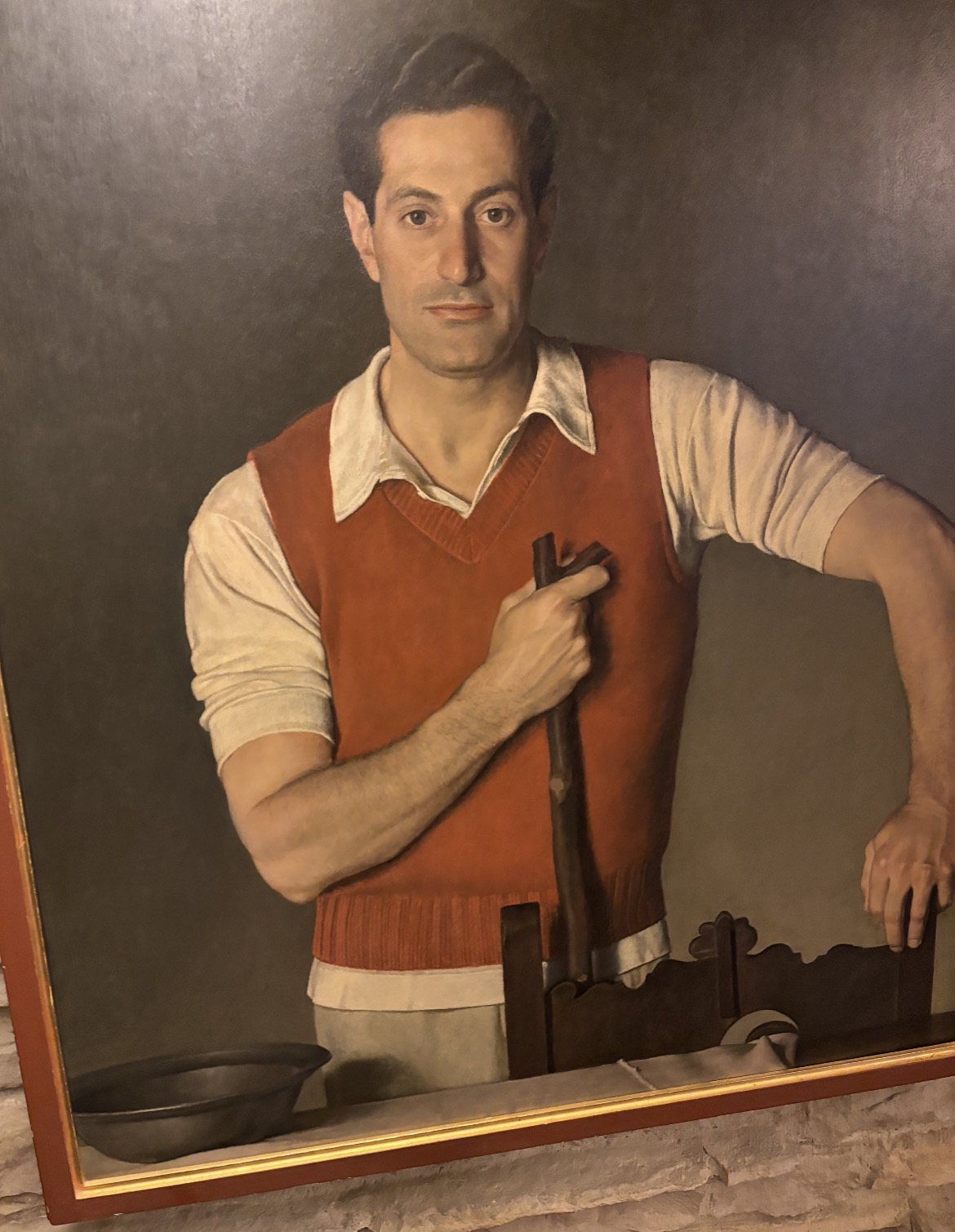
Below is Edgar Kaufmann’s portrait, done in 1929, and occasionally on display at Fallingwater, which is where I photographed it. It is filled with meaningful symbolism and clues to his personality and outlook on life. Below is my understanding of this statement.
Edgar is standing between two potent symbols, the (Christian?) alms bowl (charity) to his right, and the carefully shielded Middle Eastern crescent moon, on his left. This moon would be his own background, of the desert, partially obstructed by cloth, that is slightly pulled back to both cover it, and also reveal it by drawing the eye to it. Cloth being the most representative symbol of his department store’s biggest staple as well as its famous fashion statements.
He is holding a rustic walking stick in his dominant right hand, which puts emphasis on the importance of this simple cut branch. Yes, it is a humble symbol of hiking and the outdoor lifestyle, and it also has the V top for holding venomous snakes’ heads. The other venemous snakes in 1929 were the Nazis, and maybe this is his way of saying he would be seeking to catch them and pin them down. Or that he was at least aware of them in his life.
Edgar’s left arm leans heavily on the chair, perhaps a symbol of his never-ending work ethic stuck at a desk.
The chair’s right side, Edgar’s outdoorsy, charitable, artistic, manly, masculine, and muscular side, is well carved, carefully defined. Its left side is deliberately stunted and malformed, as if to say that his outdoors life and his charity work defined him best, and his boring work life was his least interesting aspect. Don’t we all have have different sides to us and to our personalities?
His sporty tennis sweater says all-America, while his shirt sleeves are pulled up to reveal his manly biceps. The tennis sweater is Harvard red, instead of the blue from his alma mater Yale. Something must have happened at Yale to make him upset with the school.
Edgar Kaufmann conveys an image of American masculinity straddling two worlds, one of which he must subtly hide. And the reason I picked this portrait to write about is because nearly 100 years after this was painted, America is back to that 1929 period, where American Jews have to hide their identity, lest they be hurt, abused, robbed, for merely being Jews. This is not a good reflection on Americans, that we have come back to this kind of un-American behavior.
Edgar was a political conservative, but a cultural libertine..another personality split some readers might relate to. He helped design, build, lived in, showcased, and then donated Fallingwater through his son, Edgar jr, for public benefit. Across America, so many historic tourist attractions and artistic buildings were created or donated by Jews, as were an awful lot of the donated buildings at universities. We should be celebrating this ethic, not picking on these people as a whole.
Edgar Kaufmann