About that New Zealand mosque massacre…
Once again, liberal ideas have resulted in terrible results, and yet, the people who promote those ideas blame everyone else for their failures. Now it is a mass shooting in a mosque in Christchurch, New Zealand.
The massacre did not happen in a vacuum.
New Zealand has the same kind of stupid, ineffective “gun control” that anti-firearm activists have demanded for everyone everywhere: No handguns, mass registration with the goal of eventual mass confiscation for a gun-free society (except for the police and security services controlled by the liberals). Had the members of that mosque had access to handguns, like our concealed carry laws permit here in America, then they could have defended themselves against the lone attacker. But nope, anti-gun activists require these bodies and blood in the street in order to make the emotional case for yet more anti-freedom, anti-safety gun elimination.
Sorry, mosque members. I am sorry that you were martyred by the same leftists who have brought so much destruction to everyone else across the planet.
And then, so many questions come to mind, like:
Did that mosque serve as a launching point for public or private anti-Christian, anti-Jew hatred and bigotry, as so many other mosques do around the world?
Did that mosque have members who were actively engaged in denigrating and materially undermining Christianity and Western countries from within, as so many mosques do? Did they take advantage of New Zealand’s freedom and democracy to achieve non-democratic results?
Was that mosque a security risk for New Zealand? Does it harbor violent terrorists or proponents of Islamic terrorism?
Was the mosque officially silent about the non-stop bloodbath perpetrated by Islamic jihadists against innocent people around the world, notably Christians living peacefully in Paris and London and Antwerp?
Was the mosque officially silent about the obvious danger that Islamic jihad represents to the entire world?
Did that mosque serve as a center for spreading Islamic terrorism, as so many other mosques do around the world?
These questions and many similar ones must be asked, because if any of them are affirmative, then the massacre could be construed or even understood as an act of self-defense by the perpetrator, acting on behalf of his vulnerable countrymen who are paralyzed by leftist political correctness and an inactive government run by people willing to sacrifice the entire nation on the altar of “understanding” a fascist, totalitarian ideology that is mutually exclusive with the openness and tolerance New Zealand and every other Western nation stands for.
Here in America, Muslima Terrorista Suprema Linda Sarsour used the massacre to publicly explain exactly what is at the heart of this civilizational conflict. She explicitly blamed “white Christians” as the source of all evil on Earth and of being the biggest threat to all civilizations. In other words, when some mosque somewhere gets a taste of its own medicine, suddenly jihad against Christians and whites is openly justified. As if jihad against Christians and Christianity has not been ongoing for 1,300 years! No wonder Westerners are phobic of Islam; they are afraid for very good reasons.
Here in Harrisburg, the local JCC issued a Marxist screed about the shooting, decrying, among other ridiculous things, “Islamophobia” and “bigotry” (no, not the explicit anti-Christian, anti-Jewish, anti-Hindu bigotry of the Koran). One wonders if the regular, normal, hard working members of the many various JCCs and Jewish Federations around America will ever tire of underwriting the Marxist march of their institutional professionals, who seem to specialize in delivering sappy Yiddish entertainment to elderly people and Marxist-everything-else for everyone else. In the past it was Margie Adelmann, now it is Jen Ross, the “professional Jews” who represent the very worst of secularism and controlling, destructive leftism. Neither of them was or is responsive to JCC members who want them to stop politicizing everything in the name of Marxism and political correctness.
They, too, are on a jihad, parallel with Linda Sarsour, the rest of us be damned.
Book Review: The Uneven Road, by Lord Belhaven
The Uneven Road (1955), by Lord Belhaven
I read this fascinating book twice, and I recommend you read it at least once. Heck, just the old black and white photos of mysterious holy cities, like al Q’ara, (taken with early hand-held cameras from a bi-plane in the 1920s and 1930s) and traditional Arab tribesmen, both even today far out of reach of Westerners, are worth the five or ten bucks it’ll cost you to buy it on eBay or Amazon. For just five bucks you can get one of these fascinating and educational books, and have a most enjoyable weekend reading, and learning. Find me another great, safe, healthy mind trip for five bucks, please.
Why review a book published in 1955, about the now dead Brutish Empire? What made the British Empire so grand, so great? Setting aside the natural feelings of those locals who were subject to British rule, for better and for worse, one cannot help but marvel at the remarkable discipline, planning, administrative organization the British brought to their empire. Any nation today would be well served to get one tenth that level of service from its own government.
And why would a book published in 1955 be interesting today? For one thing, history has a tendency to repeat itself, or to repeat versions of itself — things that happened in the past seem to happen all over again. If we who are living now can harness the lessons of the past, then we can avoid the mistakes of the past, too; or at least so goes the best thinking. Certainly one must know history in order to know what happened, and how to identify when the same forces are at work once again.
In order to understand where we are today, we must look at what decisions and resulting actions got us here, and why those choices were made (come to think of it, I recently read another similarly aged but highly useful book titled Why England Slept, written in the 1940s and 1950s, then authored and published in 1962 by some then-nobody named John F. Kennedy). The Uneven Road does an excellent job of explaining much of the Middle East and East Africa through one man’s colorful and risky exploits from a military and diplomatic hot seat along the Indian Ocean and the Red Sea, and then into the Italian Alps. Judging by current events, little has changed in the former.
As the title implies, the author took an uneven road in his long life, following completely neither his traditional Scottish upbringing nor his adopted British devotion to Empire. As he says in so many ways throughout the book, Lord Belhaven is a lot like his forebears, individualistic, strong, self-driven men who admired authority and convention as much as they bucked them and tried to fit into them on their own terms. Or one might say, Lord Belhaven and his ancestors tried to make convention in their own image. As an American, to me this independence streak is a highly laudable trait, even if it did damage to the already impressive careers of Belhaven and his father and grandfather.
The author is both very open-minded for his time, gleefully throwing off class and religious barriers that today seem so unbelievably feudal, especially to Americans (and familiar to those Americans who enjoyed the Downton Abbey series) with our hodge-podge zero-caste-system, but which were quite dominant in his early years. He is also representative of some persistent silly views that are also peculiar to certain groups of people where he is from, even today. To me, an American, whether I agree or not, this is all part of being a natural, well-rounded human being, and a sign of being interesting. Everyone has prejudices and sharp-edged opinions, and everyone is entitled to them. No one is perfect, our author does not claim to be perfect, nor does he engage in the vacuous virtue signaling which so sharply defines today’s Western civilization. More to the point, neither you nor I are anywhere near perfect or nearly as exciting as Lord Belhaven, and only very few people you or I have met or ever will meet are going to be nearly as interesting as Lord Belhaven.
Writing as a soldier, administrator, diplomat, lonely husband and then divorcee, and amateur historian/ethnologist/archaeologist, Belhaven is a gentleman, and also a manly man. He is the old archetypical British\Scottish aristocrat patriot, both swashbuckling and under steely self control, a thing of the past which, my gosh, we now could use much more of in our own time. He is clearly a warrior, and an effective one at that, and yet much of his book is stories about how he was not such a great warrior, or how he was charged with establishing peace in lawless places through diplomacy, and yet relied upon deadly warfare.
As he reminds us, especially with the burning of the village of Jol Madram, diplomacy without the real threat and the occasional implementation of brutal violence is simply indecisive inaction, a weakness that inevitably invites more lawlessness or aggression. For Belhaven, there is no foolish, circular “conflict resolution” without resolving the conflict to concrete terms he likes and which work for the most people. Instead of getting “triggered” and fainting into a safe space when confronted with adversity, Belhaven the man of action responds by putting his finger on the trigger of his revolver and explaining just how things are going to get back to full function, or else. In a Western world today of namby pamby political correctness and feminized men, reading this book I could not help but think How refreshing! And also, Where the hell did our masculinity go?
The author’s voice is forthright, unafraid, honest, and though a few times I may disagree with his views, I keep thinking as the pages are turned, “Now here is a man I could respect and like!” Would that Western Civilization today had many more men like Alex Hamilton, aka Lord Belhaven.
Spanning the 1920s through World War II, and published toward the end of the British Empire, The Uneven Road is one more fascinating on-the-ground report in a line of the “Hell, I was there” genre of personal adventure histories written by British military and political officers across the British Empire, upon which the sun did not truly set until the 1960s. The Uneven Road is one of the last from the frontier, and in my experience it is one of the better written and certainly the most personally reflective. In some ways it is a companion piece (maybe even a necessity) to books written by or about others who traveled, explored, dug archaeological treasures, politicked, and fought in and around the Arab Peninsula, such as Lawrence, Philby, Ingrams, Jacobs, and others.
There are many, many examples of these personal field reports and histories from the 1790s through the 1960s. Some are famous, most are obscure, some are kind of boring, and many carry an overt agenda, and yet almost all are illuminating about life among the British Empire’s boots-on-the-ground administrators and soldiers, as well as the occasionally momentous political events of the day. The fact that these personal histories exist at all, and that they are often well written, says a lot about the high caliber of the British and Scots of that time, both the writers abroad and the readership waiting back home. The Uneven Road meets or exceeds all these standards.
While other major cultural “encounters” and confrontations have been largely or absolutely settled in the same time period, in key ways that are of great interest to the modern reader, this book is about East-meets-West, a contest that has only grown sharper and more defined a full hundred-plus years after it fully got under way, as described in these pages.
Britain: A Culture of Selfless Patriotic Duty
One need not read a book to hear or know about England’s long established culture of patriotic duty and self sacrifice for king and country, but reading this book will help the interested reader gain real appreciation for both the depth of feeling most Britons had then, and for the real personal cost it then meant later on in their lives. The unbelievable battlefield losses in World War One and WW II greatly changed England’s culture, resulting in a legacy of pacifism, fear of inevitable conflict, and self-defeat we see officially operating today.
Throughout the first half of his fine book, Belhaven off and on artfully weaves an analysis full of personal anecdotes of British military culture, including how wealthy aristocracy would often take a vow of poverty (as opposed to running a family business or a valuable property) to serve in the military, for the simple satisfaction of providing patriotic service to the nation. The following quote only touches on this, but it covers enough other turf to qualify for mention here:
“One Saturday, towards the end of our last term at Sandhurst, Tony Keogh and I were both excused [from] work because of minor injuries. Tony Keogh was a dour Wellingtonian, whose ambition was to give a lifetime’s service to Waziristan on the northwest frontier of India, a country which his father had been the first to survey.” (page 40)
Waziristan of the 1920s is today several different ‘stans, including parts of Pakistan and Afghanistan. It included then as it does now all of the intolerant, violent religious fanatics who still make it such a special place. From the 1880s through the 1940s, British troop losses there were big. Can you imagine being the first person to scientifically survey a significant portion of the planet, this very rugged, remote place specifically, surrounded by such danger? And then bear a son who simply wants to pick right up where you left off? Such was the tough, brave stuff the British were made of, once.
<sigh>
And it was that same patriotic fervor and absolute selfless commitment that made such brave soldiers for World War I and then World War II, and then resulted in the pacifism of modern Britain, when few men returned home:
“Toll for the brave!” that most perfect of slow marches – how often had we marched to its slow, sharp rhythm. When I hear the tune now I can see, as I saw then, the high, shining fence of bayonets, the straight, erect lines moving forward with irresistible menace and force, the very symbol and image of war. And all with its glint of youth unafraid, unconquerable. Toll for the brave indeed; few who marched that day have pottered on as I have done for fifty years.” (Page 40)
<sigh>
His description of his surprise at winning the Sword of Honour at Sandhurst is both funny, and then sad, as his stiff-upper-lip military father refuses to acknowledge it until two years afterward, and only then sarcastically. That sword becomes a snapshot of his challenged relationship with his father and also a symbol of British culture.
Report from the Frontier: “It was impossible to be bored in Aden”
If India and Africa provided the greatest quantity of opportunity and adventure (the British defeat of France’s fleet at the Nile, the ‘Mountains of the Moon’ search by naturalist-explorers Burton and Speke for the source of the Nile, the Mahdi, the Zulu Wars, Islandlwana, Rorke’s Drift, the Boer Wars, and so on) for these far-flung representatives of Her Majesty’s Service, it was the Near East and Middle East that created the most vivid and gripping images consumed widely by the public, even today.
Think of “Lawrence of Arabia” and all the thrilling weight that phrase still carries a hundred years later. And so just a decade-plus after a charismatic young Brit, T.E. Lawrence, led the Arab revolt against Ottoman Turk rule throughout the Near and Middle East, it is primarily on and around the Arabian Peninsula that Lord Belhaven’s book takes us. It is an often militarized and occasionally one-man-army journey by foot, camel, horse, donkey, bi-plane, and boats of various type and size, including some pleasure craft of his own construction.
Based in Aden and sallying forth through abandoned ruins from hidden, unknown, lost civilizations to high mountain forts inhabited by fierce tribes, Belhaven fearlessly and luckily does his best to bring order to the fractured tribal chaos of the southern tip of the Arabian Peninsula, what today is known as Yemen and known then as the British Protectorate of Aden. Like most Brits of his time, Belhaven was an Arabist, an Arabophile who simply looked past the stark differences of Mohammedanism compared to his own culture of gentle mercy and forgiveness, stricken as he so clearly was by exotic Arab ways. His gunfights, in which he was sometimes greatly outnumbered, the aerial bombings, and his knife-edge nose-to-nose confrontations with cutthroat highway gangs and treacherous tribes are the stuff of legend; his fishing and hunting trips during working hours are not, though he does describe them in obvious joy and often at his own expense.
Though in a serious tone Belhaven opens up about his family life in the first third of the book, in the rest he makes it clear that he knew how to have fun and push British foreign office sensibilities beyond their traditional staid demeanor.
Belhaven gets extra credit for a dry wit and self-deprecating humor applied from several miles up. He does not take himself too seriously, or even seriously at all, at times, even as the bullets are flying and his life hangs by a thread. This bon vivant tone heartily leavens the serious life-and-death situations he describes, including shooting himself in the foot in the heat of battle, and nearly shooting his Somali hunting guide who chases a large leopard out of a cave and into Belhaven’s face, not to mention his rear line and front line experiences in World War Two.
One of the artifacts of time and place is the author’s fascination with genetics, a hot (and also destructive) topic of that era. Repeatedly marveling at the “pure” inbreeding of certain tribes along the southern Arabian Peninsula, the author relied upon simplistic, romantic, and plainly incorrect notions of genetics. But this is to be chalked up to the general and long lasting British awe and love for the colorfully fierce Arab nomads of that region. Whatever they did, no matter how backwards or weird, was very cool. Who can blame him for thinking thus? Were you or I to live out there today, we would find it just as alien and compelling as he did, and it would all be just as cool now as then.
Insights into his own family struggles with intimacy and finances, and the perhaps unrealistic lifestyle expectations accompanying title, are illuminating for those wondering how the famous British aristocracy slowly crumbled from the inside and out.
When it comes to archaeology, what is not mentioned is louder than what he might have written. Lord Belhaven apparently had an eye for long lost antiquities easily unearthed with the toe of a boot in the loose sand of some long lost civilization in the middle of the blistering desert. In a tempestuous sea of worldwide archaeological looting by British nobles, scientists and adventurers, Belhaven’s personal interest in a few old broken, abandoned things lying in the dirt was strangely singled out for criticism by a couple of bespectacled Peabody types in imperial administration back home. Belhaven makes no mention of any of this in his book, and maintains his focus on big picture civilizational development. As he should, in the tradition of the fighting naturalist-archaeologist hero; a kind of Indiana Jones.
Detailed references to carved alabaster amid the sands, and marble ruins, lost cities, dams, water works also occasionally appearing and then disappearing amidst the shifting sand dunes add an element of authentic mystery that is harnessed in the Indiana Jones and The Mummy movies. Except that Belhaven was actually there, and saw and explored those ancient mysteries with his own eyes.
Will a couple of “Aw, shucks” ruin all the “Atta Boys” in this book?
Though he does not explicitly set out to do so, the author’s plainly spoken recollections invite the reader to share the author’s unspoken pangs of loss over decreasing British influence and culture.
In 1955 the author was in good company, with his views on race (a word he uses many times with several different meanings), skin color, religion, and social class, even as he was clearly departing from those long-held views. Bigotry and class snobbery were then becoming a thing of the distant past, a change which Belhaven mostly embraces and in many ways led in his own “black sheep” personal way. Those anachronisms particular to that time period he retains were either common figures of speech, cultural crutches, or concrete functions of Caucasian minority survival in otherwise hostile foreign places.
We today may not agree with him or his use of some words, but he usually explains himself well, and so we can often understand his thinking. Understand is the key word here, and it does not mean or infer acceptance or approval. And if the reader wonders why I, myself, am insufficient in my condemnations of the author’s few lapses, may I suggest one consider the word “tolerance,” or the phrase “open minded,” or that almost extinct word “understand.” In other words, that was then, this is now, these are different times than then, and once again, everyone has opinions and views that others find “offensive” or uncomfortable. Get over it, get over yourself, learn to tolerate differences in opinion, and move on. I did, and you can, too.
In an educated and open society such as ours, everyone is entitled to an opinion, even a wrong opinion, and even a bad one. God knows, today’s self-righteous book-burning censors falsely accusing everyone else of political heresy and racism have plenty of bad and wrong opinions themselves. In the past, people have been and should continue to be able to disagree with one another without taking silly offense at the simplest of differences, and then retreating to corners and brandishing the war colors. Goodness gracious, people, put away the guillotines! Give people some space to be wrong, or to explain why they thought they were right. And that maturity is what a reader must bring with them to get the most on this trip through time.
For example, in a book full of many humorous and comical stories, anecdotes and quick turns of phrases, there are a couple references to race and genetics, captured so perfectly in The Uneven Road, that really shine a light onto the important evolutionary changes of thinking and attitude about race and skin color happening in the pivotal 1950s. Recall that Belhaven is a born aristocrat:
“I found the whole subject of breeding, as it was accounted in our curious society, absurd; if a man married the crossing-sweeper’s daughter, no one bothered to find out about her breeding; her father’s trade was enough to condemn the match. When it was discovered that he was a rich Jew, who swept crossings through eccentricity, opposition could be relaxed, particularly if he kept race-horses and was a member of the Carlton.” (P. 29)
One page later Belhaven hilariously describes how his Eton school class failed a basic introductory genetics course on mice, with the best and wildly cheered answer to the teacher’s question being a boy’s half-assertion-half-question that inbreeding causes parents to eat their young.
Fast forward sixteen years and Belhaven, now working as a British Political Agent in the Arabian Peninsula, writes: “I have sat in their gathering of Princes, in their Chief’s lamp-lit reception-room and watched them, their skins shining like polished gun metal in war-paint of oil and indigo, a dull sheen of gold and silver in their great daggers, curved with the curve of the moon; the remnant of a great nation indeed, virile, unconquered by arms or by time, handsome and courageous. And marvelling, I have remembered that these men among whom I sat married always, by long custom amounting almost to law, among their own family; so through the millennia they have achieved an extraordinary purity of breeding…for a period of five thousand years…” (P. 86, emphasis added)
And so, as much as Belhaven mocked his fellow students on their failure to grasp the essentials of healthy, necessary genetic diversity among mice and humans, he then later includes himself in their unfortunate company by endorsing the worst sort of human inbreeding, still going on even today in the Arabian Peninsula. This is the intellectual price one might pay for getting emotionally involved with something, as did Belhaven and all of his fellow Arabists. However, it remains fact that none in that time could have remotely foreseen that a surprisingly large number of parents across the Middle East would today encourage their own children to engage in suicide bombings and attacks. Talk about parents eating their young…
Just coming out of the real, actual Lawrence of Arabia time, an amazing time of high military and political adventure, and his living and working in that exact location with many of the same people, Belhaven’s near infatuation with all things Arab and Islam were then and are now understandable. His views on the Middle East were widely shared among his fellow Brits and Scots at that time. Even today many British still cling to detached, romantic notions of Arabia and Sharia-compliant beheadings and stonings, though having now painfully absorbed nearly half of the Arab world into London and having watched the other half wage sadistic war amongst themselves at home, and against Western Civilization abroad, has been shifting those old romantic notions into some other cold, hard, realizations.
Similarly, his views on Jews and Judaism range from the ground-breaking class acceptance (done with excellent humor at the expense of his fellow Brits; see above) to the old traditional British snobby disdain. He was only a little less tough on the Church of England. One must wonder what Belhaven would have written had he lived to see most American Jews and the Church of England and the current Pope all almost wholeheartedly embrace Marxism and anti-Western anarchy. If there is a resurrection of the dead, I want to be right beside Belhaven, so I can be the first to hear his colorful, insightful reaction to these unfortunate, really unbelievable facts.
One thing Belhaven did not live to see was the now-modern state of Israel, the then-nascent version of which he refuses to name in his book, but which he negatively alludes to several times. This is the old fashioned British Arabist coming through. Of the Jews of Yemen he has a brief but historically important and also humorous first hand encounter and report; but he then fails to mention their subsequent unjust inclusion among the nearly one million innocent Jewish refugees ethnically cleansed by his cool Arab friends from their ancient, very pre-Islamic communities across North Africa, the Near East, and the Middle East.
“So we came near to the end of our stay in Sa’na. Champion [Sir Reginald Champion, then Civil Secretary to Aden and later its Governor] and I called on the head of the large Jewish community in the city. Although considered by the Arabs to be an inferior race, the Jews of the Yemen were well treated by the Imam [Imam Yehia, a Shia leader who later lost the Arabian Peninsula to the Wahhabi al-Saud family, and whose spiritual descendants today are the once-again rebellious Hauthis]…Now there are no Jews left, they have all gone to Palestine, a Promised Land without either the milk of human kindness or the honey of their expectations…” (P. 104)
Hello, Lord Belhaven, reality is calling now, just as it did in 1955. The Yemenite Jews did not just casually get up and leave their homes in Yemen of 2,000 years for Israel out of a desire for better falafel or flush toilets; they were universally axe murdered and driven out of their homes by the same Muslims you so admire, the lucky survivors arriving in Israel with the shirts on their backs, their family homes and businesses stolen and occupied, their bank accounts looted, their personal property removed by force, like all the other Jews from every other Arab country at the same time. So why Belhaven ignores these facts to get in some shots on Israel is, again, likely a question of the impact of that romantic infatuation with remote alien cultures. Were he alive today, he would probably be a Christian Zionist like another famous and contemporaneous British Arabist, Col. Meinertzhagen (who when introduced in private to Adolf Hitler responded to the perfunctory ‘Heil Hitler‘ with his own ‘Heil Meinertzhagen‘).
Did Belhaven write some occasionally harsh stuff? Maybe so, certainly by today’s standards. But so what. Get over it. On balance, this book is 99.999% fascinating, illuminating, educational, and important history. Why judge and then dismiss the entire work based on a couple anachronisms from his own day?
As briefly mentioned above, one of the big challenges our younger generations are failing at is their tendency to immediately be offended by, and then harshly judge and dismiss, older generations by applying current standards. Instead of trying to understand how the previous generations thought, and why they fought way back when. Surely there must have been compelling reasons for the many momentous decisions that were made and then chiseled into stone or cast in bronze. Not everything back then is “racist,” which has become as hollow a crutch word as can be found. As old statues, symbols from important self-inflicted internal wars across America, are pulled down by screaming, infantile, anti-history mobs, one cannot help but wonder if the screamers will ever be interested in why the statue was erected in the first place. Or do they aim to simply re-write history (irrespective of the actual facts, causes and effects) to suit whatever political purpose suits them at some future time? I would rather have Belhaven’s honest accounting than a dishonest re-writing of who we are and how we got here.
In sum, whatever “Aw, shucks” Belhaven may have earned in a few spots here or there, they are far outweighed by the many “Atta Boys” he racks up over and over throughout this excellent book. For those younger folks who are actually and truly interested in understanding history, and how people’s views on race, religion, and income\ social standing changed over time in Britain and America, and how the Arabian Peninsula yet remains completely unchanged, The Uneven Road is a refreshingly honest and educational Exhibit A at the crucial time of the post-war 1950s.
Obscurity often means fascinating
Many years ago, in the late 1980s and early 1990s, when it was an actual newspaper that reported much actual news, instead of having the entire paper be one editorial after another masquerading as news, which it does today, the New York Times published a series of articles based on the simple methodology of having a news reporter (another extinct species the younger generations have never seen) open the New York City phone book (‘And what, too, is that?’ the younger generations ask) and randomly place his or her finger on the page. This was done ten times over the course of a bit over a year, as I recall. Whoever’s name was there over the finger nail got a call from the finger’s news reporter, who then did a detailed report on that person’s life. As the subsequent reports showed, despite living almost entirely quietly and privately in the big anonymous city, each and every one of those randomly selected people had nonetheless led a fascinating and often deeply compelling life.
And so, here now we have similarly plucked out of historical obscurity a book long out of print and probably originally of interest to few beyond aging British soldiers and Foreign Service dignitaries. Yes, here in Lord Belhaven we have a man whom very few have heard of, and as he is an aristocrat he is presently out of favor for having violated some social construct or…thing, even though he was a reflective, self-deprecating, risk taking and self-sacrificing humble public servant who enjoyed breaking with his own social norms and elevating many downtrodden. His life was more than fascinating, it was bigger than life, as we say. It was certainly bigger than my life or anyone else’s life I know of, and I know some pretty adventurous people in military and law enforcement, as well as international hunters. And today outside of Britain and America’s special forces operating abroad, very few public officials do anything close to what Belhaven did. And given the opportunity, few today would take it. Pity.
It was people like Lord Belhaven who put the “great” in Great Britain. Given how far and wide Hollywood looks for true-to-life stories, why no one has done a movie based on this book or on Belhaven’s life is one of those mysteries that highlights how shallow Hollywood is. Because it is true that Indiana Jones was mere Hollywood fiction, whereas Lord Belhaven was for real.


How to properly pronounce “Lancaster” and why it matters, here
“Lan—Cas–Ter.”
When I heard the radio ad with that unnatural, long, drawn out pronunciation of the county and city just south of me, the endless chasm between the syllables felt years apart, so unnatural that my internal warning system flashed “outsider alert, outsider alert.”
This ear-grating goofball advertisement played for two days before being pulled and replaced with the same voice, but subsequently correctly saying “Lancaster” as almost one long syllable.
How many calls and emails did the radio station get about this? Evidently enough to make an impression on the people in charge of advertising. Running a radio advertisement that annoys the audience is counterproductive, and you’d have to hear from a large enough segment or sample of that audience to get the message that your message was not just falling flat, but actually bothering your target audience. People cared enough to contact the radio station and voice their opinion.
Why do Central Pennsylvanians care about how their locations are pronounced?
Probably for the same reason that Perry County has communities like Newport and Duncannon and New Bloomfield housing most of the county’s 30,000 citizens, and yet those same people will tell you they are from Perry County. Not from Newport, New Bloomfield, or Duncannon. This is because the identity of the locals in Perry County, and elsewhere around the Central Pennsylvania region, is one of community, togetherness, joined together in common interests and identity. Not separated from one another, as in most other places. The larger community, like the county, is the defining characteristic for the residents. We all belong here and we belong to each other, in common and shared purpose.
I recall reading a linguistics study of Central Pennsylvania years ago, and how the authors traced the unique accent here to Swiss and German immigrants in the 1700s. And in fact, if you talk to older old order Amish and some older old order Mennonites, you will indeed hear that very distinct English spoken with some sort of heavily foreign accent. Like all languages, including British English, Southern drawl American, Ebonics in the ‘hood, and so on, this common sound is the sound shared by a commonly identifying group of people. When they hear the familiar pronunciation of their own language, they know they are communicating with someone who is “one of us.”
One of the defining characteristics of Central Pennsylvania is its pretty resilient regional identity, including political views and political engagement, religiousness, and so on. Outside forces may be at work here, altering our beautiful landscape with criminally ugly warehouses and temporarily bombarding our ears with Flatlander-foolish pronunciations of our local places, but through it all, we still hold on to our common identity, our common purpose, our common interests.
Central Pennsylvania is still one big community with common identity. This is one of the reasons that the Obama Administration targeted Lancaster County (and rural Minnesota) for simply air-drop dumping huge numbers of fresh foreign immigrants, most of whom could neither speak nor read English, but who had been carefully instructed how to vote for the “(D)” on the ballot. Politicized efforts to disrupt traditional American sense of community and togetherness, and common purposes and commonly held interests and values, are increasing, as one political party in particular attempts to destroy and re-make America into an identity-less, gender-less, Constitution-less, all-powerful big government global nerve center for everyone on the planet and every cockamamie idea that will destroy “evil” capitalism etc.
And this is why people here so strenuously resist the improper pronunciation of “Lancaster.”
This mispronunciation concretely represents the outside evil forces arrayed against our traditional identity and lifestyle. When we reject that pronunciation, we are asserting our identity and rejecting outsiders, carpetbaggers who attempt to sell us snake oil without even taking the littlest amount of time to understand our closest held thoughts and beliefs. And they fail to do that because they simply don’t care about us or our religious redneck identity; and, in fact, they look down on us.
For all you outsiders, for the record, here in Central Pennsylvania we pronounce Lancaster as one long, fast, single syllable, Lancaster. Not like actor Burt Lan-cas-ter, who, as a Hollywood actor engaged in silly dress-up and fanciful make-believe his whole life, was the ultimate alien to our deal-in-real, natural, down-home, farming and mountain dweller environment here.
So say it again, quickly, Lancaster.
No time or spaces between what your head tells you are syllables. Say it again, fast, one quick word, Lancaster.
There, you said it, and we like you already. See? You fit right in, you hillbilly, you. Here’s a gun, and a Bible. Display them prominently in your home.
Do young Americans have what it takes to keep America?
Observing young Americans in all the various activities we all engage in, including work places, one has to wonder if they are capable of holding on to America.
They take so much for granted, and also seem unaware of what it took to both build America and hold on to it.
If a young person has a smart phone, a five dollar coffee, and the correct cool hat, nothing flusters them. The world turns, no matter what the problem.
Problem? “What me worry” is the universal young person response.
Will a young person put on an American military uniform? Or do the Millennials think the totalitarian Chinese are our friends? The Chinese will put a bullet in the head of every openly gay, religious, and freedom & liberty-loving person who stands in their way of complete domination. Millennials don’t seem to understand this.
And the workplace environments and cultures they have created are the opposite of what is needed to be creative and experimental. Everything you say or do is booby-trapped, every office is a mine field of potential socially awkward or professionally self-immolating speech or thought crimes.
To them, Socialism is great and capitalism is just terrible and so so unfair. Never mind that the coffee, clothes, and iPhone smart phone thingy are products of capitalism that undergirds everything these young people enjoy.
If this sounds like the proverbial “kids these days” old man gripe, then it is. That gripe gained popularity after World War II, when material and physical comforts were becoming ubiquitous and American youth generally had much less work to do to achieve basic necessities. Like Aldo Leopold wrote, Americans got soft as soon as soon as they could get heat from a switch and a furnace, and they no longer had to cut firewood.
Material success has its benefits, for sure, but the accompanying materialism and soft, superficial culture resulting from it is just as deadly as a nuclear bomb or a secret poison. It just takes longer for the materialism toxin to work.
I don’t know. I’m not real optimistic about the Millennial generation. They’ve been shooting each other in schools at record levels, and simultaneously hostile toward responsible gun ownership and the Constitution that preserves that and all our other individual rights. They like everything given to them, especially by government, and really don’t want to have to pay for it. They think a country can just be a big happy coffee shop.
Kids, there’s no free lunch, not even a cup of free coffee.

CPAC banning reporter Laura Loomer proves frailty of “conservative inc.”
This past week, just days ago, intrepid and fearless reporter Laura Loomer was blocked from entering the CPAC convention, having already been there for days and having already spent her money on lodging etc. As she handed the security guys her credentials, they took them away from her and prevented her from entering the convention.
The annual Conservative Political Action Conference has been the gathering place for Republicans and conservatives for many years now. It’s a place to air out new policy ideas, air out old grievances, air out old stinky candidates or debut new ones, network, share on-the-ground war stories, and get new ideas for how to advance America-first policies and laws, including how to get conservatives elected.
But like so many other public events, of any sort, people try to make money from CPAC. Especially its administrators. When money and ego become central to the event’s raison d’etre, away go the core principles that once caused people to convene in the first place. Now CPAC has gone full commercial and totally corporate, with all the usual and customary strings attached to corporate sponsorships. Like don’t rock the boat. Suddenly raw and honest debate becomes “uncivilized,” and the “Professional Republicans” move in to correct and santize everything.
God forbid someone says something offensive! The well groomed, serious faced, and utterly hollow “Professional Republican” robots will move in to take you away.
And Laura Loomer did in fact say something offensive. Really really bad. Her big offense was to repeatedly or doggedly ask CNN political activist Oliver Darcy why he uses his celebrity status to drum conservatives out of digital websites and platforms like Facebook, Twitter, PayPal, Venmo, Patreon and so on.
Darcy is a guy who publicly crows every time a conservative is kicked off of some platform and loses their free speech rights, for the huge violation of disagreeing with the radical leftists who own or manage those public platforms. It’s not that the conservatives are doing anything wrong per se, it’s that disagreeing with the liberal book burners and anti free speech control freaks who run Fakebook, Twitter etc is itself a huge violation.
And so Loomer did what real reporters do, or used to do, she found a more-important-than-thou untouchable person (Darcy) and asked pointed questions about their (his) at-best questionable behavior. Darcy then complained to CPAC management and voila, Loomer is scrubbed from his glowing presence. Because being a happy shiny establishment media darling at CPAC is more important than what CPAC supposedly stands for.
See, the bigger question is why Oliver Darcy is even at CPAC, and then why would he expect to be protected from inquisitive reporters there, doing the job that mainstream media activists long since stopped doing. Darcy is opposed to everyone and everything represented at CPAC. He’s not there because he shares the values or principles of the attendees; rather, he’s there to be a mole, to undermine CPAC from the inside.
In any event, as CPAC has become yet another corporate bandwagon, run by “Professional Republicans” who represent “Republican, Inc.” (or “Conservative, Inc.”), the bastardized evil hybrid of political action for individual liberty and limited government with making money. Loads of money. That is what CPAC is now, and Laura Loomer threatened to undermine the shiny happy people appearance that professional GOP functionaries and their financiers value most above all.
Strike another GOPe blow against grass roots citizen activists and reporters, struggling against a big money uniparty made of both Republican and Democrat establishments.
And yet, Laura Loomer emerges as another citizen hero, a sort of Joan of Arc, a Rosa Parks who questions why not just she but all American citizens who rudely (sarcasm here) ask simple questions about the nature of our government and our rights must sit at the back of the bus, or as Oliver Darcy and CNN would have it, get kicked off the bus altogether.
You go, girl! Go get ‘em, Laura.
Still the chief of Celtic music: The Chieftains at 57

Local York Scots Bagpipers Brigade joined local York Chorale members and then audience members with The Chieftains and the Piltazke Brothers in a long snake dance that ended the performance

The local York, PA, bagpipers all dressed up in their Scottish tartans, participating with The Chieftains in a typical sharing of Celtic culture and music, to the audience’s delight
Last night the Princess of Patience and I ventured not too far down the road to the Appell-Strand Theater in York, Pennsylvania. It is a venue we have visited over the years for a variety of music types for the adults, and high-end children’s entertainment for the kids. It is a clean, pretty, historic place right in historic downtown York, easy to access, lots of free parking, and when you are done, it is easy to leave. Fellow patrons are easy, chatty, friendly, happy, and the lady I sat next to, a Lori Sims of Hanover, PA, cheerily shared gardening tips with me and disclosed her yearning for Spring to finally arrive so her garden could get under way. Then again, no wonder: she has a TWO-ACRE GARDEN.
What we witnessed last night is one of those rare moments where, if you have been lacking in faith in humanity for whatever reason, it would be restored immediately. We watched The Chieftains do what they do best: Play sweet Celtic music combined with amazing Irish dance, and incorporating local talent in a pub-like atmosphere of fellow music chums just kind of jamming along with each other in the spirit of the moment. It would be the best of what you would find at the Temple Bar today.
So here is Chieftains founding father, Paddy Moloney, who must easily be in his 80s, alternately playing both the chipper and then humorously gruff oldster commenter, as well as his own penny whistle and Irish pipes: “Oh sure, ya show-offs,” as the Pilatzke Brothers perform amazing amazing amazing Irish tap dance routines that leave the audience exhausted from the intensity and skill. Serious world-class talent.
Now in 2019, The Chieftains are celebrating their 57th anniversary. Think about that. Fifty-seven years as inspiring performers of not just music, per se, but keepers of traditional culture, Gaelic language, ancient musical instruments, and the music and the rural, undeveloped, natural Irish landscape that binds all that together. It is quite a gift to all of us that they provide. At 57 years of live musical-cultural performances, The Chieftains are an institution, a world heritage institution.
Despite having a stack of Chieftains CDs, I can never really get enough of them, and last night my mind drifted back to one evening in the summer of 1992, during the Celtic Festival at Wolf Trap, in Virginia. The Princess of Patience and I were about to be engaged to be married, and our long-time friend Lori encouraged us to join her at Wolf Trap for that evening. The weather was perfect, the music was perfect, the musicians and performers were perfect, our snacks and wine were perfect, the audience was rapt and enthusiastic. It was all quite perfect. And there they were, now 27 years ago, The Chieftains up on stage, looking a hell of a lot younger than now, and probably having a few more teeth then than now. But still flawlessly performing the same beautiful, inspiring music.
That was the same evening I heard the best-ever joke about the bagpipes, and it is a surprisingly unknown quip, because whenever I pass it along, people respond with great mirth, as if they have never heard it before. I will disclose it here, because I know the three people who read this blog have zero interest in Celtic anything and they will immediately forget this secret to being the star at any dinner party attended by Irish or Scots.
This joke arose as an Irish pipes player dueled with a bagpipes player on stage that evening at Wolf Trap. When played correctly, the Irish pipes are of course the most heart-tugging sound the human ear will encounter. Squared off against the blaring, loud, military-oriented bagpipes, the Irish pipes are like a gentle, sweet whisper versus an aggressive, loud shout.
So after their duel on stage, during which he had played the most mournful, beautiful, inspiring sounds, the Irish pipes player said to his Scotsman counterpart: “You do know, the Irish gave the bagpipes to the Scots. And the Scots never got the joke.”
Cue uproarious audience response and a big grin from the Scotsman. Audience participation in Celtic music is expected, and it is given, as is good-natured banter among the performers.
So, on that same beautiful summer eve 27 years ago, into this good-natured banter with Celtic music and culture stepped The Chieftains, playing with humble passion on the stage at Wolf Trap. And literally over twice as many years later, The Chieftains are still chief, tops among Celtic bands. Thank you for a wonderful night of happy moment after happy moment, guys. Cheers to you, Paddy Moloney, may you see a hundred years, ’cause God knows, why not, you about look it already.
Jusse Smollett hoax an inevitable result of 24/7 Fake News industry & why ‘racist’ now a dead term
Jusse Smollett is an aspiring actor who falsely accused some MAGA-hat-wearing “white men” of attempting to lynch him with a rope, because he is black and, therefore, automatically a victim and automatically given credence by a mainstream media eager to promote such stories because such stories advance a political narrative that suits the liberals running the mainstream media.
Problem was, Smollett’s false accusation turned out to be a hugely, ridiculously contrived, utterly false hoax.
So unbelievable, so incredibly disbelievable was it that on a 10-degree-Fahrenheit night in one of downtown Chicago’s best neighborhoods that a couple of mean old white privilege racist MAGA hat wearing men would be prowling, just looking for someone to victimize, that the police were already kind of suspicious of his story.
And the rest is recent and public history: Smollett is a liar, guilty of not only creating the false police report to build up his own public standing, because he is a bit-actor desperately wanting to be a celebrity actor, but of also racistly slandering/maligning an entire group of Americans because of their skin color (white men).
The question is, why did this even happen?
Another question is, why did the national media report his accusation before waiting for the facts to emerge?
The answer to both is painfully simple: Jusse Smollett’s fake accusation racial hoax is a natural byproduct of the 24/7 Fake News mainstream media industry that promotes and protects false accusations and victimhood by favored groups and individuals, while simultaneously protecting racist and sexist liberals and Democrats from being publicly outed for their very real racism and sexism.
Think Judge Kavanaugh being falsely accused by mainstream media darling but obviously disbelievable Blasey Ford.
Think the Rolling Stone story falsely accusing an entire men’s sport team of gang raping a black woman and using racist epithets during the non-deed.
Think of the mattress-carrying college student who destroyed a young man’s life with a false accusation of rape, because he would not date her.
Think of the violent criminal thug Trayvon Martin physically attacking an innocent bystander, receiving a huge dose of justified physical response that left him dead, and yet nonetheless becoming a poster child hero for (totally fake) racism.
Think of the serial rapist and sexual harasser Bill Clinton.
Think of the serial rape and sexual harassment enabler Hilary Clinton.
Both Bill and Hill get total and complete passes from their media chums for their known evil deeds, because they are in the “right” political party.
And think of the recent atomic explosion of Democrat Party malfeasance in Virginia, where nearly every senior Democrat Party leader there is now proven to be a racist or is seriously alleged to have been a rapist and/or sexist…and yet, the Washington Post and other mainstream media arms of the Democrat Party are doing everything they can to cover for these Democrats, to protect them, to shield them from public scrutiny by explaining away facts or declining to report the facts at all.
A week ago an imbecile congressman named Green actually took to the floor of the US House of Representatives to claim that even the over-the-top Democrat Party racism, rapism, and sexism in Virginia was excusable “because of President Trump.”
For real.
And of course the mainstream establishment legacy media let Mr. Green off the hook by allowing his ridiculous statement to stand unchallenged.
In other words, if you are a Democrat, liberal, or Hollywood celebrity, you get a complete pass from the mainstream media, from Hollywood, and academia: You can be the biggest racist, rapist, sexist, or anti-gay person in your state, you can say and do just about anything, and no matter what, they will all protect you by failing to report the actual facts.
On the other hand, regular Americans just need to have the letter (R) listed after their names, or white skin, and the same mainstream media falsely accuses them of being automatically racist, sexist, anti-gay etc. Even and often especially when the person is none of those things! And even if you are a MAGA hat-wearing teenager minding your own business saying nothing to anyone!
It is a complete and totally contrived double standard, all created by a totally racist and misogynistic Democrat Party and supported by its 24/7 Fake News mainstream media arm.
So into this double-standard environment steps Jusse Smollett, who figures all he has to do is make up a story and the media will run with it, make him a victim, make him a star. And it turns out, Smollett is probably smarter than he appears, because he was right, the media did run the story, with some outlets tossing in an “alleged” or “reported” here and there, but all of them reporting it long before any actual facts were known. They wanted him to be believed.
Smollett’s fake accusation against “MAGA hat wearing white men” is a natural outcome of the totally phony mainstream media’s openly partisan propaganda activism and endless double standards. Smollett’s fake accusation fits right in with all of the fake fake fake accusations and news that have gone on, including the most very racist notion of “white privilege.” Apparently, this is the price Americans must pay from Fake News 24/7.
And the other takeaway from all of these recent events in Virginia, in Hollywood, and in Chicago, is that the white liberals behind the modern Democrat Party have pretty much destroyed the term “racist” by using it for partisan purposes, by repeatedly crying “wolf!” with it. You cannot use that term again and be believed, and what a shame that is.
It is a shame because there is an entire American political party built on racism and devoted to promoting racism, and it needs to be corrected: That is the Democrat Party.
And that is probably why the Democrat Party has destroyed the believability of racism, to cover the party’s own ongoing racist mis-deeds.

Actor Jusse Smollett: Liar, fake victim, racist. A natural byproduct of the mainstream media’s 24/7 Fake News assault on America.
Rendering bear grease, Round II
Last year was a first try at something that has beckoned for a long time, and that was making bear grease out of bear fat. If you search here in the blog you will see the kind of double boiler approach that effort started with, and you will see that it took too long, though it did provide a good product.
Why would someone want to make bear grease from rendered bear fat? Fair question.
To begin with, in the natural world, fat is a major and valuable commodity. It is important to survival and is hard to come by; under normal natural conditions, it is a sign of high health. Only in modern, materially successful, over-consumptive Western countries has high human fat become a liability, a health problem. Just a couple hundred years ago, heck even a hundred years ago, most Americans could not eat enough to make up for the energy they spent during their daily lives. Today we Americans are overfed and sedentary, eating ourselves into early health problems. We do not move enough. So we look at fat and think fat is “bad.”
But bear fat is especially good. Because they hibernate from late November through March, bears usually pack on a tremendous amount of fat starting in July and August. The fat reserves they build up will feed their sleeping bodies over the long cold winter in a specialized and not totally understood way. Bear fat is very different from any other kind of fat you will ever see, and some people have said it most closely resembles whale blubber. While whales do not hibernate, they are warm-blooded mammals that occupy freezing cold oceans and dive to unbelievable depths for food. Such a hostile surrounding requires a wall of natural fat that both protects and feeds the whale’s body. So bear fat is supposedly a lot like whale fat, which means it is unique and performs unique tasks that most other animals do not require.
[Sidebar here: Think about the Canada Toad, which survives in frozen tundra by having its body freeze solid over the winter, while a special hormone keeps its blood thinned, liquid, unfrozen, and moving slowly throughout its body to keep its organs alive. Some of these adaptive traits are things we humans can benefit from for medical purposes, if we but care about the animals’ habitats so that they are around when we get around to wanting to study them]
Think about Inuit and Inupiak (“Eskimos”) in the Arctic Circle and North Pole region. Even today, many of them will sit down and eat raw seal and whale blubber as a snack, usually warm right off the carcass. Clearly this is not a bad thing, as these impressive and hardy humans have thrived on this natural food for at least 15,000 years in the most brutal conditions. So again, bear fat is closely related to these other sources of needed fat and thus it is a good fat. If you were to consume mostly bear fat in your daily diet, your body would probably function a lot better. I am willing to bet that bear fat is far easier for human stomachs to break down and for human bodies to metabolize than dairy butter, deadly chemical margarines, and beef and pork tallow.
So why would I make bear grease from bear fat? Because I want to, that’s why. I am drawn to natural living and natural things, and getting back to basics is what a healthy life is all about. While I myself will not eat bear fat or grease (or whale or seal blubber for that matter), there are many people who I care about who can and will eat it. Plus there are other uses for it, which I have experimented with and found it to be amazing. Those uses are as a leather preservative, and bear grease is AMAZING at this, far better than anything you can buy. And then there is the lubricating function on a patched round ball rammed down the barrel of one of our flintlock rifles. So far I have seen bear grease provide a longer lasting, better lubricating film on the metal than any other bullet lube I have used. And I use all the best commercially available bullet and patch lubes on the market. Finally, I have begun experimenting with bear grease as a rust preventative on steel, like shop tools and machine parts. I am in the middle stage of this experiment, so right now I have nothing to report back with. But if it is anything like the patch lube effect on our rifle barrels, it will be excellent.
And again, yes, if you want to bake pastries with bear grease, you can. People say it is absolutely delicious and the best of all oils for that use. Some of the recipients of the bear grease I have created will probably do that. If I hear from them, I will report back here.
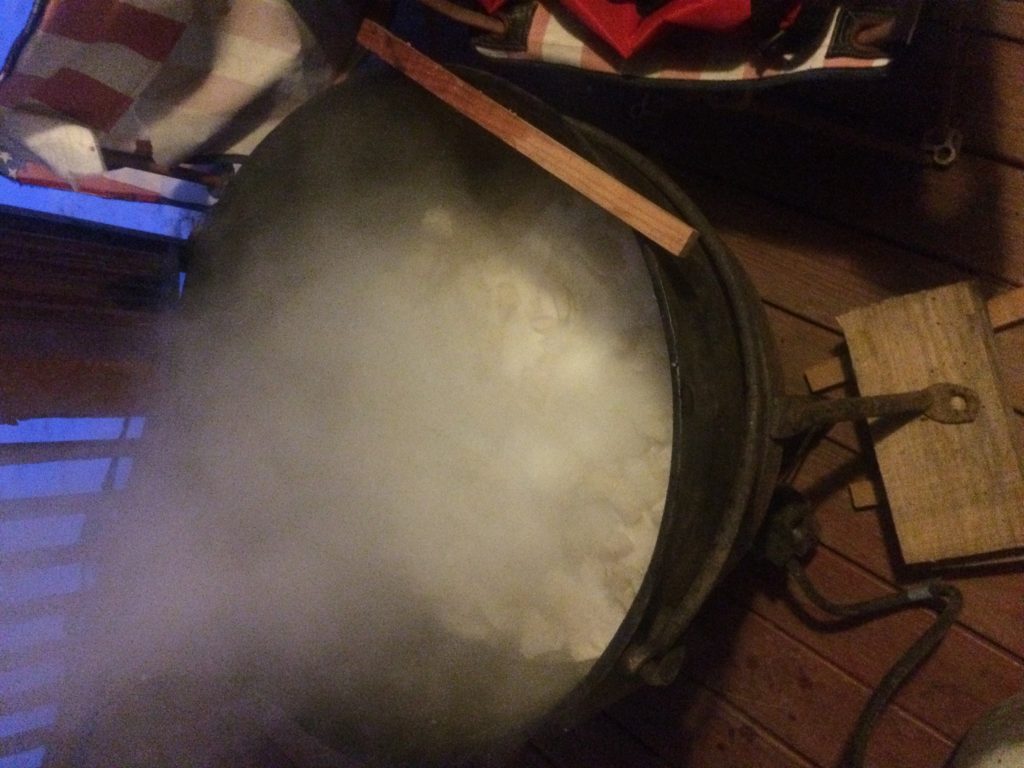
So this time around, I used an antique cauldron. A big one, on a tripod, over a propane burner. The fat came from a 611-pound male black bear killed by Travis Dietrich here in Dauphin County, on ground I manage. Travis was able to get about 40 pounds of bear fat into a cooler, and it has sat in a freezer or outside in the frozen cold, since Travis dropped it off at my home a month ago. The cauldron could have held a lot more bear fat, probably a few hundred pounds of it, but we puny humans could only remove and store that one big hunk this time, and so that is what we had to work with. Last year I had about five pounds to work with, from a young, tender bear killed by Kenny Youtz, actually very close to where this year’s bear was taken.
Maybe the next time a bear is killed, we will just move the cauldron and burner to the bear and start tossing the fat right into the pot. That way we can get all of it used, at its freshest, and waste nothing.
Learning from last year’s experiment, the double boiler method was just too damned long. So this time four gallons of well water were poured into the cauldron and heated to a boil, and then chunks of trimmed and cleaned bear fat were tossed in. Remember last year: Include zero meat, and I mean none, not even a tiny sliver, if you want a smell-free grease to result. Even the tiniest pieces of meat impart a pleasant but very meaty aroma to your leather preservative.
Fat chunk sizes ranged from fist to finger, and one of the lessons learned in this trial is that size matters. Actually, smaller is better when it comes to rendering bear fat. Most of the people who do this regularly use a meat grinder to get the bear fat broken down into strands that really truly cook down, quickly, and give up as much of the fat content as can be had.
And let us take note: Bear fat itself is kind of…a meaty consistency. It is not like any fat you have handled before, unless you work on a Japanese or Russian whaling ship, or you are a whale or sea mammal biologist (studying cetaceans). So cutting up the fat with a knife takes time. Use a clean cutting board and be prepared to resharpen your knife along the way.
What was learned this time is that the initial boiling water does buffer the process. It starts gently melting the bear fat and creating a pool of rendered liquid that will itself become the direct rendering agent for the bulk of the fat chunks after the water has steamed off in a great billowing mass. And when the water has boiled off, which you can tell because the steam is reduced and is becoming replaced with light smoke, turn down the heat, or the grease will quickly scald and burn, and then you have just about ruined it. The pool of grease that has been rendered so far will then get to work on rendering the rest of the fat remaining in the pot. It is like deep frying fat chunks.
The resulting chittlins (or cracklings as some people call them) are supposed to be really tasty, and I saved mine for friends to eat and for my own trap bait. Yes, some people will eat trap bait. Or, some people will use gourmet cuisine as trap bait. Strange world we live in. Take your pick.
This has been a lengthy post and I am about out of time and words. Here were my takeaways this time:
- Render your bear fat as fast as you can. The longer it sits, the more you will get some faint rancidity on the surface that must be trimmed off.
- Cut your bear fat chunks as small as possible, using a meat grinder if possible.
- Do not over heat or overcook the bear fat. This year it was on the slightly over-cooked side, because I was operating in the dark and did not notice just how deeply brown the chittliins had become. A slight brown shows they are cooked. A deep brown shows they have been completely deep fried and the oil has become super heated. The oil/ grease will then become brown from the high heat. We are aiming for a creamy white grease that solidifies easily when refrigerated or frozen.
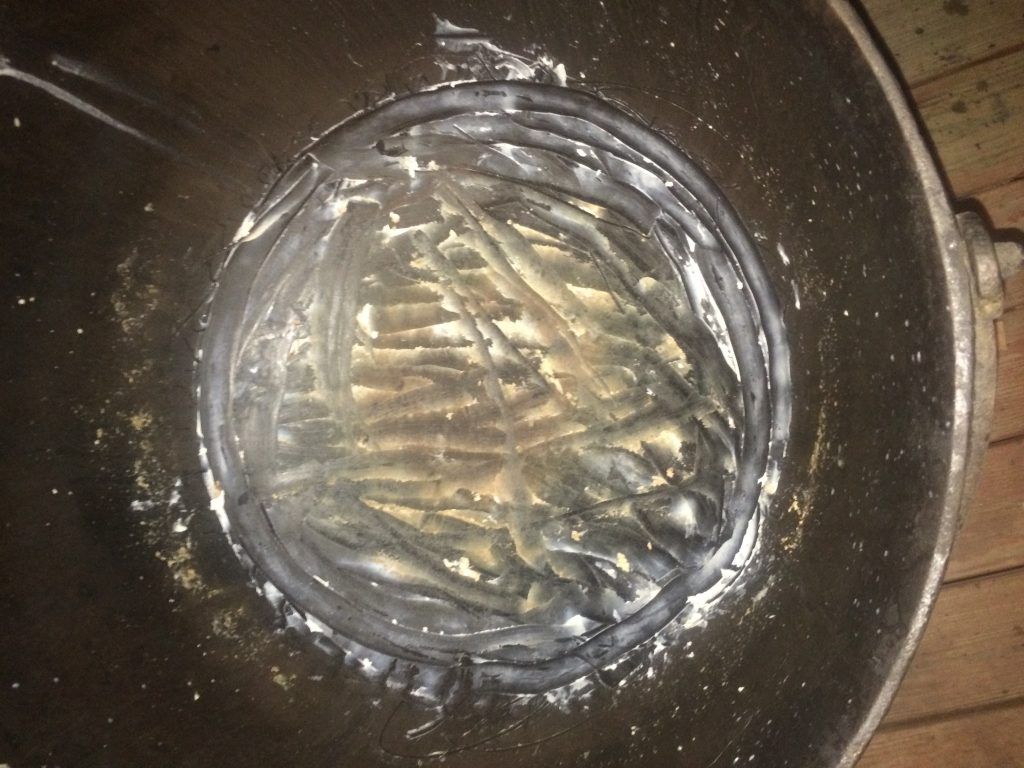
- You can strain your bear grease through a cloth or coffee filter, but I did not. As I am not eating it, I just left the cauldron outside overnight in the 25-degree cold, which caused the grease to congeal. In the early morning I scooped up the best fat first, which is easily identifiable as the hard white tallow. Below the surface was the slightly brownish grease with a slightly grainy texture, and then below that were the fine particles that were not scooped out with the strainer. I took everything, each with its own use and purpose. The bottom of the barrel, so to speak, was taken for my friends’ dogs, which will probably enjoy the tasty treat and get a super glossy coat of hair. The creamy white, hard tallow is best for leather preservative. The brownish, unfiltered grease will harden up and is best for greasing ball patches and preserving steel surfaces.
Pictures and captions below should help, and I do hope this helps. Last year’s bear grease post was right up there in the top two or three on all the search engines, so people are really reading up on this neat process.
NOTE: WordPress has recently been “improved,” and it is now much less user-friendly, very hard to use. Especially with posting photos. When I went to the WordPress online forum today, a lot of other users are complaining. I have already spent a lot of time on this essay and lost half of what I put in. The new editor is terrible, and simply deletes a great deal of text. I apologize for the poor photo formatting, but I am not yet used to whatever “improvements” were made to the software. Believe me, I am trying to edit these, but the straight forward commands that WordPress had before are now gone. Like so many things digital today, “improvements” are made that eliminate the simplicity and ease of use of prior generations. Maybe this is a job guarantee for coders. Please bear with our technical difficulties…
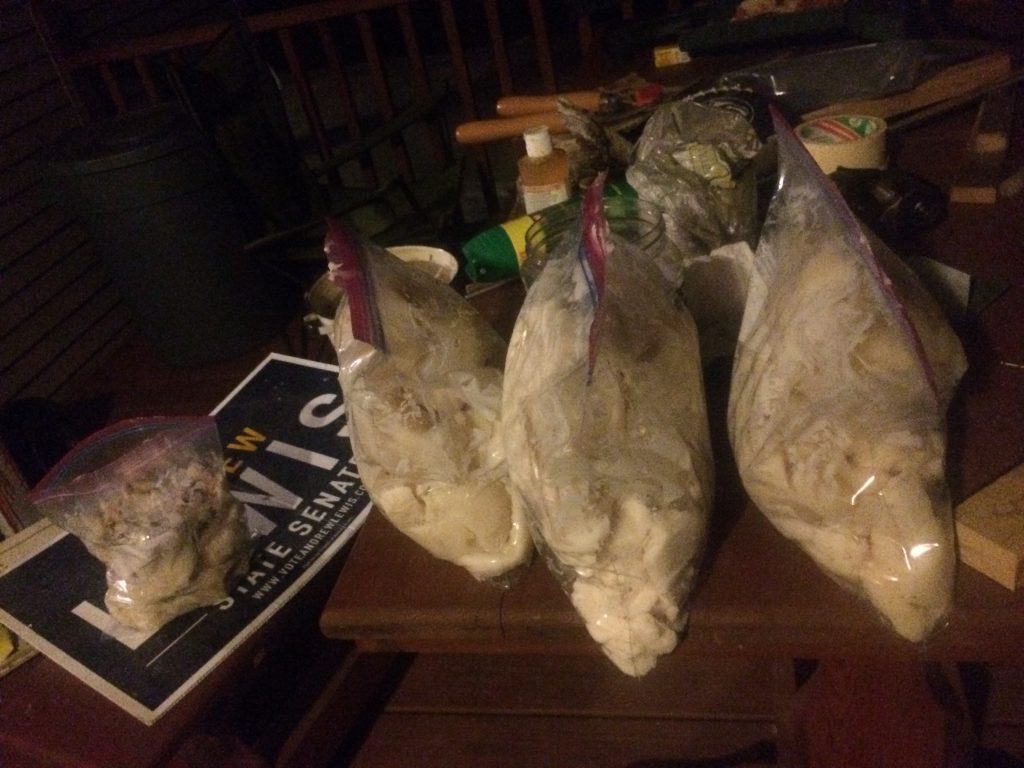
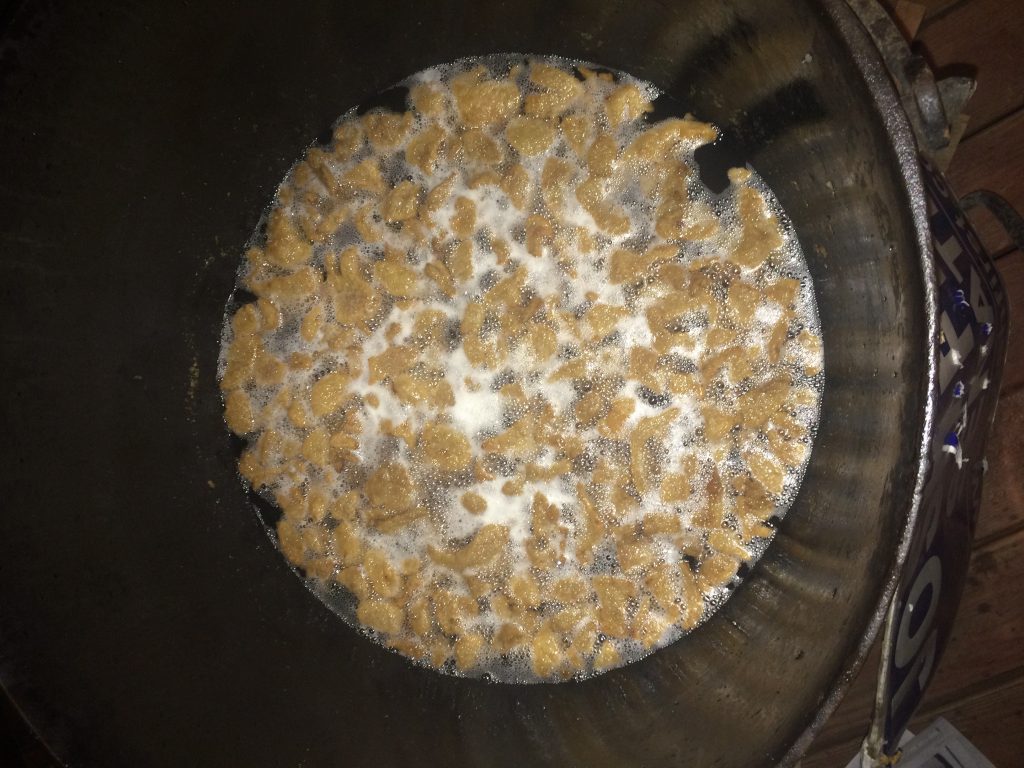
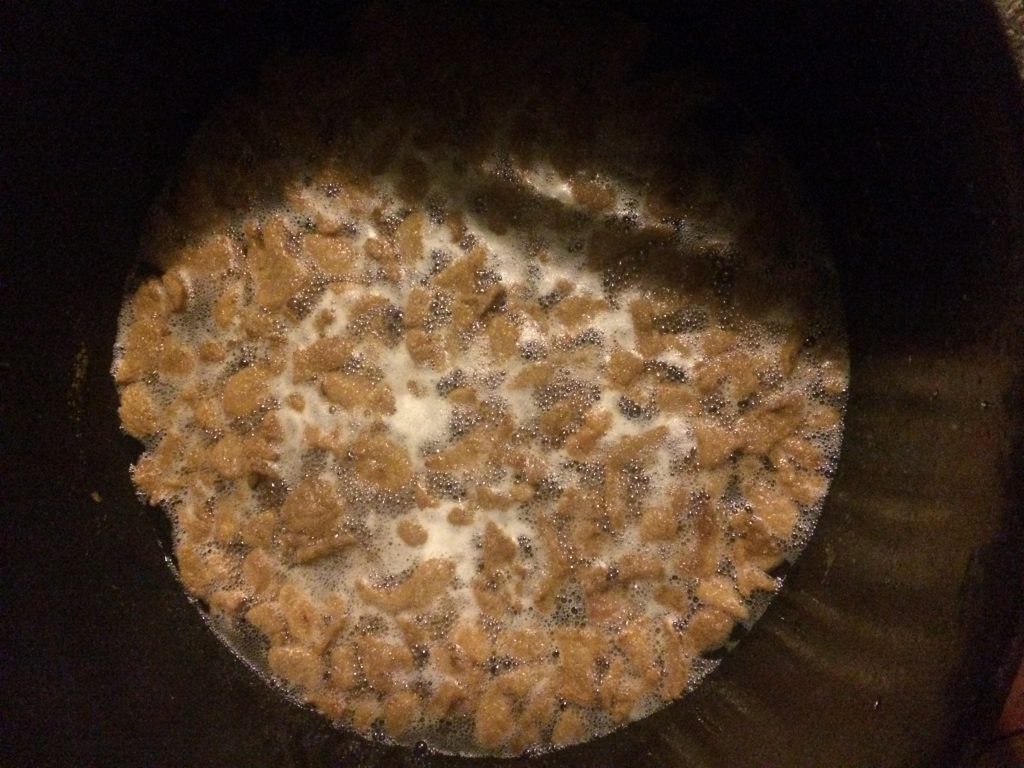
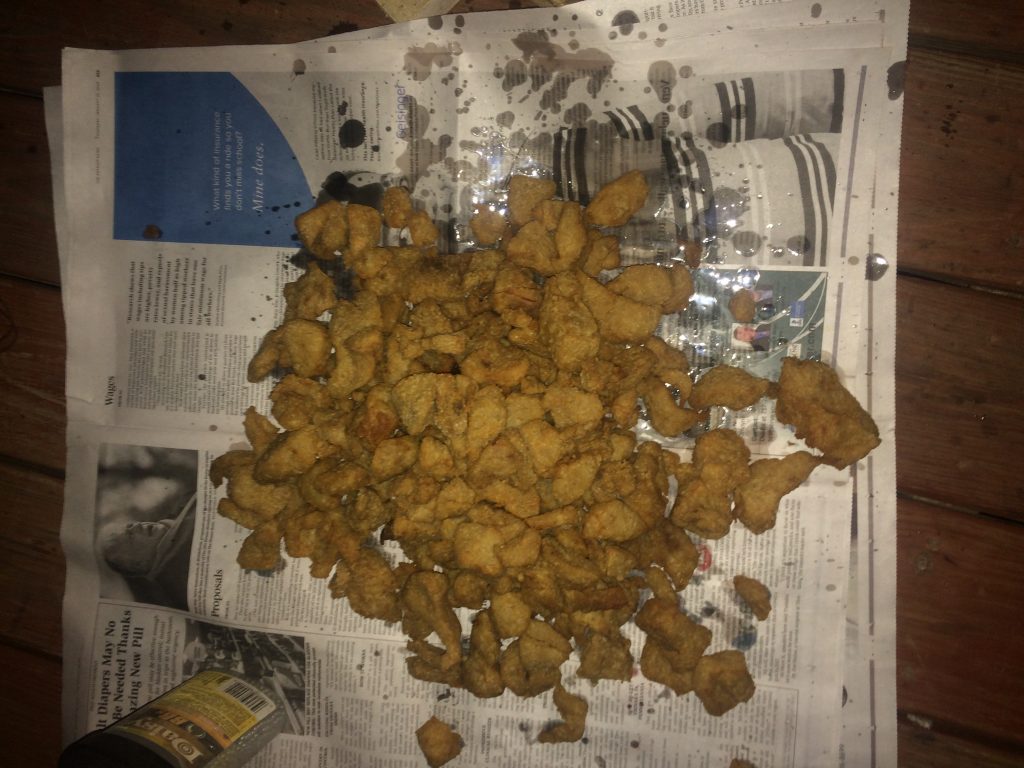
Chittlins. I saved these as trap bait and for friends who like wild game cuisine. The newspaper underneath is the Patriot News, and this is the highest and best use for that partisan propaganda Fake News publication.
Americans Agree with Prez Trump: America IS Great
Last night President Trump delivered an unbelievably powerful and persuasive State of the Union address, and the emotions playing out so plainly across the faces of everyone seated in Congress said he was penetrating through the partisan intentions of all but a few purposefully anti-America (can you believe it?) officials, like Comrade Cortes. She made it a point not to cheer on or clap for America when even her fellow liberal Democrats were clapping all around her. As if she is some sort of “victim” of America! Even as she is seated in Congress!
Why would Americans vote for someone like her, and why would the Democrat Party seat her in Congress? She is a shame and a discredit to the Democrat Party.
Anyhow, Trump did a fabulous job, so well, in fact, that the legacy media did everything they could do try to explain away the phenomenal, overwhelmingly positive reception the president received from his audience afterwards. I will not belabor the various political activist outlets like NBC, CBS, ABC, NPR, many of whom had anchors who actually attacked the address before it was even begun, or even over. Talk about having your mind made up!
If Trump could walk on water, the legacy media people would criticize him for being unable to swim.
Poll after poll found just shy of 80% of Americans watching the address received it positively, and almost all overwhelmingly positively.
I myself was impressed by Trump’s address. Not knowing exactly what to expect, I began by listening to him on the radio, while I did work on my computer. But about ten minutes in I realized that this was a historic speech and I had to see how Trump appeared on TV, so I went and turned it on.
Wow.
For those who have said that Trump is an idiot, a moron, a fool, too dumb to tie his shoes, etc, all they had to do was watch him masterfully deliver one of the best political speeches ever delivered in Congress to realize that their partisan opposition to Trump is one thing, his high quality is another thing. He is an exceptionally talented communicator, and if he lies, which I have seen no evidence of, he is nowhere near the blatant liar that Obama was (“You can keep your doctor”).
Americans who watched or heard the president speak last night agreed with him: America’s greatness is still our own unique asset, something to nurture and value.
Thank you, Mister President!

AOL is a left-wing political activism outlet, and never misses an opportunity to attack Republicans and conservatives over anything at all. But who do they think they are kidding with this headline?