Category → Family
Weis soda instead of Coca Cola Coke soda
“Woke” companies like Delta Airlines and Coca Cola Coke have been leading with their chins lately, daring their own consumers to punish them for having turned against their consumers. Leading with your chin means that you run the risk of being punched back on your chin, and really suffering.
I myself run a small business devoted to achieving public benefits using private markets. Whenever possible, I buy land and try to get it folded into the existing public lands around it. State Game Lands, state forests, state parks, etc; if we have a public partner on a given property, then we can conserve that land.
But I would be blowing up my own business if I directly attacked the very people I need to do my business with, like Delta Airlines and Coke have been doing. For some odd reason, these two companies have joined with the National Football League, the National Basketball Association, and now Major League Baseball to crap on the very people who they want to have as customers. Who they expect to be customers. It is the oddest thing, really. It probably stems from this notion that a certain segment of aggressive Americans have that all of these enterprises, including America itself, are just too big, too rich, too successful to ever fail. Which is, of course, foolish. Every enterprise can and will end at some point, but doing things that directly harm your own interests just serves to hasten your own end faster than it would naturally come.
So the latest with Coke and Delta Airlines is that they did what they could to punish the state of Georgia for passing a voting law designed to protect voting rights. Somehow, the decision makers at Coke and Delta Airlines were confused into believing that the Georgia law is a bad thing, when in fact it is a very good and important thing. Voting is the basis of our entire American enterprise, and if voting ceases to mean anything, the entire thing ceases to mean anything. So anything that can protect the concept and practice of one person-one vote is a good thing. Except in the eyes of Coke and Delta Airlines executives.
Maybe they are so tight with China’s leaders, who desire to use weak American voting laws to elect people in America who are favorable to China, that they have thrown America overboard.
So people like me, who value voting rights and counting all legal votes, are unhappy with Coke and Delta Airlines. As a result of our unhappiness, we have been looking for alternatives to these two products. After all, we would rather support companies that are at least not at our throats.
Therefore, I am happy to announce the discovery of a very refreshing alternative to Coca Cola Coke, and that is the Weis brand of sodas (see photo below) (I “discovered” these refreshing Weis sodas at my friend Scott’s house, in an ice chest cooler, on his porch). Most generic, off-brand sodas are not very tasty or refreshing. I mean, let’s face it, Pepsi and Coke spent decades perfecting their products to meet the widest taste acceptance possible. These two companies have been so successful they now completely dominate the soda market. Very few competitors can even try to take some market share from them. And that means that most competitors who do show up have expensive alternatives, or their products are not very good tasting. Until now.
Whatever Weis is doing, their diet cola tastes a lot like diet Coke. It is very close to the same taste soda drinkers enjoy. It is also cheaper than Coke. Weis is a regional company, run by a family from Sunbury, Pennsylvania. Weis has been a part of my own food shopping experience since I was a child, and they still are now in my adult years. So see if you can find a local Weis, and try some of their sodas. I was more than pleasantly surprised at how good they are; actually, I was almost shocked.
If you are looking for a good alternative or substitute to Coke, try Weis. You will like it, and you will be supporting a local family run business, not some global corporation working hard to make friends with America’s worst enemies, and punish Americans for protecting America.

Carlisle’s “Truth & Reconciliation Commission”
Carlisle, Pennsylvania, is home to the northern-most military attack by Confederacy troops during the first (or second, if you justifiably count the Revolutionary War as the first one) Civil War. It also houses Dickinson College, the Dickinson School of Law, the Army War College, and the Letort spring creek, one of central PA’s better native trout fisheries. But now, Carlisle is even more infamous.
Last month, the Carlisle borough council passed a resolution establishing a “Truth and Reconciliation Commission” with the purported purpose of “improving racial justice and racial equity within the scope and jurisdiction of the borough council…including policies, practices and actions that have contributed to racial inequity and systemic racism.”
How refreshing this is. Really, I mean it, I am not being snarky here. This commission is a huge step forward for white liberals/leftists/ Democrat Party members to begin their inward-looking process of accepting the corrosive effects of their own racist white liberal thinking that has so badly damaged every minority in America since 1865.
Because the Democrats never forgave the Republicans for taking away their slaves in 1865, the Democrat Party has ever since losing that Civil War devoted itself for 155 years to regaining power, re-asserting slavery and control every way possible, over as many Americans as possible. They used Jim Crow laws, the Ku Klux Klan, lynchings, burnings, the poll tax, and a slew of other patently illegal and undemocratic ploys to keep American blacks from voting. And despite all of these methods being morally wrong and illegal (so is stealing elections), the empirical evidence visible to everyone’s eyes is that the Democrat Party has been wildly successful.
One way we can measure white liberals’ success in achieving their 1865 goal of re-establishing slavery and racial inequity is by the huge number of American cities, municipalities, and boroughs today that are majority minority (mostly black or Latino), bankrupt, violent, high-tax, low-municipal services, financially and socially failed, and which are nonetheless run by white liberals.
My own city of Harrisburg is like this, filled up with poverty-stricken minorities and kept that way decade-by-decade by their white liberal slave owners. Oh sure, the poor minorities are thrown tidbits of welfare and taxpayer support by the white liberals, but they are never allowed to leave. Any black or Latino who dares to speak out against white liberal racism is denounced as…a racist. By white liberals, no less. This same situation is found elsewhere, notably Chicago, Los Angeles, New York City, San Francisco, Saint Louis, etc.
Another way of measuring the Democrat Party’s inbred lust for absolute power and coercive control over every breathing and dead person is their stolen 2020 election, from which the they have launched an all-out assault on the individual freedoms enshrined in the US Constitution and Declaration of Independence, through a multi-prong effort to white-out Free Speech, Self Defense, Freedom of Assembly, Freedom of Religion, and a whole host of other absolute rights. It is mind-boggling how in just a few months America’s white liberals have designed a totalitarian federal government that fits every American like a glove. It is almost like they have been thinking about this for a very long time…but hey, when you are looking to expand your pool of slaves from 40 million to 340 million, ya gotta go big, and so that is what the Democrat Party has done. Enslave an entire nation, to big coercive, forceful, unaccountable, unjust, lawless, untouchable federal government.
So this racial justice business in Carlisle offers its white liberal progenitors some real tangible opportunity to come clean, to own up, to ask for forgiveness for the sins of generations of white liberals. For all the pain and suffering they have inflicted upon American blacks, especially, the forced inter-generational dependence on white liberals, and the forced failure, so that dependent minorities never, ever escape their grasp again.
Man, do I really look forward to the Carlisle Truth and Reconciliation Commission getting the ball rolling on this. I know that the Republican Party kind of lost its raison d’etre after they defeated the Democrat Party Confederacy in 1865 and gave American blacks voting rights in 1964, but here is a real opportunity for the Cumberland County GOP to help these poor white liberals come to terms with their own racial inequity and systemic racism built into the Democrat Party. After all, the Democrat Party could not have won any elections, real or stolen, without at least the appearance of Black loyalty at the stuffed voting box.
Let the education, honesty, and reconciliation begin, right at home where it started, with white liberals.
“Stop Asian Hate,” manufactured crisis du jour
America is being manipulated daily by a partisan media-entertainment complex intent on shaping our beliefs and values by shaping our perceptions. Shaping our perceptions is achieved both by shoving crap in our faces, and by censoring competing information out of our reach. So this week we are suddenly told, out of the clear blue, that it is time to #stopAsianhate. That is, Stop Asian Hate. As in, we must all gather together to stop Asians from being hated, not stop Asians from hating us.
Where this bit of racialist activism comes from is anyone’s guess. The few Asian people I know and asked about it rolled their eyes, or arched their eyebrows, and said “I have no idea where this comes from.”
Asians in America tend to be more affluent and materially successful, and more politically conservative. That correlation is likely to continue on, unless someone can get in between Asians and their perceived sense of belonging, acceptance, and integration. Most of the Asians I know are married to Caucasians, and they have very handsome and bright kids. To my knowledge, they feel fully integrated into American society. So someone with a political ax to grind is trying to alter this situation.
Or worse, this faux cause du jour is timed with the faux political confrontation with China. China owns the Biden family lock, stock, and two smoking barrels, and so perhaps the Chinese are trying to use our feewings to make us Americans feel badly about rejecting Chinese genocide and attempts to take over America.
In high school and college I dated two Asian women, one Chinese and one Korean. The parents of the Korean lady were openly racist towards everyone, especially “white” people, except for Jews, who they said were smart. Both of the women I dated have gone on to be wildly successful in their fields, making scads of cash and living very happy lives. With Caucasian husbands.
Yes, I know, I cannot draw on my own personal experiences to shape my reality. I must accept that there are larger trends happening outside of my own personal experience. But one thing I can tell you firmly and with great confidence is that this #stopAsianhate (again, it is probably not about Asians hating people) is a fake issue, not based on anything really substantive. Like so many other fake issues emanating from the Left side of America, this issue arises from some other goal or problem. If I were to guess, I would say it is the Left’s China problem.
The Left in America is loyal to China and they are disloyal to America. The Left hates America and is using America’s government to destroy America. Now that is a hate I could get into stopping right now.

Here is the manufactured political issue du jour propagandized by YouTube, a big piece of the partisan media-entertainment complex. On review, I think my YouTube interests are pretty neat.
Keith Oellig, another American keeping America moving forward
Every day of his life, Keith Oellig was one of the few Americans who, rain or shine, kept America moving forward. He grew the crops and raised the beef that Americans across America take for granted every day that they simply buy and eat these products.
Raised on a central Pennsylvania farm with chores and work, work, work before play, Keith’s friendship was as strong as his nonstop work ethic. He was a dear and devoted friend to many fortunate people, including me, and he died unexpectedly last week from a life-long heart condition he managed as best he could until it caught him by surprise one last time. He was just 56 years old.
This essay is my way of memorializing this amazing human being, and saying goodbye.
Keith was a representation of everything the farming life is supposed to be – down to earth, honest, truthful, hard working, generous, natural, patriotic, devoted to community and fellow man. He served on many boards, including the Dauphin County Farm Bureau, the Central Dauphin East School Board, the Dauphin County Planning Commission, and others I can’t recall off the top of my head.
His heart was golden, always ready to do a kindness for someone, and the more distant the stranger the better. Almost every year he grew great patches of sweet corn and donated much of it to his church food pantry, and to any others in need. But they would have to pick it themselves. Straight out of the Bible, which is what inspired him, drove him, filled him. (Those friends who merely enjoyed sweet corn got the phone call that it was ripe about three days after everyone else in true need had had a shot at it)
Keith was politically active, but he had mixed feelings and thoughts about politics, because so much of it is divorced from the sacred walk of life whose values he cherished.
Every election he and I would run around his farms putting up signs, especially really big ones along the road frontages and both sides of I-81 by Penn National Race Track/ Hollywood [!?] Casino. And as hard as he worked putting them in, Keith would also grouse about career politicians, even about the person whose sign he was putting in. He even did it to me when I ran for state senate. Like out of a comedy movie: “Sure, I’ll help ya, and I’ll bet you’re going to be just as corrupt as everyone else. Now hurry up because we have a lot more signs to put in the ground.”


Keith and I worked as a team to fell dozens of dead and dying ash trees, and some oaks and poplars (see background), in an area where he wanted to expand the cattle pasture. I ran the chainsaw while he pushed with the front end loader. It was dicey and scary work, as his smashed windshield shows. A week later, a huge limb carved a gigantic V in that cab, but Keith just kept on, peering around either side of the destroyed metal and glass to see where he was going.
America’s Voice gone but not silenced
Sadly, America’s Anchorman Rush Limbaugh has died.
Anyone who regularly listens to his show is not surprised, as the stand-in radio show hosts have been daily for the past couple of weeks. Their daily presence was an indication that Rush was physically unavailable, due to his increasingly severe cancer. And it was only that kind of bar that would keep Rush from sitting at the EIB Golden Microphone himself. His love for what he did was clear.
Rush’s impact on American culture and world-wide politics was unprecedented. He represented the thinking of at least half of America’s citizens. He raised unique questions about the world’s best political system, America, and he posed piercing analysis of the players in it, including members of both major political parties.
Ironically, Rush was a product of a politically partisan mainstream corporate media that had fully merged with the Hollywood entertainment industry. Had the mainstream media actually produced real “news reporters” that simply reported the facts, instead of mounting nonstop daily attacks on Heartland America and the conservatives who represent it, Rush Limbaugh would not have had an audience. Because there would have been no demand for Rush’s service.
Rush’s greatest service to America has been to point out the obvious lies and partisan hypocrisy in the American media and establishment cultural centers, and to be a powerful force for limited government, individual freedom and liberty.
“Rush’s death is a huge loss. He was the best, period. He had a way of articulating the seriousness of politics in a way that didn’t depress the listener. He was a relief to listen to, and of course understood the real nature of politics and politicians better than anyone,” says Central Pennsylvania political activist Ron Boltz.
Right on, Ron. Perfectly said.
I myself was introduced to Rush Limbaugh in 1991 by my friend Kenny Gould in Potomac Maryland, when I was working at the US EPA. Listening to Rush changed my life for the better, and to be frank, I don’t think any radio hosts come close to his performance. Of all the radio hosts I have heard, I believe that Mark Steyn comes the closest to capturing Rush’s analytical way and also his positive, personal way interacting with radio listeners who called in to the show.
America is a poorer place with Rush Limbaugh removed from our national conversation. His quotes and voice will live on, as will the pro-freedom America-first movement he helped start. We will miss you, Rush. Godspeed to wherever you are headed now.
p.s. Rush’s “bumper music” in his radio show was usually the 1970s fun disco/funk stuff from a time when skin color boundaries were being broken by music and generally people felt good about being together. Here is one song that he especially liked: Every 1’s a winner by Hot Chocolate.
p.p.s. for those people who claim that Rush Limbaugh was “racist” etc, they obviously never listened to his radio show, and therefore had no justification for their ridiculous accusation. Rush was the canary in the coal mine for American conservatives, who are now being silenced for “wrongthink” by Big Tech, Big Media, and the Big Political Establishment Uniparty, all of whom try to badmouth and impugn anyone who disagrees with them.
Rusty ducks and ammo
My friend called me and asked if I wanted to hunt ducks on the Eastern Shore of Maryland. Same general location that my son killed his first deer; a vicinity I have fished for many years. Several other guys would be along, all but one I already knew and liked. Sounded like a fine plan, and I signed up to share a hotel room with my friend and his son.
As the days went by my pile of preparatory hunting gear got bigger. Neoprene waders and boots, check. Huge and super warm waterfowling jacket with super old school camo pattern I bought at LL Bean decades ago, check. Shotgun in waterproof case, check. Wool long johns, wool shirts, scarves, bison wool hat, gloves and glove liners, warm boots, check check check.
Ammo. Right…hmmm…shotgun shells for the shotgun. What about the steel shot we have had to use since the 1990s ban on lead shot for waterfowling? Although I knew I had some already, I needed to get a good supply of that shot in twelve gauge, because ducks in general and sea ducks in particular are fast as hell and easy to miss. For every duck a hunter brings to hand, he might fire four or five shells. She might fire three or two, by the way.
So on an unrelated trip to that area several weeks ago, I checked Cabela’s in Hamburg, PA. I found a guy on his knees studying eight boxes of shotshells, and describing his find to someone on the other end of his cell phone. And I mean eight boxes total out of what had been a shelving system five feet high and forty feet long once filled with thousands of shotshells, and now containing a grand total of eight boxes of 25 shells each. And four were in 20 gauge, useless to sea duck hunters, who need the maximum power and shot load of a 12-gauge magnum.
So that left four boxes of 12-gauge #3 steel shot, which is OK for regular fresh water ducks but of limited use on sea ducks, which are bigger and tougher. And the guy kneeling down studying them was running his hand over the boxes, and describing them to some unseen prospective buyer chum.
“Tell your friend on the phone that if you don’t buy that 12-gauge right now, I am buying it,” said I to the guy studying the ammo.
“Buy it! Buy it!” came the cry on the other side of the cell phone.
And so I departed Cabela’s with only a flashlight and no steel shot. What the hell people are doing hoarding steel shot is beyond my ability to guess or even imagine. No civil wars will be won with steel shot. No home invaders repelled with steel shot. I don’t believe there are so many waterfowlers that every daggone shell produced is being used as we sit and read this.
And so it went at the other outdoor stores I visited, including mass retailer Bass Pro, where ammunition is usually sold by the truck load. Nothing, nicht, zero. Which then drove me past the retail approach and back into my ancient stashes of hunting ammunition. And indeed, I discovered a wide assortment of waterfowling ammunition accidentally stored in all kinds of odd and dubious places, like wader pockets, inside boots, PFDs, and in crumbling boxes moldering away in musty corners. But at the end of my search, I discovered in total about two boxes worth of steel shot, ranging from 2-3/4″ to 3-inch magnums to half a box of 3.5″ super magnums. Some of the shells needed help, though, before they could be fired in a gun.
And so a Dremel with heavy grit sandpaper was employed to remove heavy rust, and then a small wire brush at high RPMs to give a decent polish. Yeah, I was that desperate, but the work paid off. I was happy to have what I had.
I am pleased to report that the rusty old ammo garnered a healthy haul of ducks, which could be dubbed the rusty ducks.
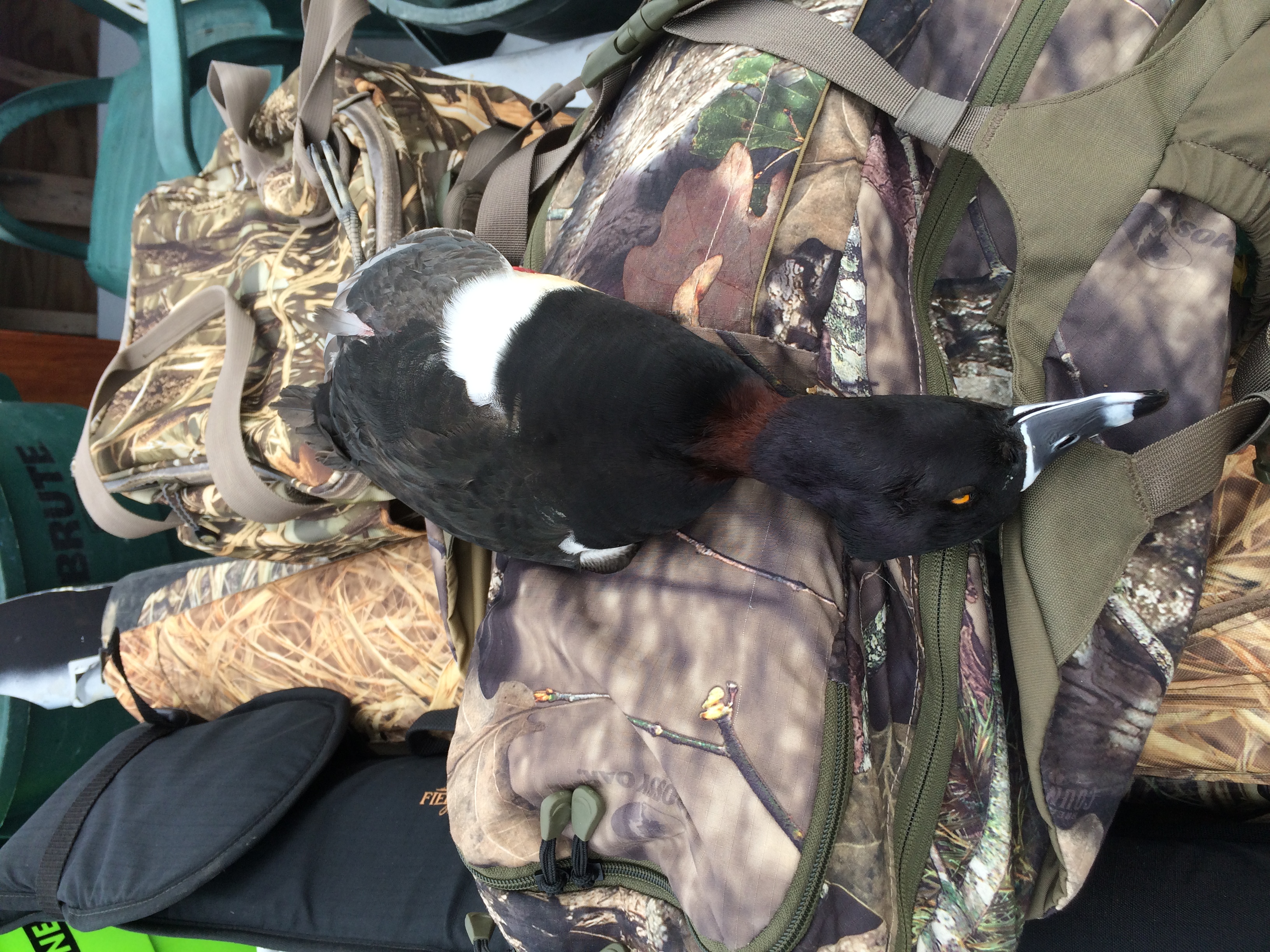
A ring necked duck, an uncommon visitor to the Chesapeake Bay’s southern waters
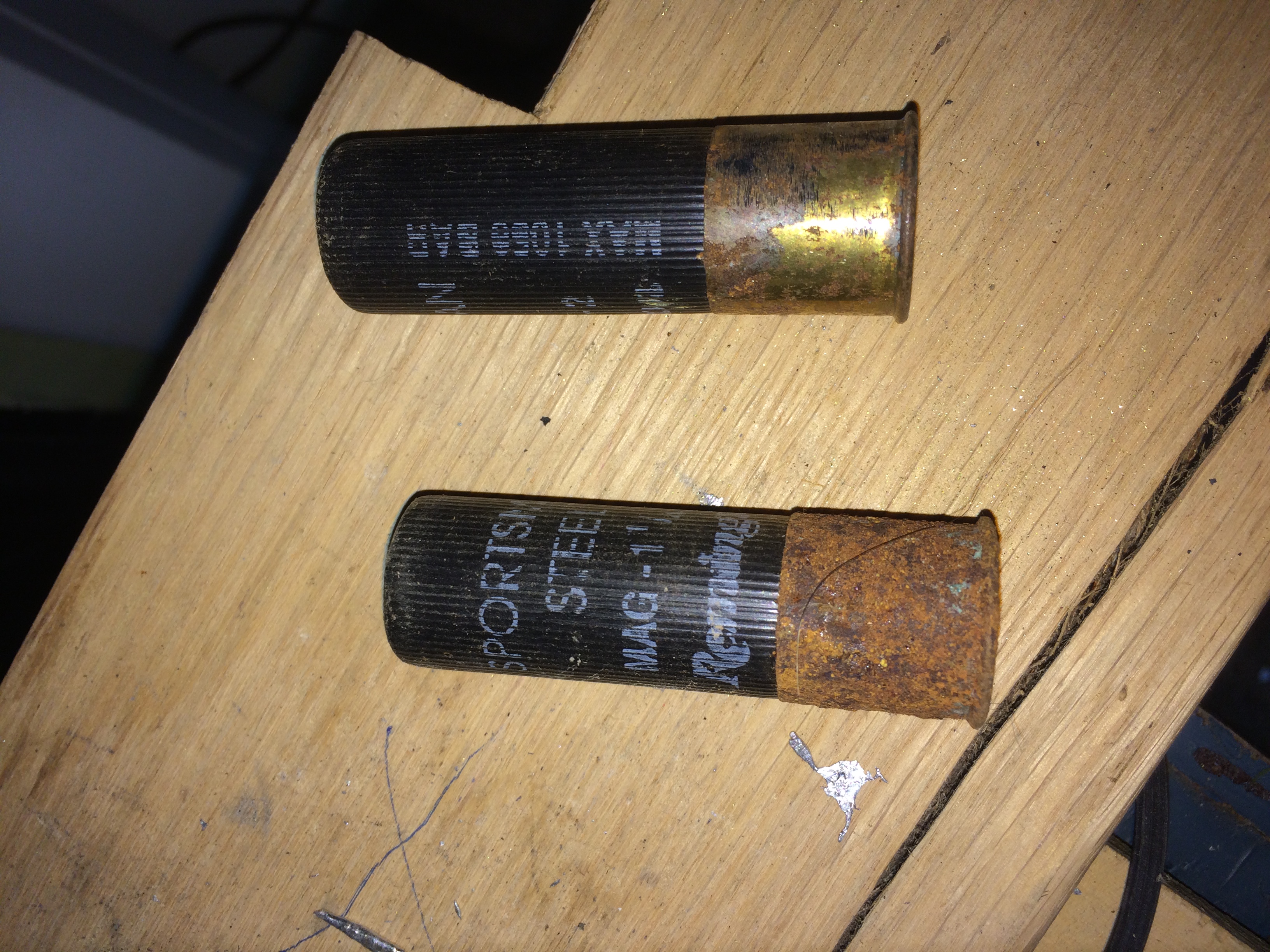
Rusty old ammo, and happy to have it

Turning rusty old ammo into dubious but functional ammo that worked and got ducks

Sunrise off of Tilghman Island. What life is all about
PA’s must-do 21st century deer management policy
When Gern texted me on November 12th “planning to plant the entire farm with grass next Fall… 100% hay… can’t afford to feed wildlife. Going broke trying to make money,” I knew that my best deer management efforts had finally failed over the past 13 years.
Every year I work hard to make sure our deer season is as productive as possible. Because our tenant farmer pays us a per-acre rent every year, which covers the real estate taxes and some building maintenance, and for 13 years he has grown soybeans, corn and hay in various rotations across the many fields we have. Our arrangement has generally worked out well both ways, but that text message ended my sense of satisfaction.
While I do wear dirty bib overalls when I run the sawmill and also when I try to impress people who don’t know me, Gern is the actual farmer who tills (broad sense), fertilizes, plants, and harvests a very large farm property in Dauphin County, some of which I own and all of which I manage. Our property is one of many that comprise about 30,000 acres of farm land that Gern and his family cultivate in Central Pennsylvania. To say that his family works hard is the understatement of all understatements. Gern embodies AMERICA! in flesh and spirit, and to see him so utterly beaten down by mere deer is heartbreaking.
Over the years I knew that both overabundant deer and bears were taking a significant toll on our grain crops (Gern’s primary source of family income), and so I worked hard to recruit the kinds of good hunters who would help us annually whittle down the herds, so that the pressure was taken off of our crops. About five years ago I proudly photographed one of our late-summer soybean fields, at about four super healthy feet high, indicating a minimal amount of deer damage. When I passed the soybean field pictures around to other farmers and land managers, nothing but high praise returned. And so I patted myself on the back for our successful deer management, and congratulated our guest hunters, who were killing about 25-35 deer a year on our property. Our hunters were filling an impressive 50% to 65% of the roughly 54 DMAP deer management tags we hand out every year, as well as some of their buck tags and WMU 4C tags.
But, change is life’s biggest constant, and while I rested on my hunting laurels, deer hunting changed under my feet. The past few years have seen a lot of change in the hunting world. First and biggest change is that hunters in Pennsylvania and other states are aging out en masse, with fewer replacements following them. This means that a lot less pressure is being brought to bear on the deer herd. Which means a lot more deer are everywhere, which is not difficult to see if you drive anywhere in Pennsylvania in a vehicle. There are literally tons of dead deer along the side of every road and highway, everywhere in Pennsylvania. We should be measuring this at tons-of-deer-per-mile, not just the number of dead deer and damaged vehicles. Frankly this overabundant deer herd situation is out of control not just for the farmers who feed Americans, but for the people who want to safely drive their vehicles to the grocery store. Hunters are sorely needed to get this dangerous situation under control, and yet Pennsylvania’s deer management policies favor overabundant deer herds to keep older hunters less crabby.
So, because I am about to break out the spotlights and AK47 to finally manage our farm deer the way they need to be managed (and yes, PA farmers are allowed to wholesale slaughter deer in the crops) (and yes, I feel the same way about our favorite forested places in the Northern Tier), here below is the kind of deer management/ hunting policy Pennsylvania needs via the PGC, if we are going to get the out-of-control deer herd genie back into its bottle and stop hemorrhaging farmland on the altar of too many deer:
- Archery season is too long. At seven weeks long, the current archery season lets a lot of head-hunters stink up the woods, cull the very best trophy bucks, and pressure the deer enough to make them extra skittish and nocturnal before rifle season begins. Even though rifle season is our greatest deer management tool. The same can be said of bear season, which is the week before rifle season. So shorten archery season and lengthen rifle season, or make the opening week of deer season concurrent with bear season, like New York does.
- Rifle season must be longer, and why not a longer flintlock season, too? Is there something “extra special” about deer come the middle of January, that they are prematurely off limits to hunting? Most bucks begin to drop their antlers in early February. Have three weeks of rifle season and then five weeks of flintlock season until January 30th, every year. Or consider flintlock hunting year ’round, or a spring doe season in May.
- More doe tags are needed. There are too few doe tags to begin with, and most doe tags sell out and are never used. This is especially true in WMUs 5C and 5D, where despite enormous tag allocations, tags quickly become unavailable. That is because individual hunters can presently buy unlimited numbers of doe tags, for some reason having to do with the way deer were managed in the 1980s…c’mon, PGC, limit of two or three doe tags for each hunter in these high-density WMUs, and at least two doe tags in Big Woods WMUs like 2G and 4C.
- Despite good advancements in reducing the regulatory burden on deer hunters this past season, there are still too many rules and restrictions. For example, why can’t our muzzleloading guns have two barrels? Pedersoli makes the Kodiak, a fearsome double percussion rifle that would be just the ticket for reducing deer herds in high deer density WMUs where the PGC says they want more deer harvests. But presently it is not legal. Another example is the ridiculous interruptions in small game seasons as they overlap with bear and deer seasons. This bizarre on-again-off-again discontinuity of NOT hunting rabbits while others ARE hunting deer is an unnecessary holdover from the long-gone, rough-n-ready bad old poaching days of Pennsylvania wildlife management. PA is one of the very few states, if the only one at all, with these staggered small game and big game seasons. Bottom line is hunting is supposed to be fun, and burdening hunters with all kinds of minutiae is not only not fun, it is unnecessary. Other states with far more liberal political cultures have far fewer regulations than Pennsylvania, so come on PA, give fun a try.
- Artificial deer feeding with corn, alfalfa, oats etc on private land during all deer and bear seasons must end. Not only does this “I’m saving the poor starving deer” nonsense lead to spreading deadly diseases like CWD, it artificially draws deer onto sanctuary properties and away from nearby hunters. Or it is baiting, plain and simple. Feeding causes overabundant deer to avoid being hunted during hunting season, but then quickly spread out on the landscape where they eat everything out of house and home when hunting season ends. This year up north (Lycoming and Clinton counties) is a prime example. We had no acorns to speak of this Fall, and whatever fell was quickly eaten up by early November. As the weeks rolled on through hunting season, the deer began leaving their regular haunts and unnaturally herding up where artificial feed was being doled out. This removed them from being hunted, and creates a wildlife feeding arms race, where those who don’t feed wildlife run the risk of seeing none at all. So either completely outlaw artificial feeding or let everyone do it, including hunters, so they can compete with the non-hunters. And yes, people who buck hunt only, and who do not shoot does, and who put out corn and alfalfa etc. for deer during hunting season, are not really hunters. They are purposefully meddling in the hunts of other people by trying to keep them from shooting “my deer.”
- PGC must better communicate to its constituency that too many deer result in unproductive farms that then become housing developments. Because the landowner and farmer must make some money from the land, if farm land can’t grow corn, it will end up growing houses, which no real hunter wants. So real hunters want fewer deer, at numbers the land and farms can sustain.
Why flintlock hunting mistakes happen
Last Saturday Pennsylvania’s flintlock deer season started. A surprising number of people take to our winter woods with primitive flintlock rifles in pursuit of super skittish deer. After two weeks of rifle season, which ended two weeks ago, our deer are as wary as possible. They are either burrowed into hillsides, or yarded up in suburban back yards, hiding from anyone that looks like a hunter. Deer are surprisingly good at separating people shoveling snow from people carrying rifles, so you might see a pile of deer in the oddest places right now.
Flintlocks involve pouring gunpowder down the barrel, followed by a small piece of cloth and a round lead ball. Then a small amount of fine gunpowder is put into the flash pan, and is then hopefully ignited when a piece of flint hits a piece of steel, thereby making sparks, ultimately igniting the powder that was poured down the barrel. That pushes out the lead ball with enough force to kill an animal.
This is the theory, anyhow.
Because there are a bunch of moving parts in a flintlock, each one of which is necessary for the whole to function properly, a lot of things can go wrong after the trigger is pulled. Here are a few problems that happen to flintlock hunters every year, and some suggestions on what flintlock hunters can do to fix the situation up front, before the trigger is pulled on a deer and the gun does not go “BANG.”
Problem One: Flint does not spark well or at all.
Solution one: Make sure the flint has a sharp edge; after lots of practice shooting, the flint edge gets chipped and dulled. If yours is dulled, then replace it with a new one, or re-sharpen the edge with a piece of steel.
Solution two: Ensure the frizzen is clean and dry; if it is oily or wet, it will not spark.
Solution three: Ensure the flint squares up exactly with the frizzen. The two must meet one another directly and perfectly aligned so that the flint edge scrapes evenly down the frizzen face. If only a corner of the flint connects with the frizzen, then very few sparks will result. This is probably the most common mistake associated with no or poor sparking.
Solution four: Ensure your lock is properly tuned and timed. This is both easier and harder than it sounds. It is common for people to buy inexpensive off-the-shelf flintlocks (especially the really cheap plastic and stainless steel ones) and expect them to work at the same high level of functionality that a comparable budget-level center fire rifle operates. This is misplaced trust, because unlike a modern rifle, a flintlock’s lock is full of tumblers, bars, levers, and springs, all moving in precise harmony with one another in a millisecond. If any of these moving parts is not tuned to work smoothly with the other moving parts, then your lock will have timing issues. You will pull the trigger, and only small hints will tell you that something is wrong, like hang fires, or many failures to ignite the flash pan powder. But each time you pull the trigger, you will not hit your deer. After a lot of heartache, you will eventually ask a competent flintlock expert to evaluate your gun’s issues, and he will immediately diagnose it as “Your lock don’t work.”
It is important to use only a trained flintlock gunsmith, and not a regular “gunsmith.” Most modern gunsmiths know as much about a flintlock as they do about maintaining mechanical Swiss watches, which is absolutely zero. Many modern gunsmiths will sell themselves as being able to do the work on a flintlock, but they will be overwhelmed when they pull the lock plate off and behold the incredible “primitive” inner machinery. I have seen a modern gunsmith actually destroy either the lock mechanism or the inletted stock wood, or both, so only take your gun to an actual flintlock gunsmith, and an experienced one at that. Here in Central Pennsylvania, we are super fortunate to have a lot of flintlock experts, including people at Dixon’s near Lenhartsville, and Fort Chambers in Chambersburg, Mark Wheland in eastern Huntingdon County, and many, many others sprinkled around.
When I had my first flintlock made, the new “gun builder” I hired actually ground off critical pieces of the lock, and then tried to blame me when the gun would not fire properly. It cost me a deer. I also had to pay Bill Slusser (now in Kentucky) $220 dollars to rebuild the lock and then properly re-attach it to the wood, which included him TIG welding back on metal that had been unnecessarily removed by the first guy. The lock is a delicate piece of machinery, and the bargain basement ones are very rough, so take your new gun to a competent flintlock gunsmith to get it tuned before you take it hunting. If you bought your flintlock new from a gunmaker, like Mark Wheland or Bill Slusser, then it is guaranteed to be fully tuned and ready to kill. Same goes if you had a gun custom built for you. Just don’t use the bargain basement “gun builder” guy who promises a quick turnaround, or a regular gunsmith who says “Yeah, I can do those.” They can’t do it, but they can do it in.
I learned that expensive lesson so you don’t have to.
Happy hunting and good luck!
The Spirit of the Season
Today is Christmas Day, America’s national holiday at least as much as Thanksgiving Day. It is a day of good cheer, happiness, kindness, family, acts of charity, rest and relaxation; a Sabbath of sorts. Across Western Civilization this day has played several different roles and in different formats over the past thousand years, the earliest being solely religious and quite somber. The later versions of Christmas being a non-offending marriage between Christianity and northern European paganism, and being more celebratory.
Christmas as we know it now is largely a creation of Englishman Charles Dickens, who decried the caste system’s forced poverty and lack of Christian charity in his own land, and whose 1843 book A Christmas Carol championed the triumph of kindness and generosity to all over greed and miserly wealth. A literal ghostly spirit of Christmas invaded old man Scrooge’s otherwise selfish life, and left him a changed man. Scrooge’s personal changes, in the true spirit of Christmas Day, then resulted in a domino effect of increasing happiness and beneficence spreading outward from the formerly unhappy and mean old man to all those around him and beyond.
Dickens’ powerful message was a seed that grew wildly in fertile soil, as the contemporaneous Industrial Revolution had created a great amount of wealth and also a great many have-nots. And a hundred years later downtown Manhattan USA at Christmastime was full of powerful images and themes drawn directly from Dickens’ writings. That resulting Christmas culture has spread far and wide, and is now a mix of all the good stuff, including spirituality and morality, along with some old fashioned American consumerism. This has all morphed into the modern version of Christmas most Americans practice or at least enjoy today. It is kind of a third version of Christmas.
But if we go back to its beginning, Christmas Day is closely linked to Christianity’s predecessor, Judaism, and its own festive holiday of Chanuka. Christmas Day always starts on the 25th of December, which is usually right around the Hebrew date of 25th of Kislev, the start of Chanuka. While Chanuka has eight days, Christmas has twelve (similar to Passover having eight days and Easter’s Holy Week having seven at least, and possibly more, depending upon where one lives). And if we then immediately fast-forward back to the present, we see that Christmas has profoundly influenced the practice and understanding of Chanuka. Chanuka now being a heavily mysticized and joyful celebration of a vague miracle involving some olive oil. If you dig deep, you might get an American Jew to tell you that Chanuka is generally about individual freedom, and freedom of religion specifically.
Truth is, Chanuka was indeed originally about freedom, but the kind of freedom we Westerners no longer seem to value, or which we seem to take for granted.
Chanuka is described at hebcal.com as “Hanukkah (Hebrew: חֲנֻכָּה, usually spelled חנוכה … in Modern Hebrew, also romanized as Chanukah or Chanuka), also known as the Festival of Lights, is an eight-day Jewish holiday commemorating the rededication of the Holy Temple (the Second Temple) in Jerusalem at the time of the Maccabean Revolt of the 2nd century BCE. Hanukkah is observed for eight nights and days, starting on the 25th day of Kislev according to the Hebrew calendar, which may occur at any time from late November to late December in the Gregorian calendar.”
OK, but what was the Maccabean Revolt, you ask? Ah ha, here we have suddenly discovered the true spirit of Chanuka! And one could surmise, the true spirit of Today’s Christmas Day, as well, heir as it is to Chanuka.
The Maccabean Revolt was a true-life rebellion by a small group of totally dedicated, religiously pure Jewish families against an enormous Assyrian empire that was then occupying then-Israel/Judea, roughly 2,200 years ago. It is the triumph of the little guy over the big bad bully; the triumph of monotheism over evil paganism; morality over immorality. Chanuka is the story of winning freedom by the edge of the sword, at total risk of one’s own survival. Those Jews who then strapped on a sword and successfully fought to the death over several generations to rid themselves of the yoke of Assyrian slavery, then set in motion so many future events. Like the subsequent existence of Jesus, the eventual creation of Christianity, and the resulting creation of Christmas Day by people seeking to directly link the day with Chanuka.
Early Christmas was observed by religious Christians as a day of spiritual freedom, similar to the Chanuka celebration of national freedom and sovereignty, without which there was no spiritual freedom for the Jews, whose Temple service had been disrupted by the Assyrian occupation. Which makes one wonder, in the context of where we are right now, December 25th 2020 , as America is poised to be captured and subjugated by China through its secret treaties with Joe Biden, Big Media, and Big Tech…. what was and is the true, original spirit of Christmas Day, and does it have relevance for us right now?
Religious Christians will provide an orthodox Christian perspective, but it is no stretch to say that today’s Christmas spirit could use a heavy dose of the original Chanuka spirit. We need some of that old time religion. We need a modern equivalent of the Maccabean Revolt against the fraudulent, illegal election that just took place, in which America as we have known her for 244 years is about to collapse and be replaced by repression and slavery.
So, I will raise a glass of eggnog to everyone in the spirit of good Christmas cheer. Salud! And I will also raise the American symbol of freedom, defiance, and sovereignty in salute of the brave American citizens who we know are the last hope of restoring our republic: The American longrifle and its updated equivalent, the AR15.
Merry Christmas! May the ancient spirit of the Maccabees fill every patriot heart.