Posts Tagged → charity
Portrait of an American Man
Across America, tourists visit all kinds of special places, built and natural. Across America, university campuses are home to special academic buildings, donated by successful business people who graduated from those same colleges. Probably everyone who visits and studies at these places take them for granted, except the conservancies, land trusts, and other caretakers charged with the operations and maintenance jobs.
Here today, we look at one of these historic donors, who built and donated one of America’s most famous architectural statements. He was a successful businessman from humble beginnings in Pittsburgh, Pennsylvania.
Back in the 1920s and 1930s, the heyday of department stores, which were the internet/ Amazon/ eBay of their time, his family went from owning small clothing, fabric, and hat stores to one big department store in downtown Pittsburgh. The enormous store was famous for carrying everything that every household required, in grades, qualities, and prices that every household could afford. Foods, clothing, fabrics for making clothing, pots, pans, utensils, firearms and ammunition, fishing gear, shoes, work boots…the list is endless.
Incidentally, in the 1970s State College, PA, where I grew up, the O.W. Houts department store, out at the Western very end of College Avenue, carried everything a family would need, including old coins, stone arrowheads dug up in the local farm fields, records, a wide selection of utility-grade firearms (where I got my first .22 single shot rifle and a 16 gauge single shot shotgun), clothing, shoes, food, etc. Next door was the Houts Hardware store and Lumber Yard. They sold nails by the pennyweight, tools, keys, and of course all kinds of locally sourced lumber.
Despite its relatively small size, the O.W. Houts department store and hardware store were absolutely core parts of the State College area lifestyle. And so we can imagine what the gigantic Kaufmann Department Store was like in Pittsburgh, many many times the size of Houts. The wives and daughters of coal miners shopping for calico two aisles over from the wives and daughters of coal mine owners shopping for lace and fur trimmings. 1920s Pittsburgh was a gigantic melting pot of iron, steel, and fifty different nationalities from around the world, and everyone got most of their necessities from the Kaufmann Department Store.
Edgar Kaufmann built the family business from the ground up, taking big risks and making big sacrifices along the way, and became exceptionally wealthy. His family upbringing emphasized giving charity, which he did in large amounts throughout his life. The one charitable donation he is best known for is Fallingwater and its surrounding Bear Run Preserve.
Below is Edgar Kaufmann’s portrait, done in 1929, and occasionally on display at Fallingwater, which is where I photographed it. It is filled with meaningful symbolism and clues to his personality and outlook on life. Below is my understanding of this statement.
Edgar is standing between two potent symbols, the (Christian?) alms bowl (charity) to his right, and the carefully shielded Middle Eastern crescent moon, on his left. This moon would be his own background, of the desert, partially obstructed by cloth, that is slightly pulled back to both cover it, and also reveal it by drawing the eye to it. Cloth being the most representative symbol of his department store’s biggest staple as well as its famous fashion statements.
He is holding a rustic walking stick in his dominant right hand, which puts emphasis on the importance of this simple cut branch. Yes, it is a humble symbol of hiking and the outdoor lifestyle, and it also has the V top for holding venomous snakes’ heads. The other venemous snakes in 1929 were the Nazis, and maybe this is his way of saying he would be seeking to catch them and pin them down. Or that he was at least aware of them in his life.
Edgar’s left arm leans heavily on the chair, perhaps a symbol of his never-ending work ethic stuck at a desk.
The chair’s right side, Edgar’s outdoorsy, charitable, artistic, manly, masculine, and muscular side, is well carved, carefully defined. Its left side is deliberately stunted and malformed, as if to say that his outdoors life and his charity work defined him best, and his boring work life was his least interesting aspect. Don’t we all have have different sides to us and to our personalities?
His sporty tennis sweater says all-America, while his shirt sleeves are pulled up to reveal his manly biceps. The tennis sweater is Harvard red, instead of the blue from his alma mater Yale. Something must have happened at Yale to make him upset with the school.
Edgar Kaufmann conveys an image of American masculinity straddling two worlds, one of which he must subtly hide. And the reason I picked this portrait to write about is because nearly 100 years after this was painted, America is back to that 1929 period, where American Jews have to hide their identity, lest they be hurt, abused, robbed, for merely being Jews. This is not a good reflection on Americans, that we have come back to this kind of un-American behavior.
Edgar was a political conservative, but a cultural libertine..another personality split some readers might relate to. He helped design, build, lived in, showcased, and then donated Fallingwater through his son, Edgar jr, for public benefit. Across America, so many historic tourist attractions and artistic buildings were created or donated by Jews, as were an awful lot of the donated buildings at universities. We should be celebrating this ethic, not picking on these people as a whole.
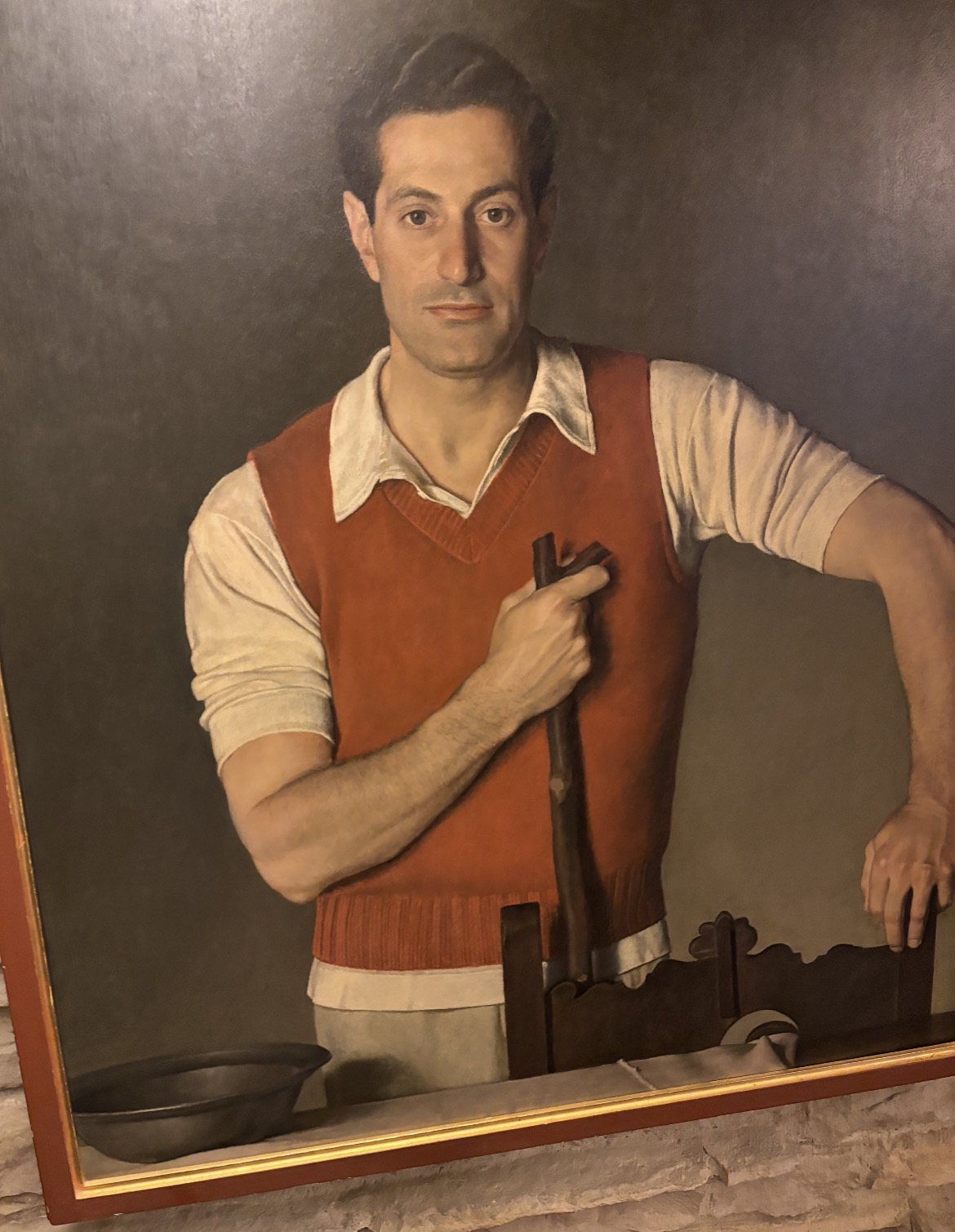
Edgar Kaufmann
Merry X-Mas to all Americans
Today is Christmas, the national holiday of America and most Western nations. Its origin is easy enough to decipher from the English name we use today, which is a conjunction of two words, Christ and Mass, or Christ’s-Mass, Christ being the Anglicized version of the Greek Chrystos, which means anointed.
Why does any of this matter? Because people best do things they agree with and understand, and in order to understand a thing, a person must understand the entire thing, especially its genesis.
Holding a Christian Mass -or Christmas- in honor of the Jewish man Joshua the Nazirite (or Joshua of Nazareth) whom orthodox Christians believe fulfills anointed messianic prophecy as interpreted from the Hebrew Scriptures (TANACH, or Torah (The Old Testament), Nevi’im (the Prophets), and Ketuvim (the Writings), is a way of celebrating the person at the center of the Christian faith. At least as the faith has been understood after the First Nycean Council (held in Nyceae Greece, now Iznik Turkey, in the year CE 325), when the first 275 years of Christianity was then greatly reformed and shaped, and out of which a religious orthodoxy emerged that both Protestants and Catholics today follow.
Apparently observed mostly as an austere holiday devoid of outward joy or expressions of happiness for most of its 1,500 year history, and conveniently set for the 25th day of December to match up with Hanuka’s 25th day of the Hebrew month of Kislev, Christmas as we now know it in America was created by a Briton, a 19th century writer named Charles Dickens.
Charles Dickens wrote A Christmas Carol, something almost all Americans are familiar with. Starring one Ebenezer Scrooge and Tiny Tim and a cast of other characters designed to tug at our heart strings and elicit our deepest sympathies and emotions, A Christmas Carol aggressively addresses what Dickens saw as a dearth of happiness and Christian charity. Especially at that time, when the modern industrial revolution had pulled people off the rural farms and pooled them into teeming urban slums, creating a huge strata of direly poor people in need of everything and unable to provide for themselves as they had back on the farms.
(note that Karl Marx wrote his Communist Manifesto at the same time in response to the same industrial revolution socioeconomic dynamics playing out in Germany and Europe, but instead of trying to encourage Christian faith to rise to the occasion, like Dickens, Marx sought to supplant Judaism and Christianity with his own new religion…)
Dickens believed that those who had benefited most from the industrial revolution and its cheap labor had a Christian duty to share their success in the form of charity with those living in the urban slums. And so Dickens’ A Christmas Carol story is both a huge guilt trip and emotional plea that was immediately and wildly successful when it debuted and continues to shape our own Christmas experiences to this day.
Combined with Scandinavian traditions of Santa Claus and reindeer, evergreen trees decorated with festive lights, and German gift giving, Dickens’ vision of a friendly, happy, merry, relaxed Christmas is how Americans celebrate, observe, or simply enjoy the holiday today.
So today is Christmas in America. Whether or not one is an orthodox Christian, an orthodox Jew, a Hindu, a Buddhist, or any other religious or nonreligious faith or identity, this day is yours to make of it what you will. Religious or secular. Even the secular version has the best of human traits.
Why not make the most and best of it? Wishing some stranger in the shopping center a Merry Christmas can have as much theological meaning as you want it to have, or it can simply be your best of heartfelt personal well wishes to a fellow American citizen. It is yours to choose what you mean by saying Merry Christmas, but the point is that saying it neither detracts from your own faith, nor does it add to anyone else’s faith if you simply wish them a Merry Christmas.
Some places like Dearborn, Michigan, and Borough Park, Brooklyn, have such an absence of Christians that it would not make sense to wish anyone one encounters there a Merry Christmas.
But to everyone else in America, I wish you a very Merry Christmas, with only the best of hopes for you today and in the year 2023 ahead.
Merry Christmas and Happy New Year, folks*
In case you are one of the three people who regularly read this web site, then you have noticed that a good long while has passed since anything overtly political was posted. There is a good reason for this, and it is because weeks ago we entered the really best, nicest time of the year.
We are in Christmastime, the weeks preceding and the weeks following Christmas, a time of peace and reflection, neighborliness, good cheer and charity.
Yes, there have been a lot of politics worth writing about, but you know what? I just did not feel like writing about frustrating, conflict-filled current events. More than anything I am enjoying basking in the glow of what should be, what must be, a time of togetherness and common good purpose.
If you are a religious Christian, then you may object to all this namby pamby touchy-feely do-gooder happy time stuff. You know what I am talking about, the kind of Miracle on 34th Street feeling.
I am sorry if you feel this way, but I have yet to encounter any religion or religious sensibility that evokes the kind of generous togetherness that that particular product of Hollywood disseminated, or that the basic Christmastime in America has uniquely produced.
And so yes, I am a cheerful proponent of the old fashioned commercialized Christmas, because I am a proponent of simple happiness and brotherhood, old fashioned American identity.
Merry Christmas, friends, and may 2019 be a year of happy prosperity for you and all those whom you love. See you then, in 2019!
 UPDATE: Bob Durgin died today, at noon, on Christmas Eve. Durgin was the very long time growly voiced challenger to all things Politically Correct and Big Government at WHP580 radio station here in Harrisburg. Bob was perpetually frustrated and then verbally evocative by examples of how bad government touched people’s lives in the Central Pennsylvania region. He was the last of a line of gruff and rough and tough-talking radio talk show hosts who really said what he meant and he said it in a way that left no doubt in the listener’s mind. Bob frequently invited government officials on his show to speak about their actions, and he spared no one from a serious grilling. He was often the next-day public response to the local establishment media “newspaper” Patriot News propaganda and leftwing political activism masquerading as news or real information. I was a guest on Bob’s show a number of times, for different reasons. The one time I recall best was when he got on me about being an “environmentalist,” to which I responded that I am a hunter, conservationist, and a life member of the NRA. He was openly puzzled by this, and you could feel the wheels turning in his head as he was trying to find the right words live on the air to either hit me over the head or hug me. I jumped in and said something like “Bob, I am like Teddy Roosevelt, a hunter conservationist,” which provided immediate relief and approval and the ability to keep the interview moving along without a hitch. Good gosh will I miss Bob Durgin. Rest in peace, cowboy.
Federal assault on land conservation continues…no surprise
Gathering enormous momentum over the past four years is an all-out assault on land conservation by the federal government. Led by the Internal Revenue Service (IRS), charitable donations of land and land development value across America have been subject to incredible scrutiny and disdainful investigators who repeatedly assert that the donations of real property literally have zero value.
Private citizens defending their generous charitable contributions often spend tens of thousands of dollars. When they win in court, the IRS agents just walk away and start again with someone else.
The investigations and audits by the IRS have spawned hundreds of lawsuits by charitable donors who feel rooked, first by having donated real property value said to be worth nothing, and then by having their own government turn against their generosity.
The donors are Americans of every walk of life, from urban elites with rural second properties, to poor dirt farmers trying to preserve the home farm and their way of life. Ducks Unlimited, Trout Unlimited, The Nature Conservancy, and every little local land trust in between Bangor, Maine, and Santa Barbara, California is subject to this onslaught and Gestapo tactics.
It is difficult to accept that protecting America’s inspiring landscape through private donations to registered charities is such a problem that the IRS must expend hundreds of millions of dollars on it every year. And yet the agency’s juggernaut rolls on. We aren’t talking about junk cars worth $300 in parts being claimed for $3,000. Rather, the donations run from tens of thousands of dollars to millions of dollars, carefully appraised by certified real estate appraisers.
Tax courts have repeatedly taken dim views of the investigations’ impetus and the IRS’s conclusions, often rebuking the government’s cases from the basic claims all the way through its reasoning, evidence, and methodology. It hasn’t stopped the IRS.
Why, one might ask, is this happening, even gathering steam, during the reign of such a perfect presidential administration? You know, the one which gets constant kudos, plaudits, and free passes from the usual array of environmental advocacy groups that during the Bush administration didn’t miss a second of the constant drum beat against their (alleged, supposed, manufactured, and yes, often real) faults and failures…Not that those environmental advocacy groups could ever, ever be accused of being partisan….
Here is one theory: Barack Obama hates private wealth, he hates private property, and he hates the idea that wealthy people can donate real estate value and be big heroes for it. Land conservation is very much the realm of wealthy blue bloods, big Republican foundations, land-rich-cash-poor ranchers and farmers who haven’t voted for a Democrat in oh, a few decades, and plenty of gun owners and outdoorsmen. In other words, land conservationists are mostly comprised of the very people Obama calls “enemies.”
Land conservation is underwritten and mostly run from stem to stern by the people most symbolic of America’s traditional modes of success: Land and natural resources. These are the people most at odds with Obama’s views of economics, wealth, and supposed historic injustices. So we can expect this assault on land conservation to continue. And we can expect the nakedly partisan advocacy groups who pretend to be neutral on natural resource conservation to continue to give this administration a 100% pass.